Who enforces HIPAA? And how to ensure your business is compliant?
Anthem, an America-based healthcare industry, was fined $16 million in 2018 for violating HIPAA compliance. It’s the largest HIPAA violation penalty ever.
So, to avoid penalties, healthcare organizations must ensure they keep the patient’s sensitive information safe.
This article explains who oversees enforcing the HIPAA Rules, the various levels of fines for violations, and how to protect your organization from those penalties.
Who enforces HIPAA?
The Department of Health and Human Services (HSS) Office for Civil Rights (OCR) is the primary enforcer of HIPAA Security and Privacy Rules.
However, to some degree, other organizations, such as the Centers for Medicare and Medicaid Services (CMS), the U.S. Food and Drug Administration (FDA), and the Federal Communications Commission (FCC), have participated in HIPAA enforcement. In addition, the incorporation of the Health Information Technology for Economic and Clinical Health (HITECH) Act into HIPAA in 2009 granted state attorneys general the power to enforce HIPAA Rules.
How did HHS office for civil rights enforced HIPAA?
The HHS Office for Civil Rights analyzes all data breaches reported by covered entities and business associates if a data breach impacts more than 500 individuals. At times, more minor data breaches are investigated, especially when several small breaches of a similar nature have been reported that could indicate compliance failures.
OCR also investigates HIPAA complaints filed by patients and employees of HIPAA-covered entities over suspected HIPAA violations. OCR investigates complaints, conducts compliance reviews, and educates relevant entities about compliance requirements. It can also levy penalties against non-compliant entities if needed.
When HIPAA violations are discovered, OCR can take actions like investigating complaints, conducting compliance reviews, educating relevant entities about compliance requirements, and levying penalties against non-compliant entities if needed.
OCR classifies HIPAA violations into four groups based on their severity as follows:
1. Lack of knowledge
The covered entity was unaware of a violation that could not have been realistically avoided.
2. Reasonable cause
A violation that the covered entity expects and knows but still couldn’t have avoided. This violation doesn’t yet constitute wilful neglect.
3. Wilful neglect, corrected in 30 days
A violation is caused directly by “willful neglect” of HIPAA rules in cases where an attempt has been made to correct the violation.
4. Wilful neglect, not correct in 30 days
A violation due to wilful neglect of HIPAA rules where the organization was aware of its errors and did not rectify them.
What are OCR’s HIPAA penalties?
Violation fines cap up to $1,500,000 per violation per year. To determine a specific fine within each of these categories, OCR takes the following factors into account:
The covered entity’s size
The type of data exposed
The duration of the violation
The number of individuals affected
The severity of the damage done
The entity’s cooperation with the investigation
As discussed above, HIPAA violation penalties are categorized as below:
Category
Cost per violation
Lack of Knowledge
$100-$50,000
Reasonable Cause
$1,000-$50,000
Wilful Neglect, Corrected in 30 Days
$10,000-$50,000
Wilful Neglect, Not Corrected in 30 Days
> $50,000
What are the tips for maintaining HIPAA compliance?
Although complying with HIPAA saves a lot of time in maintaining Security and Privacy rules, we compiled the most important best practices to help your organization remain compliant.
1. Employee training
Security & privacy awareness and training are essential in maintaining HIPAA compliance. We recommend that you train your employees once every quarter to follow those policies during the employee onboarding process and on a daily basis.
2. Enforce a rigid privacy policy
Enforcing a rigid password policy will go a long way in helping to protect Personal Health Information (PHI). Passwords are frequently used to perform the most common tasks in a HIPAA-regulated office, including logging into computers and accessing emails. The passwords should be changed at least once every 90 days.
3. Conduct self-audits
According to the HSS, self-audits must be conducted at least once a year to remain compliant. Conduct audits of your physical, technical, and administrative safeguards.
4. Backup of all patient records
All entities covered by HIPAA, including medical practices, must establish and implement procedures to create and maintain retrievable copies of electronic PHI to save themselves during a data breach.
How do I become HIPAA compliant?
Scrut Automation is an innovative and radically simple governance, risk, and compliance automation platform for growing startups and mid-market enterprises. With Scrut, compliance teams can reduce ~70% of their manual effort in continuously maintaining compliance towards SOC 2, ISO 27001, GDPR, PCI DSS, HIPAA, and CCPA.Schedule your demo today to see how it works.
19 Sep 2022
4minutes
Authored by
Aayush Ghosh Choudhary
Co-founder & CEO at Scrut
Introducing Risk Management: Assess, prioritize and manage risk hassle-free!
Risk assessment is critical to understanding any threats that your business faces and taking the necessary steps to absorb or mitigate them. From an infosec compliance perspective, it is a mandatory requirement for successful audits and is often attributed as a top reason for delays in achieving SOC 2 and ISO 27001 certification. Despite its criticality to business, risk assessments are done partially and with insufficient depth.
Most organizations struggle with risk assessments, either because they struggle to understand how to conduct a risk assessment or due to a lack of bandwidth to conduct a comprehensive risk assessment. Both lead to an incomplete risk analysis, which can jeopardize the organization’s infosec audits.
To prevent such situations, larger enterprises use conventional Enterprise Risk Management (ERM) systems to handle risk assessment and management procedures. Still, these systems are painful for mid-market SaaS and Fintech startups to use because of their complex workflows and lack of relevant integrations.
Scrut risk management is focused on resolving exactly this problem. We are excited to launch Scrut risk management, which is a simple, lightweight solution that strives to assist clients in gaining better visibility into their risks, helping them better prioritize and manage risks, and allowing them to focus on what is essential.
What is Scrut Risk Management?
Scrut risk management is a single-window solution that allows organizations to identify risks, provide suggestions on mitigating these risks, and track compliance with mitigating controls.
Scrut risk management is designed to reduce the time traditionally spent on categorizing risks, mitigating them, and tracking their progress. In simpler terms, Scrut risk management is a helpful assessment tool that combines all required elements of risk management, including mapping standard-specific controls to risks, tracking compliance progress against each mitigated risk, and computing inherent and residual risk – under one umbrella.
How can Scrut Risk Management help my organization?
Scrut risk management is not just any assessment tool; it functions as a single-window dashboard where you can manage your organization’s risk posture. Every question from which risk areas need to be prioritized or which strategies to use for mitigating a particular risk to the status of the mitigation tasks is answered in one place through this module.
Because risks constantly change and evolve, businesses must adopt a proactive stance while managing them. Identifying gaps and developing action items to close them early in your compliance journey can safeguard vital assets and help your business avoid operational, financial, and reputational problems. Scrut risk management is a tool that provides you with the opportunity to act sooner rather than later.
It is also important to remember that risk management is a necessary precondition for organizational security. If an organization doesn’t recognize its risks, the stakeholders won’t be ready if/when the risk materializes, making the organization vulnerable.
Unknown risks have the potential to seriously hurt a company, including losing customers, paying penalties, gaining a bad reputation, losing money, and going out of business. Luckily, avoiding all these consequences is possible by conducting a comprehensive risk assessment and creating a trackable tactical strategy for managing them using the Scrut risk management.
Our risk dashboard also helps organizations rapidly spot areas of concern and assess the status of risks at a glance. As you improve the risk posture of your business, you will obtain practical insights that will make it easier for you to track issues and quickly address them. The dashboard also makes it incredibly easy to share reports with your executives and creates a transparent communication chain.
What does Scrut Risk Management include?
Automated risk identification
Scrut risk management provides you with the opportunity to scope through a pre-built library of controls to assess risks associated with the business. You may uncover high-risk regions and gain a better understanding of your risk posture by combining information with built-in, repeatable, industry-standard scoring methods and rankings recommended by experts.
Mitigating controls to reduce risks
Scrut risk management contains automated procedures for documenting the use of mitigation controls. With the help of Scrut risk management, you can create mitigation tasks, define a timeline for completion and assign individual owners, and track completion.
Automated workflows for risk management
Save time by using automated alerts and workflows to reveal compliance-related issues so you can identify them and take immediate action to address them. Using Scrut risk management to create work tasks allows your team to focus on more valuable strategic work to improve the organization’s information security initiatives.
Real-time tracking with the risk register
Scrut risk management saves you the hassle of managing and constantly updating a risk register on numerous spreadsheets. Scrut risk management automatically compiles all risks, their inherent and residual risk scores, mapped controls, and mitigating tasks in one place, which can be easily shared with the auditors for faster compliance audits.
Automated evidence collection
Automated evidence collection is one of the best features of Scrut risk management. We collect reports and evidence through pre-built cloud-based integrations across your cloud, HRMS, DevOps systems, and more, so you don’t have to spend time manually updating evidence against each risk.
Integrated and informative dashboard
Scrut risk management has an intuitive dashboard that provides a bird’s eye view for understanding the risk posture of the organization. Moreover, the module automatically generates automated risk assessment reports that can be readily shared with compliance auditors for SOC 2, ISO 27001, PCI DSS, GDPR, and other infosec frameworks.
With Scrut risk management, you can start your risk assessments in only a few minutes by cutting out the numerous hours spent defining and mapping risks, threats, and controls and setting up associated activities.
Scrut risk management is an effective way to assess an organization’s risk posture without spending inordinate amounts of time documenting risks, mapping controls, and mitigating risks.
Scrut Automation is an innovative and radically simple governance, risk, and compliance automation platform for growing startups and mid-market enterprises. With Scrut, compliance teams can reduce ~70% of their manual effort in continuously maintaining compliance towards SOC 2, ISO 27001, GDPR, PCI DSS, HIPAA, and CCPA.Schedule your demo today to see how it works.
19 Sep 2022
4minutes
Authored by
Aayush Ghosh Choudhary
Co-founder & CEO at Scrut
Introducing Trust Vault: Let trust accelerate your SaaS sales
One of the major frustrations we noticed in our customers is due to the amount of time spent fielding the same questions repeatedly in the form of security questionnaires, security certifications, and report requests. This increases the timeline for deal closures with customers and partners alike. Moreover, this also takes away precious time from engineering teams which otherwise would be better spent on what matters most – building a user-centric product.
As a user-centric company ourselves, we directed our efforts to address this very problem – to build a product focused on building trust in our customers with their ecosystem.
We are thrilled to introduce Trust Vault, Powered by Scrut Automation, a disruptive tool for building trust with prospective customers and partners.
Trust Vault is a single window to streamline certification and report requests, demonstrate security protocols, build real-time transparency into your security and compliance postures, and keep your customers informed with your latest subprocessors.
What is Trust Vault?
Trust Vault allows you to publicly showcase your real-time security posture on your website. Trust Vault helps you emphasize the message that you take information security seriously by unleashing the power of Scrut Automation’s continuous control monitoring.
Trust Vault integrates seamlessly with your website and showcases your certifications and attestations, such as ISO 27001, SOC 2, PCI DSS, and HIPAA, often requested by customers and partners alike. With Trust Vault, your security, sales, and marketing can manage your security reports in one place and provide hassle-free access to prospective customers and partners. Trust Vault allows you to build trust with your ecosystem by demonstrating your commitment to security and transparency.
How can Trust Vault help my business?
Trust Vault streamlines the requests for your security and compliance protocols through public display of information security-related certifications, reports, and attestations, coupled with gated NDA-backed access to detailed reports. The Trust Vault page will always be updated with your latest proofs, backed by underlying smart GRC platform. It enables you to showcase your daily compliance and security measures to external and internal stakeholders.
But most importantly, Trust Vault builds customer trust through a real-time view into your organization’s security and compliance posture, reduces time spent on security reviews, and accelerates your sales cycles
What does the Trust Vault include?
Seamless integration with your website
The Trust Vault can integrate directly with your website and be customized to match your brand and visual identity. Trust Vault allows you to modify the page with the information you want to display, including your logo, description, key points of contact, certifications, assessment reports, and security controls.
Compliance reports
All certificates, attestations, and reports that you wish to share will be displayed on your Trust Vault page, including SOC 2, ISO 27001, HIPAA, PCI DSS, and more. A customer or partner can go to the page and request any of these documents at one single location.
NDA-backed gated access
While anyone visiting the Trust Vault page of your website can see the security certifications, attestations, and reports you have, you can restrict access to detailed reports through NDA-backed gated access. A prospective customer or partner can request any of these reports after signing the Non-Disclosure Agreement (NDA). The Trust Vault administrator will receive the request and can decide to approve or deny it. On approving the request, the requester will receive an email with the requested document and the signed NDA.
Monitored controls
The Trust Vault page displays the security controls and their status, directly integrated with continuous monitoring through Scrut Automation’s platform. You can customize which controls you wish to showcase. These controls will show the real-time status from the underlying smart GRC platform, removing the effort of manual updates.
Security policies and reports
Trust Vault also acts as the central location to access security reports, such as penetration tests or vulnerability assessments. You can also choose to showcase essential security policies, programs, and protocols that you follow to keep your data safe within your Trust Vault page.
Subprocessors
Transparency with respect to your sub-processors, their purpose, and data location reassures customers and partners that you are holistically thinking about information security. Trust Vault automatically pulls your subprocessors from vendors maintained on the smart GRC platform, reducing further manual effort in managing the list of sub-processors.
Searchable security database
Trust Vault automatically builds and updates a searchable knowledge database, from all the completed questionnaires and reports, enabling anyone, whether it be from the security, engineering, marketing, or sales team, to answer security questions from customers and partners with complete accuracy.
Trust Vault, powered by Scrut Automation, is a way to demonstrate your commitment to developing trust-based relationships with your ecosystem.
Scrut Automation is an innovative and radically simple governance, risk, and compliance automation platform for growing startups and mid-market enterprises. With Scrut, compliance teams can reduce ~70% of their manual effort in continuously maintaining compliance towards SOC 2, ISO 27001, GDPR, PCI DSS, HIPAA, and CCPA.Schedule your demo today to see how it works.
19 Sep 2022
4minutes
Authored by
Aayush Ghosh Choudhary
Co-founder & CEO at Scrut
Advantages of information security for businesses
Cybercrime was expected to inflict $6 trillion worth of damages worldwide last year. If this was to be equated with GDP – cybercrime would be the world’s third-largest economy after the U.S. and China. Cybercrime costs globally are expected to reach a whopping $10.5 trillion by 2025, up from $3 trillion in just 10 years.
Let it sink in for a minute.
Needless to say, cybercrime has reached far and wide just as technology and the internet. Organisations across the world are establishing strong controls not just to be compliant – but also to safeguard their stakeholders, avoid business disruptions and protect their reputation. If you are a technology company building software – protecting the privacy, confidentiality, availability, and integrity of sensitive data is as important as building the product itself.
F500 companies such as Morgan Stanley, Yahoo, Google, Microsoft and Ikea are deeply inflicted with such threats and attacks. These companies have dedicated capability and capacity to manage information security – but are still struggling to keep themselves secure due to growing sophistication of cyber-criminals. This problem grows exponentially with smaller hyper growth startups, which lack such resources. Thus, focussing on robust information security operational procedures is the best mechanism to combat such threats.
What is information security?
Information security is a set of practices implemented to keep data secure from unauthorised access or alterations when the data is being stored and transmitted from one machine or application to another.
Advantages of information security
1. Protects sensitive information
In the tech-savvy world, sensitive data including but not limited to, company’s confidential information, customer, employee and vendor personal details, is stored and transmitted online. Goes without saying, this data is critical – and any data breach can result in significant reputational losses and breach of trust. Often times, this also results in real financial losses, through lost sales, fines and corrective actions.
2.Offers organisation-wide protection
It protects your entire organisation from technology-based risks and other, more common threats, such as poorly informed staff or ineffective procedures.
3. Reduces the risks of remote work
The COVID 19 pandemic has evolved the way we work, with companies experimenting with different forms of work environments – Remote, flex-work, distributed and hybrid work models replacing the traditional work from office models.This has increased the threat of leakage of sensitive information and the expanded the risk perimeter of businesses tremendously. Investing in a good Infosec solution protects your company from potential security threats and assesses where your business ranks in terms of cyber resilience, enabling you to take proactive steps for remediation.
4. Infosec policies keep you away from penalties and fines
Do you know, Uber alone has 600,000 drivers and 57 million user accounts breached? And it was fined $148 Million for violating state data breach laws. It was the biggest data-breach fine in history at the time.
American and European countries have implemented regulations to protect their citizens’ personal data. Any company violating these regulations can lead to substantial fines and penalties. Below are a few examples, and the extent of these penalties:
Health Insurance Portability and Accountability Act (HIPAA) was legislated in the United States in 1996 and imposed several regulations on companies in the healthcare sector that handles patient data. It is the duty of all institutions handling healthcare data in America to protect the information gathered in compliance with HIPAA. Institutions that failed to comply are fined between $100 to $1.5M a year.
General Data Protection Act (GDPR) applies to all businesses that handle people’s personal data residing in the European Union (EU). GDPR was designed to protect European citizens from data breaches. Companies that failed to comply are fined up to €20 million (roughly $20,372,000), or 4% of worldwide turnover for the preceding financial year – whichever is higher.
Payment Card Industry Data Security Standard(PCI-DSS) applies to all companies that handle credit card information. The PCI Security Standards Council, an agency established by Visa, Mastercard, and other payment companies, administers and enforces this regulation. Retailers who failed to comply with PCI-DSS are fined between $5,000 to $100,00 a month.
Conclusion
In short, robust infosecurity posture is critical due to 4 key reasons:
It helps protect sensitive data
Infosec policies prioritise protecting intellectual property and sensitive data such as personally identifiable information (PII) of key stakeholders, company operational data, customer sales data etc
It enables proactive risk management
Effective infosec policies help identify risks to information from the perspective of security, availability, integrity, confidentiality, and privacy. Maintaining an effective risk register can help a company in making calculated decisions on risks they want to avoid, mitigate or manage, based on the likelihood of risk actually materializing and the severity of the impact of such a risk.
It builds trust with customers and other stakeholders
Infosec policies summarise the organisation’s security posture and explain how it protects IT resources and assets. This is critical in building trust with customers, employees, vendors and others alike that the company is reliable and is capable of managing their sensitive information and confidential processes.
It helps avoid unnecessary compliance penalties
Having a good infosec posture managed internally, validated with controls of the local infosec regulations – will help in avoiding such hefty fines which can go from several hundred to several million dollars.
Scrut Automation is an innovative and radically simple governance, risk, and compliance automation platform for growing startups and mid-market enterprises. With Scrut, compliance teams can reduce ~70% of their manual effort in continuously maintaining compliance towards SOC 2, ISO 27001, GDPR, PCI DSS, HIPAA, and CCPA.Schedule your demo today to see how it works.
19 Sep 2022
8minutes
Authored by
Aayush Ghosh Choudhary
Co-founder & CEO at Scrut
User access review: Quick guide for Infosec compliance
The user access review is a systematic process that involves periodically assessing and validating the access privileges granted to both employees and third-party individuals for various resources such as data, applications, and systems. The primary goal of this review is to strike a balance: granting users the appropriate access rights necessary for a productive work environment while ensuring that no one has access to resources they do not require for their job responsibilities.
It’s crucial for any organization to categorize its data based on relevance and restrict access exclusively to authorized individuals. This practice serves as a crucial safeguard, as it helps in mitigating potential vulnerabilities within the organization. By limiting access to only what is necessary, it reduces the potential attack surface and, consequently, the likelihood of a cybersecurity breach. User access review stands as one of the most dependable procedures for ensuring information security compliance. Let’s delve deeper into the specifics of user access reviews.
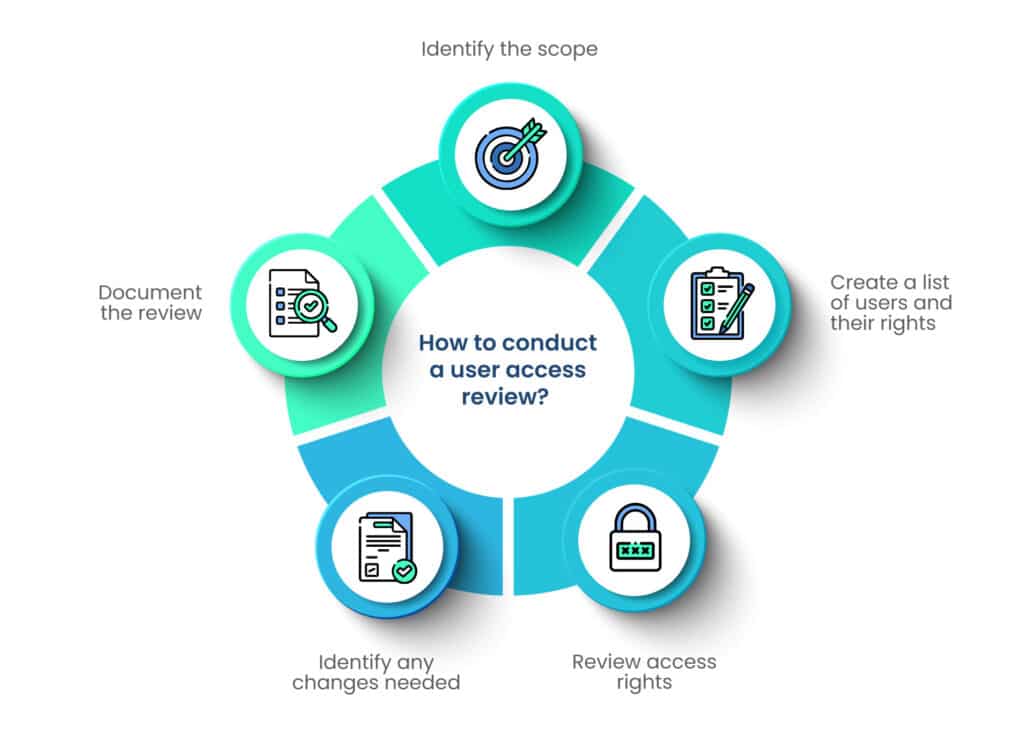
How to conduct a user access review?
An organization must conduct a user access review periodically. This means, depending on the requirement of the organization, the access review should be conducted quarterly, half-yearly, or yearly on a regular basis. If there are security incidents, then the review must be conducted when the organization discovers the intrusion. Plus, a review is needed if the organization faces any major administrative or strategic change. An organization must follow the steps below to conduct these user access reviews.
Step 1: Identify the scope
The scope of user access review depends on many factors, including the size of the organization, its industry, the sensitivity of its data, and the laws and regulations it falls under. These factors differ for each organization; therefore, the scope of user access review will also differ.
The scope should include the active as well as the inactive accounts in the system. It must include an unbiased review of all data access given to the employees, contractors, and third parties.
Step 2: Create a list of users and their rights
In this step, the organization must create a list of all of its users, including the employees who are not working for the company anymore but have access to the organization’s database. This employee list should be bifurcated into sections according to the roles and responsibilities of each employee and the data access they would need to carry out that role. Always remember to remove the rights of the employees once they leave the organization; otherwise, they can use them for malicious purposes.
Data should also be segregated on the principles of relevance and sensitivity. If the data is more sensitive, it should be shared with fewer employees and vice versa. Then the employees should be given access to the data as per the requirement.
Step 3: Review access rights
In this stage, the organization reviews the access rights on paper to know whether the rights given to the employees are excessive. If the management finds that the employees are given more rights than they need, the rights can be rescinded.
The authorized employees can access the data by using the credentials provided by the organization. If they don’t have the right credentials, they can’t access the data—it’s that simple. The employees must protect these credentials and not share them with anybody else.
Step 4: Identify any changes needed
After deciding which employee will get how much access, the organization should give access rights. It is crucial to observe the employees’ work after giving them access to know whether they are able to perform their duties or not.
If an employee is not able to perform their duties due to the lack of access, the management can consider giving them more access. A test run can be conducted to know if all the employees have adequate access. If the management finds any loopholes during the test run, they can be solved before implementing the system.
Step 5: Document the review
The last step is to document the whole access review process for future use. If there is any type of confusion in the future regarding access rights, the documents can give clarification. In addition to this, in case there is a data breach, the management can pinpoint the areas from where the data has been stolen. It can also seal off the data flow to minimize the effects of the data breach. A clearly documented access review can help the management take quick steps.
How can user access review help in infosec compliance?
User access reviews are crucial for the organization to maintain information security. They also help in following compliance standards and frameworks. Some examples of infosec compliance that require regular user access reviews are given below.
HIPAA
Health Insurance Portability and Accountability Act (HIPAA) is a US federal law that sets the standards for protecting sensitive patient information. This information is called protected health information or PHI. People who are expressly authorized are given access to the PHI of the patients.
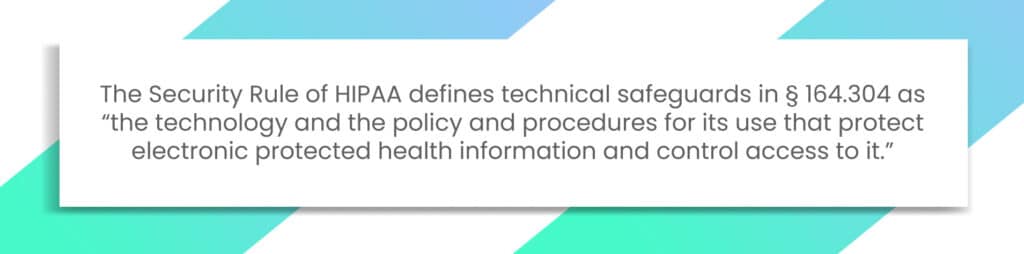
The security rule of HIPAA requires the covered entities to maintain appropriate safeguards to protect PHI while maintaining confidentiality, integrity, and availability (CIA) of information. Moreover, the administrative safeguards recommended by HIPAA are designed to limit the access of PHI to those who need it to perform their duties. It requires the covered entities to have “security management processes” to implement measures to “reduce risk and vulnerabilities” to the data. Therefore, the organizations covered under HIPAA must conduct regular user access reviews.
PCI-DSS
Payment Card Industry Data Security Standard (PCI-DSS) is a global standard for organizations that hold credit cards and cardholders’ data. It was designed by major credit card companies to protect the data of credit cardholders and is widely accepted worldwide. The following are some of the requirements by PCI-DSS regarding user access reviews:
PCI-DSS requirement 7: Data should be accessible to authorized users only. The principles of “least privilege” and “need-to-know” basis must be followed throughout the organization. No data that is not required for the performance of duties should be shared with the employee.
The organization must define access requirements for each role and provide access to data based on these requirements. If any exceptions are there to these requirements, they must be documented with the reasons for such exceptions. Except for the users who are expressly authorized to access the data, the setting must be tuned to “deny all.” All the affected parties should know and follow these rules.
PCI-DSS requirement 12: This requirement mandates the organization to review the access policy at least once a year or when there are environmental changes. This requirement also specifies rules to use alternate technologies and devices in the organization to ensure that the user access review is not just for the data.
SOX
Sarbanes-Oxley Act (SOX) is a federal law of the United States of America that sets rules and requirements for corporate governance and financial reporting. User access review is one of the most important requirements of SOX to ensure the accuracy and reliability of an organization’s financial information. Financial information should be released only to a handful of people who need the data to perform their responsibilities.
Section 404 of SOX requires public companies to establish and maintain an adequate internal control structure and procedures for financial reporting. It requires the management to verify the effectiveness of the company’s internal controls over financial reporting (ICFR). Although SOX Section 404 doesn’t specifically mention user access review, it is deemed to be included in the internal controls. While conducting 404 audits, the companies must assess their access reviews to ensure that the financial information passed on to the stakeholders is true and fair.
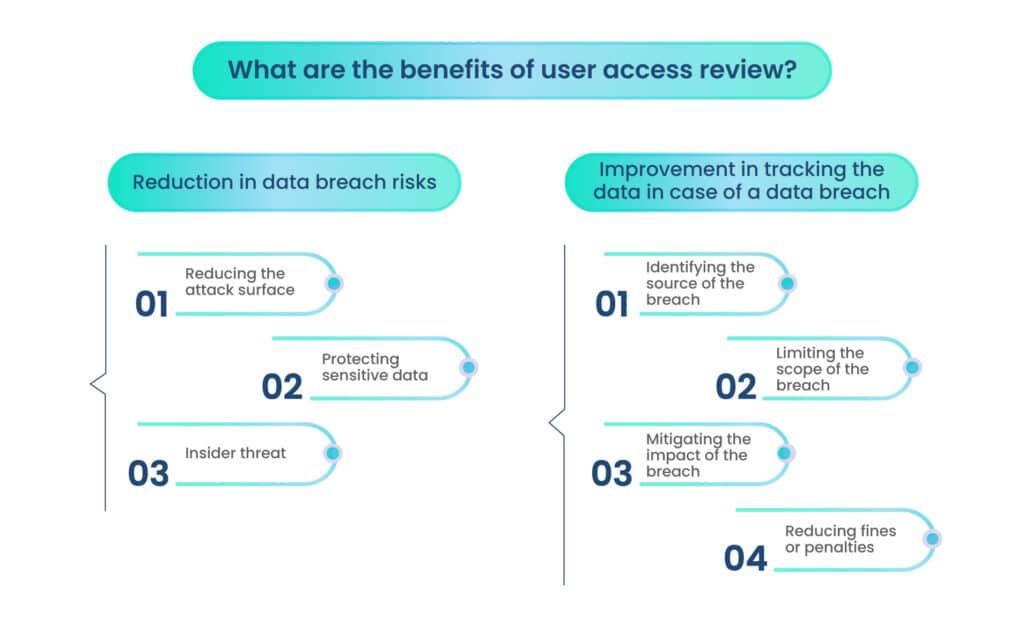
What are the benefits of user access reviews?
Reduction in data breach risks
In The Cost of Data Breach Report – 2022, IBM reported that 21% of the breaches were due to human error, including those caused unintentionally through the negligence of employees or contractors. The report also confirms that with adequate identity and access management, the organization can save an average of $224,396 from the total cost of a data breach.
The statistics elevate the need to assess human behavior to protect the organization’s systems. The data breach risks can be mitigated by:
A. Reducing the attack surface
User access reviews limit information access to authorized people only, thereby reducing the attack surface and the data breach risks. An attack surface is a sum of all the network parts that an attacker can use to gain entry into the organization’s systems.
B. Protecting sensitive data
If the organization loses sensitive information about the customers or other stakeholders, it can also become a victim of secondary attacks. Therefore, it is necessary to prevent attackers from getting their hands on sensitive data. User access reviews ensure that the sensitive data is accessible to the bare minimum of people. Hence, it can be protected better.
C. Insider threat
IBM also reported that about 12% of the breaches were caused due to insider threats. Insider threats include employees or contractors who are given access to the organization’s network to get the job done; however, they leak the information to the attacker due to malicious intentions or negligence.
User access reviews help the organization assess privileges given to the employees periodically. Thus, the management can ensure the visibility of the data flow. The employees are also aware that only some of them have access to sensitive information, and if leaked, their activities will be observed under a microscope. Therefore, they will think twice before leaking the information.
Improvement in tracking the data in case of a data breach
We saw how the user access review could improve the cybersecurity posture of an organization. But what happens when the organization becomes a victim of a data breach? User access reviews can assist the organization in this case too.
As the management periodically carries out user access reviews, it has a clear-cut understanding of which data is stored where and who is able to access this data. In case of a breach, the management needs to take the following actions related to the user access review.
A. Identifying the source of the breach
The management can easily verify which users had access to the compromised data and where the attack began. Whether there is a malicious insider or negligence on an employee’s part can be known faster.
B. Limiting the scope of the breach
The management has clear visibility of the data flow in the organization. When a breach is discovered, the management can stop the flow of information from that point onward to prevent additional data from being stolen.
C. Mitigating the impact of the breach
The management can reduce the impact of the breach by revoking access to compromised accounts, notifying affected users, and implementing effective measures for a more secure future.
D. Reducing fines or penalties
When there is a breach, the organization must report it to the regulatory authorities. When they investigate the breach, the regulators often look into how compliant the organization has been. Penalties and fines are levied if they find that the organization has not complied with the regulations. User access review is one of the core requirements of all the regulations, and by not carrying it out, the organization increases its chances of fines and penalties.
Conclusion
In a nutshell, the user access review is a process of providing data access on a least privilege basis. If an employee doesn’t need the information to perform their duties, they are not given access to the data.
Organizations must make detailed documentation of user access reviews to form a policy to protect their data. The user access review is part of compliance standards and frameworks, including HIPAA, PCI-DSS, and SOX.
Moreover, user access reviews also help the organization prevent data breaches by reducing the attack surface and increasing the visibility of the data flow. Additionally, user access reviews can be helpful in the event of a data breach, as the management can follow through with the breach effectively. It helps in reducing the fines and penalties, as the management can prove that it has taken adequate measures to prevent a data breach.
Take the first steps towards user access review, or get your process verified by experts at Scrut. Schedule a demo to learn how Scrut can help you manage compliance requirements.
FAQs
1. What is a user access review?
A user access review is the process of ensuring that only authorized users have access to data and systems. It is useful in ensuring data privacy and security.
2. What are the main benefits of user access reviews?
The main benefits of user access reviews are a reduction in data breaches and an improvement in responding to data breaches.
3. How often should you conduct a user access review?
Typically, user access reviews are conducted annually. However, in case there is a breach or a change in organizational structure, they are conducted soon after the event.
19 Sep 2022
7minutes
Authored by
Aayush Ghosh Choudhary
Co-founder & CEO at Scrut
ISO 27001 certification: Everything you need to know
With security breaches breathing fire under many companies’ noses, information security (infosec) has become a bigger issue than ever. If your business handles sensitive data of any kind, you should start taking steps to build trust with your established customer base.
You can use the ISO 27001 certification to show your customers that you take security seriously and have effective measures to handle the clients’ data. Therefore, in short, to show that you have their best interests at heart. To understand how it works, let’s go through this article that covers everything!
The standard demands that companies should identify information security risks present in their systems and list out the corresponding controls that address them. ISO 27001 consists of 114 controls that are divided into 14 categories. There is no mandatory requirement to implement the full list of ISO 27001’s controls since they are simply a representation of possibilities that an organization may consider.
ISMS has to be examined by a professional auditor who ISO has accredited. They overlook the documentation to see if the company’s security measures live up to the set ISO 27001 standards.
However, the entire process of certification is governed by ISO 27001. Your company will get an ISO 27001 certificate if you pass the audit. One might wonder, if the certification is optional, who should you put your business through this assessment? Let’s see why!
How does an ISO 27001 audit serve your business?
If you’re wondering who would go through the pains of getting ISO 27001 certified, then the statistics may shock you because more than 33,000 organizations are currently ISO 27001 certified. Which makes us question, how does an ISO 27001 Audit serve your business?
The answer is simple: The benefits outnumber the troubles. Here is a list of the rewards you can receive after pursuing ISO 27000 compliance:
1. Law Compliance
Certain restrictions are imposed by the GDPR (European Union’s General Data Privacy Regulation) and HIPAA (the United States’ Health Insurance Portability and Accountability Act). Failure to meet these restrictions can mean fines; hence, an ISO 27001 certificate ensures that your organization complies with all data privacy laws.
2. More trust means more customers
The ISO 27001 certification and compliance make a big difference forpotential clients and customers. How? Because they are well aware of the increasing risks posed by data breaches, they take information security into serious consideration when deciding what companies to work with.
To conclude this part, we can only say that every organization seeking ISO 27001 compliance has its own reasons. The choice to pursue or not is entirely your decision!
Difference between ISO 27001 and SOC compliance
ISO 27001
SOC
Type of Security
The aim of ISO 27001 is the same as SOC but it works in a more restricted way. It demands that organisations must build and document their information security management system for effective compliance.
SOC refers to a set of guidelines that are more free and flexible in their approach to measure what your company is doing to protect the customers’ data.
Area (geographically)
ISO 27001 is better known outside North America and hence, is used widely outside of that region.
They are more widely known in North America and carry more prestige there.
SOC certification can be defined as a set of criteria based on the guidelines introduced by the American Institute of Certified Public Accountants (AICPA). Rather than assessing companies based on a pre-written control checklist as done in ISO 27000, the SOC compliance has fairly flexible standards for every organization under audit.
In the end, however, both of them are fairly the same, with about 95% of controls copied in ISO 27000 and SOC criteria. The most suitable choice for your company depends primarily on the geographical location. A SOC report holds more prestige in the United States, while the ISO 27001 certification is more prestigious in the rest of the world.
The ISO 27000 family consists of 12 separate standards. However, in case you’re looking to get an ISO compliance certificate, then ISO 27001 is the only mandatory set. That said, you must have a working knowledge of the other sets to determine which ones are applicable to your business.
ISO 27001
ISO 27001 points out the requirements for establishing a compliant ISMS. It is mandatory to meet these requirements If you want to get a certificate. What are these requirements? So, ISO 27001 has listed its requirements in detail in seven clauses. It demands that an Information Security Management System should be
Clearly documented
Supported by senior leadership
Capable of anticipating and mitigating risks
Supplied with all the resources, it needs to function
Be regularly reviewed and updated.
Annex A under ISO 27001 has a list of specific controls that your organization can use in order to meet these requirements. It includes 114 ideas that you may find relevant.
ISO 27002
The next set is ISO 27002, which has been built based on the controls discussed in Annex A of ISO 27001. While Annex A provides a quick description of every control, ISO 27002 lists them out in detail.
It is useful because every company under ISO 27001 audit needs to address the relevant controls for them. For instance, you may not have any remote employees, so you don’t need to implement controls that supply information on leaving company computers in public spaces.
ISO 27003
The ISO 27003 is responsible for providing general guidance for building an ISMS. It is a great resource that is useful during the pre-audit phase, especially during gap analysis.
ISO 27004
The next set standard, ISO 27004, is built as an extension of ISO 27003 since it is useful in suggesting ways to evaluate and study the security of your information security management system. It also comes in handy when organizations measuring has to determine which of the listed controls in ISO 27002 can be used for audit preparation.
ISO 27005
ISO 27005 is solely dedicated to risk management. Forecasting, analyzing, and mitigating risk is crucial parts of ISO 27001 certification, and since this standard deals in these areas, it is beneficial to study it in as much detail as possible.
ISO 27006
The next set of standards,ISO 27006, determines whether or not a firm is qualified to conduct ISO 27001 audits. This standard is not applicable or in your interest, if
you do not deal with the same field.
ISO 27007 and ISO 27008
The ISO introduced this pair of standards in 2019. They are influenced by ISO 27006 and provide guidelines for accredited organizations on how to conduct ISMS audits.
It is beneficial if you read this standard before you seek an ISO 27001 certificate for your company since it will give you an idea of what your auditor will ask while they evaluate your information security management system.
ISO 27017 and ISO 27018
ISO 27017 and 27018 were first introduced in 2015 when cloud services were beginning to boom. They are responsible for providing controls to secure any and every data your company stores in the cloud.
ISO 27033
ISO 27033 is responsible for governing network security. While ISO 27002 consists of several controls for securing a company’s internal network, ISO 27033 is built on these controls and offers suggestions for effectively implementing them.
ISO 27701
ISO 27701 is one of the newest ISO standards and is centered on privacy. It was introduced in response to the strengthening of GDPR by the EU and, in turn, demanded organizations to take “appropriate measures” to secure the private information of users. It is mostly focused on suggesting guidelines to build a privacy information management system (PIMS) in line with your ISMS.
What is the cost of getting an ISO 27001 certification?
The cost of an ISO 27001 audit can vary depending on the size of the organization. It is usually noticed that larger companies usually build their ISMS or information security management system with a greater scope, which directly translates to a longer duration for audit. And we all know the longer the auditor spends at your offices, the more they will cost you.
For instance, a company with 50 or fewer employees can be estimated to spend between $5,000 and $10,000 on the ISO 27001 certification audit for three to six days. After which, you can add approximately $1,800 for every extra day of the audit. On the other hand, a large company with 500 or more employees can be estimated to spend about $19,000 for 11 days of auditing.
Despite estimation, the absolute price of the audit cannot be fixed because there is more to the story. The actual audit may only take weeks, but preparation (which also adds costs) might take up to six months at a mid-sized company. You need to take into consideration the expenses for those six months, where you would either be required to hire new contract employees or shift current employees from their regular duties.
Requirements for passing ISO 27001 audit process
Only getting adequate knowledge about the ISO 27000 standards will not help you get certified. In order to get an audit using the ISO 27000 series, you will have to follow a few guidelines. These are as follows.
Selecting the right auditor
Choosing an auditor is an essential and often overlooked part of the compliance process. You must take on this search with the mindset of hiring a new employee and performing proper protocols.
Perform an internal audit first
Performing an internal audit won’t just help you get ready for Stage 1 and certification audits but also get you prepped to maintain the ISO 27001 certification after you receive it. It is a fruitful practice since ISO 27000 demands organizations to perform internal audits regularly.
Establish the right controls
It is imperative you go through all the standards in the ISO 27000 series because they are all there for a specific reason. That reason could be either to offer you advice, help you sneak a peek into your auditor’s mind, or advise on what controls will be perfect for your company.
Check for automation tools
Using compliance automation can make preparing for an ISO 27001 audit much easier. With Scrut, you can integrate all the technology present in your information security management system, automatically scan for potential risks and violations, and improve your security.
Conclusion
Not every established Information security Management System can meet the standards laid out in the ISO 27000 series, which is also the reason why the time taken to complete ISO 27001 compliance can vary from a few weeks to a few months, depending on the baseline.
Scrut Automation is a one-stop shop for compliance. Our software provides the fastest solution for achieving ISO 27001 standards, making it an ideal choice for busy startups. Schedule your demo today to see how it works.
19 Sep 2022
8minutes
Authored by
Aayush Ghosh Choudhary
Co-founder & CEO at Scrut
The essential GDPR compliance guide: What businesses need to know
The General Data Protection Regulation (GDPR) is a data protection and privacy regulation that applies to the European Union (EU) and European Economic Area (EEA). Often regarded as one of the most stringent data security and privacy laws globally, GDPR sets a high standard for compliance.
While GDPR was crafted and enacted by the EU, it extends its reach to encompass any entity worldwide that handles the data of EU residents, regardless of their geographical location. This regulation is known for imposing severe fines and penalties on those found in breach of its provisions. Consequently, it’s imperative for organizations, irrespective of their global presence, to familiarize themselves with the fundamental guidelines outlined in GDPR. This blog covers everything you need to know about the regulation.
Key definitions of GDPR
Some of the terms used in the GDPR as well as in this article, are defined below.
Personal Data: Personal data is the information that pertains to an individual who can be identified directly or indirectly using this data. Location, gender, biometric data, ethnicity, religious beliefs, etc., are examples of personal data.
Data subject: The individual whose data is being collected, processed, or transmitted is called the data subject.
Data controller: The person who decides how and when data will be processed. An owner or an employee of the organization collecting the data is the data controller.
Data processing: Any automated or manual process that is carried out on the data is called data processing.
Data processor: Data processor is a third-party person or organization that processes data on behalf of the data controller.
The scope of GDPR
An organization that processes the data of EU citizens or residents or sells goods or services to such people is covered under the GDPR even if it is not located in the EU. It also applies to organizations located in the EU, even if the data is stored or processed outside the EU. If the organization monitors the online behavior of EU residents and citizens, then it is covered by the GDPR regulation.
However, the following are not covered under GDPR:
Data collected for “purely personal or household activities.” For example, collecting personal information like email addresses or phone numbers of friends and family.
Data collected for anything other than “professional or commercial activities.” For instance, collecting personal information about somebody for purposes not related to business.
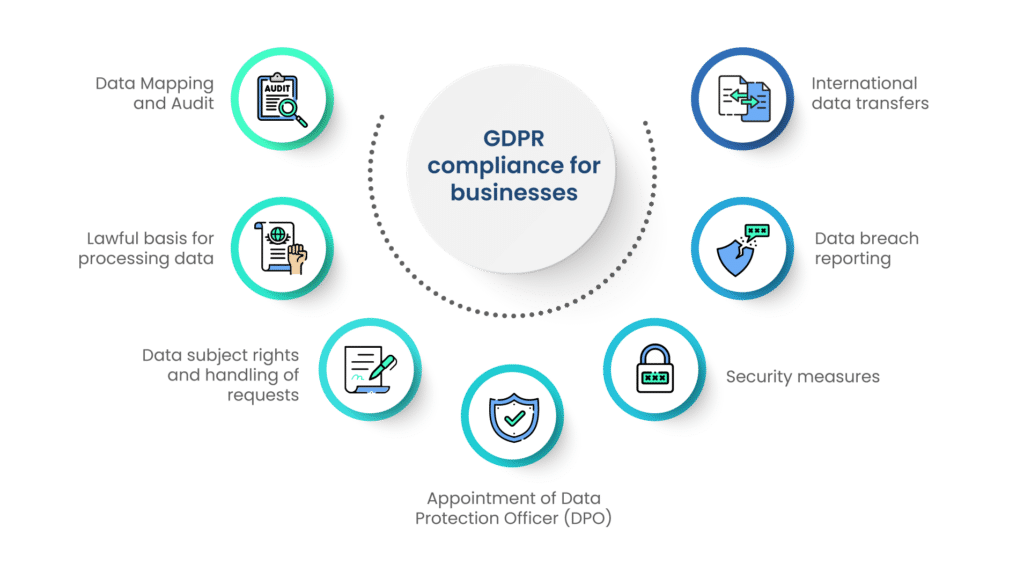
GDPR compliance for businesses
If you are covered by GDPR regulations, here is a checklist for you to follow:
1. Data Mapping and Audit
Data mapping is the process of identifying and documenting all the data an organization handles, its storage location, who has access to it, and how it is used. This step helps the organization have clear visibility of the data they are controlling and the risks associated with it. Once the organization is aware of the risks, it can develop policies and procedures to protect the data.
During the GDPR audit, the auditor assesses the mapping documentation, policies and procedures implemented to maintain data privacy, and measures to protect that data from verifying whether they are in compliance with the GDPR. The auditor also verifies whether there is any non-compliance and suggests corrective actions.
2. Lawful basis for processing data
Under the GDPR, there are six bases where the organization processes customer data. It is crucial for GDPR compliance that the organization recognizes and documents the lawful basis. They are as follows.
Consent: The data subject has given express consent to use their data for a specific purpose.
Contract: There must be a contract to process customer data.
Legal obligation: The data controller must follow the legal requirements to process the data.
Vital interest: Data processing is necessary to protect the interest of the data subject or another natural person.
Public task: The controller either processes data in the public interest or in exercising the official authority vested in them.
Legitimate interest: The processing is necessary for the legitimate interest of the controller or third parties.
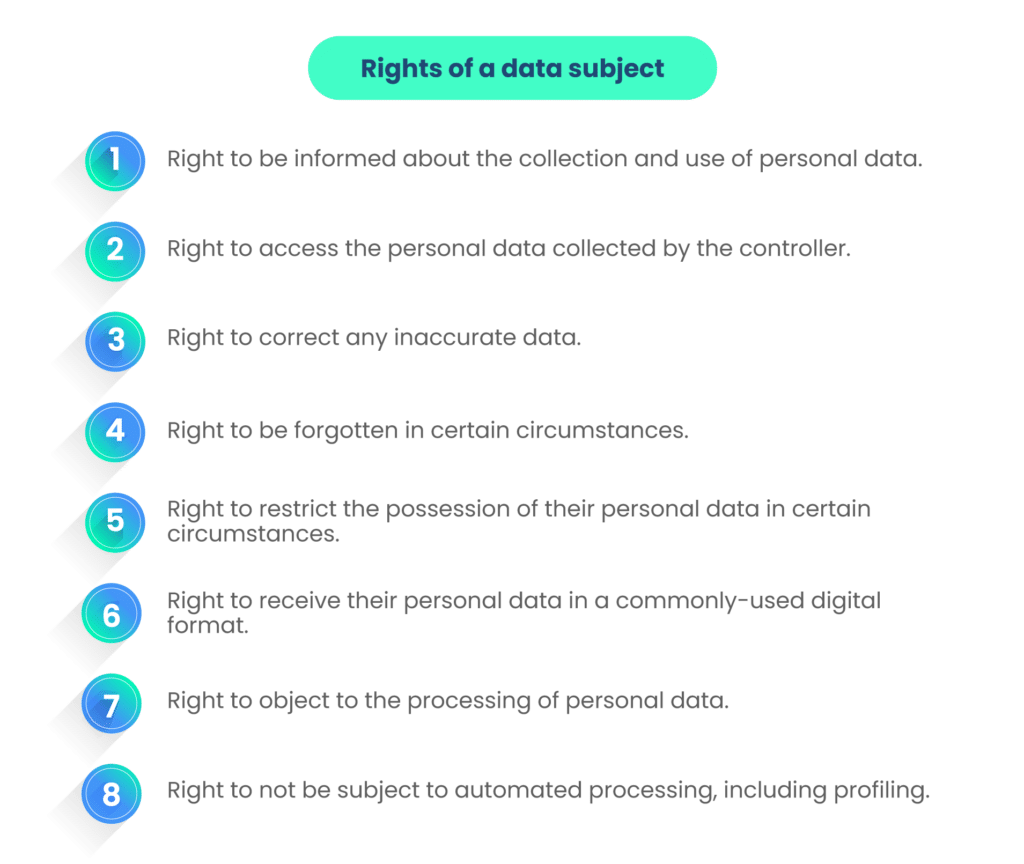
3. Data subject rights and handling of requests
A data subject has several rights under GDPR. These rights include:
When the data subject requests to exercise any rights, the controller must adhere to them immediately and no later than a month after receiving such request. If the request is complex and requires more time, the controller can extend it up to two more months.
The request can be met after authentication of the data subject’s identity. To verify it, the controller may ask for further information. The response must be concise, clear, and in an easily readable format using plain language.
If the controller refuses to meet the data subject’s request, they must inform the data subject of their reasons for doing so. The data subject can lodge a complaint with the supervisory authority and seek a judicial remedy.
4. Appointment of Data Protection Officer (DPO)
If you are a large-scale organization, regardless of whether you are a controller or a processor, you will be required to appoint a data protection officer (DPO). You may appoint a DPO voluntarily, with the same rules applying to you too.
A DPO is responsible for monitoring the organization’s compliance with GDPR. They provide advice on data protection and data breach notification while acting as a contact point between the organization and the regulatory authorities.
The DPO must be highly knowledgeable and possess expertise on the regulations. They report directly to the highest authority in the organization.
5. Security measures
GDPR takes data security very seriously and requires the organization to follow the basic principles of security, namely confidentiality, integrity, and availability. The controller and processor must maintain appropriate security measures, including:
Considering the use of pseudonymization and encryption to protect personal data.
Implementing appropriate measures to ensure that only authorized employees get access to protect user data.
Controllers must test the effectiveness of security measures regularly.
Controllers must have plans for efficient incident management, including detecting, reporting, and investigating the data breach.
Controllers must carry out data protection impact assessments (DPIA) for high-risk processing activities.
Controllers must ensure third-party risk management if somebody else is processing the data.
Failure to implement adequate controls to protect data can bring fines and penalties, reaching millions of pounds.
6. Data breach reporting
One of the other steps for being GDPR compliant is having a solid data breach reporting plan. If your organization is breached, you are required to notify the authorities within 72 hours of the detection. For a large organization, the DPO can help you send out the breach notification. If the notification is not sent out within the stipulated time, the controller must give the reasons for the delay to the relevant authorities.
The data breach notification should also be given to the data subjects if their personal data is breached. The notification must include the extent and consequences of the data breach along with the measures taken by the organization so far. It should also give the contact details of a designated person to gain more information about the breach. Failing to follow the notification requirements could lead to significant fines and penalties.
7. International data transfers
The controller must meet certain conditions if the data is transferred to a location outside the EEA. The laws of the country in which the data is transferred are adequate for the security of the data. If the laws are not adequate the organization can use standard contractual clauses (SCC) approved by the European Commission to ensure data protection. SCC is nothing but a standard contract between the controller and the data subject for data protection.
There are times when the company transfers data outside EEA to within its own group of companies. The binding corporate rules (BCR) are the internal rules to protect personal data. Apart from these, if the organization obtains explicit consent from the data subject, it can move the data outside EEA.
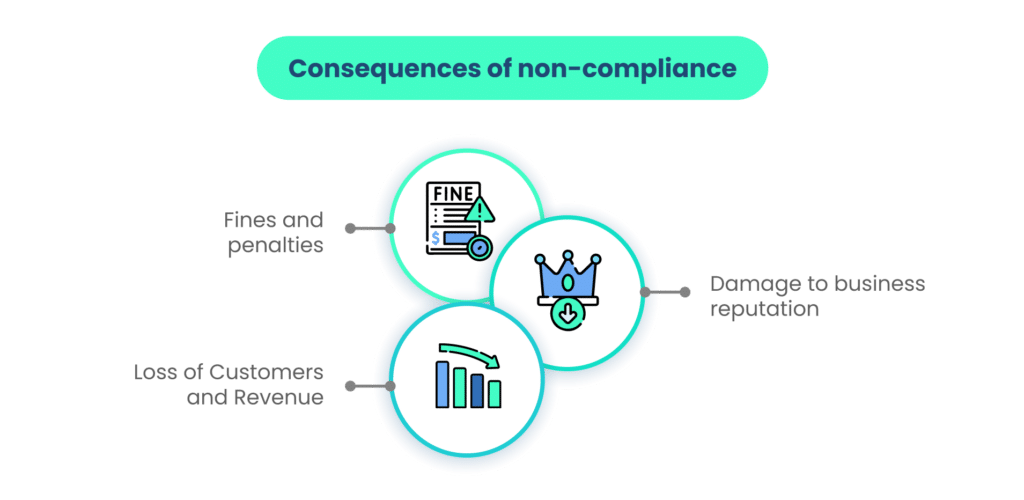
Consequences of non-compliance
If you are covered under GDPR, and you fail to comply with the regulations, then you will face the following consequences:
1. Fines and penalties
If there is an infringement of regulations, the data protection agencies will impose a temporary or definitive ban on data processing coupled with a fine of up to €10 million or 2% of the business’s total annual worldwide turnover for Tier I and €20 million or 4% of the business’s total annual worldwide turnover for Tier II.
2. Damage to business reputation
As a result of non-compliance, the business’s reputation will be damaged. It may face legal charges from the data subjects and other stakeholders. The authorities might investigate the data breach leading to a loss of reputation.
3. Loss of Customers and Revenue
Customers lose trust when the organization fails to protect their data. It has been observed that customers don’t buy from an organization whose data has been breached, causing revenue loss for the organization.
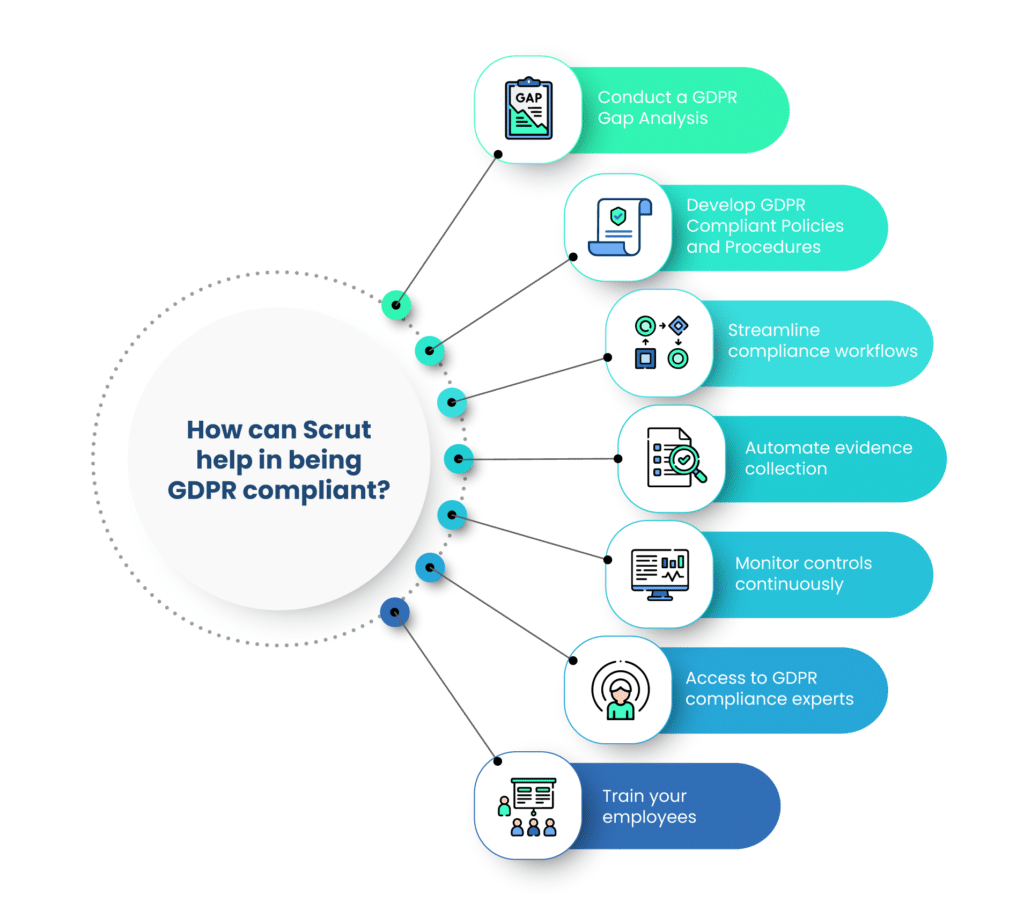
How can Scrut help in being GDPR compliant?
Scrut can help you simplify your GDPR compliance and audit processes. Let’s take a look at how it does this.
1. Conduct a GDPR Gap Analysis
The Scrut platform allows you to carry out everything you need for GDPR gap analysis, including cloud risk assessment, control reviews, employee policy attestations, and vendor risk assessment. It helps you identify the gaps in compliance swiftly and also helps you to fix them.
2. Develop GDPR-Compliant Policies and Procedures
The Scrut library boasts an extensive collection of more than 50 pre-constructed policies, offering you both guidance and the option to implement them directly. Additionally, our platform allows you to upload your customized policies to establish your information security program. If you wish to make modifications to the pre-existing policies, our platform provides an easy and straightforward process, including the option to have them reviewed for accuracy by our team of experts.
3. Streamline compliance workflows
To streamline your compliance workflow, Scrut lets you create, assign and monitor tasks within your team and share artifacts. You can also collaborate with the auditor on the platform for faster audits.
4. Automate evidence collection
Scrut lets you integrate 70+ commonly used applications for evidence collection. More than 65% of the evidence collection is automatic on the platform.
5. Monitor controls continuously
You can identify gaps and critical issues in real time with continuous automated control monitoring. You can receive alerts and notifications to maintain daily compliance.
6. Access to GDPR compliance experts
Scrut lets you consult with GDPR auditors, consultants, and in-house GDPR experts.
7. Train your employees
You can select a training program for your employees and keep an eye on their progress on the platform dashboard. You can also assess your employees to know how much they have retained and retrain them if needed.
Bottomline
GDPR, a European Union (EU) regulation designed to safeguard the data of EU citizens and residents, applies globally to any organization handling this data, irrespective of its geographical location.
We’ve explored the essential checklist that businesses must adhere to when operating under GDPR, recognized as one of the world’s most rigorous data protection laws. Non-compliance can result in hefty fines and penalties, often in the millions of euros.
Achieving compliance with GDPR demands a substantial investment of time and effort. Here, Scrut steps in to simplify the process, making it easier and more streamlined to pass the GDPR compliance audit successfully.
If you have any questions regarding how Scrut makes your GDPR compliance a walk in the park, you can schedule a demo of our products.
FAQs
1. What is GDPR, and who does it apply to?
GDPR stands for General Data Protection Regulation, a data protection and privacy regulation that applies to the European Union (EU) and European Economic Area (EEA). It applies to any entity worldwide that handles the data of EU residents, regardless of their geographical location.
2. What is the scope of GDPR, and what types of data are not covered?
The blog explains the organizations and activities covered by GDPR and clarifies what types of data are not included, such as data collected for purely personal or household activities.
3. What are the essential steps for GDPR compliance for businesses?
The blog outlines a checklist for GDPR compliance, including data mapping and audit, lawful basis for processing data, data subject rights, appointment of a Data Protection Officer (DPO), security measures, data breach reporting, and international data transfers.
19 Sep 2022
13minutes
Authored by
Aayush Ghosh Choudhary
Co-founder & CEO at Scrut
How GDPR affects Marketing:
Hey there, savvy marketers! We are here to guide you through the impact of GDPR, the General Data Protection Regulation, on your marketing efforts.
Whether you’re a small business owner or part of a multinational corporation, understanding and embracing GDPR is vital for maintaining customer trust and avoiding hefty penalties.
However, meeting its requirements is not always easy. It can be difficult to handle given the evolving nature of data protection regulations, including figuring out how to get permission to use data and handle it.
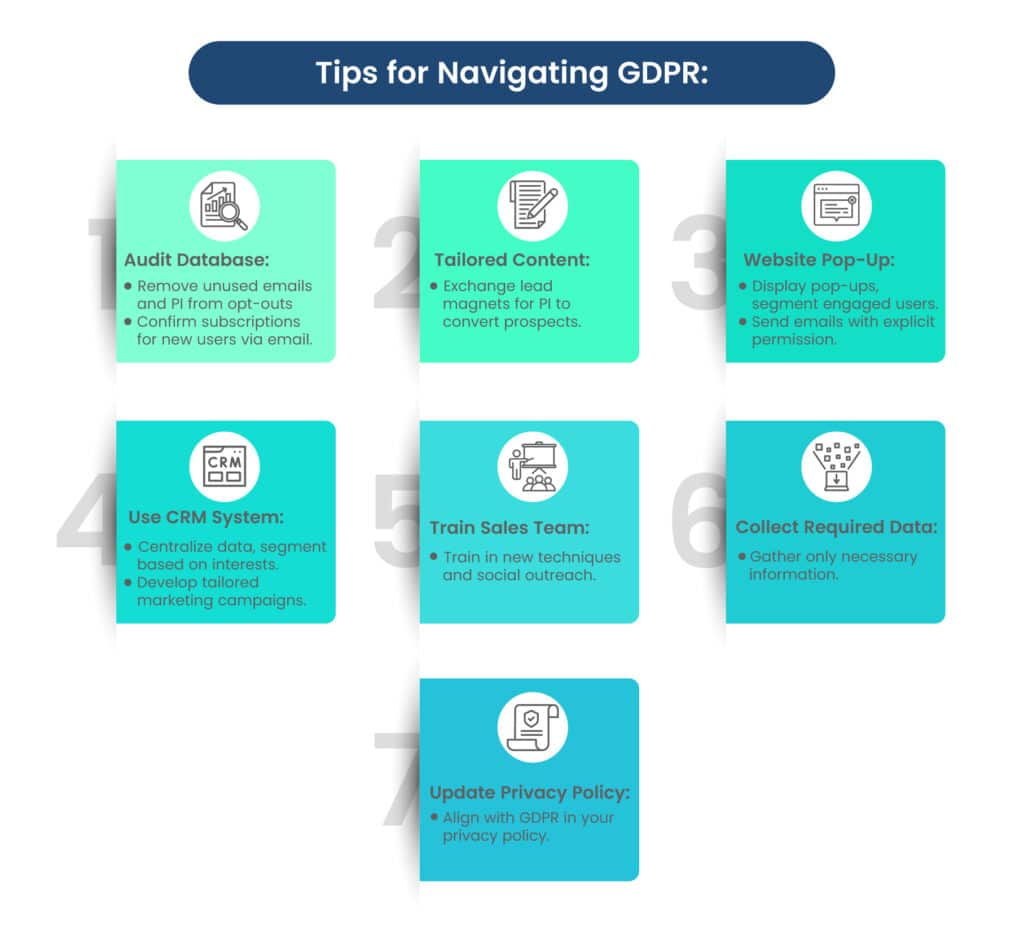
So, let’s dive right in and explore how GDPR can shape your marketing strategies and tips and tricks to navigate GDPR.
Why does GDPR matter?
Personal data is so valuable that it’s being collected at an incredible rate, and it’s vulnerable to theft and misuse. The people who use customer data the most don’t fully understand how they should use it.
Besides, customers do not even know why they receive emails and messages from brands they didn’t sign up for, and they divulge information without knowing why.
To tackle this, the European Union (EU) government developed a privacy regulation called the General Data Protection Regulation (GDPR).
GDPR is a comprehensive data protection law that came into effect in 2018. This set of regulations was designed to give EU, EEA, or UK residents more control over their confidential data.
Its primary goal is to protect the personal data of individuals within the European Union (EU) and ensure that businesses handle this data responsibly. In short, GDPR is the core of Europe’s digital privacy legislation and outlines how the EU wants their personal data to be managed.
But here’s the crucial part: GDPR doesn’t just apply to EU companies; it has an extraterritorial reach, affecting any business that processes EU, UK, or EEA residents’ data, regardless of its location.
Why was GDPR introduced?
GDPR, by a long measure, is the most impactful regulation in place for data protection in a tech-driven generation.
The EU has long valued its citizens’ online privacy and believes that they should be protected and empowered rather than exploited or ignored.
The EU regulators felt that the companies were misusing their citizens’ data for their own gain and that they should be transparent about how they were using the data. GDPR was introduced to end this and give back power to customers.
History of GDPR
GDPR is adapted from a document that was first adopted in 1980 and later modified in 1995.
The outdated version could not cover the necessary data privacy principles for social media, smartphones, or any advanced web technology like artificial intelligence (AI) or virtual reality. The obsolete version was never a compulsion, so companies had a chance to opt out of it.
Since May 25, 2018, this is no longer the same. With GDPR, every company across Europe or companies that handle EU data must follow the data privacy principles.
What should organizations do to comply with GDPR?
Organizations that store customers’ personal data should be meticulous about what kind of personal information they want to collect and why.
Organizations also need to regularly conduct privacy impact assessments, strengthen the way they seek permission to use the data, document how they use personal data, and improve how they communicate data breaches. Data mapping helps simplify GDPR compliance for organizations.
And since it’s a regulation, it cannot be opted out of or ignored. Companies failing to comply with GDPR are fined up to 20,000,000 EUR, or 4% of their annual turnover for the preceding financial year.
The world’s largest e-commerce company, Amazon Europe, was fined €746 million.
The world’s most popular messaging app, WhatsApp Ireland, was fined €225 million.
The world’s most used search engine, Google, was fined €90 million.
Not just big MNCs, but any company that violates personal data is heavily fined.
How does GDPR impact marketing?
In our digital age, personal data is the fuel that drives marketing campaigns. But with great data comes great responsibility.
So let’s take a look at how how gdpr affects marketing.
GDPR injects a strong dose of responsibility by enforcing stringent rules on how data is collected, processed, and utilized. For marketers, this means an enormous shift in how strategies are crafted, campaigns are executed, and customer relationships are nurtured.
Key principles of GDPR
To operate within the GDPR framework and ensure GDPR compliance, marketers must grasp its key principles.
Data minimization (collecting only what’s necessary)
Purpose limitation (using data only for its intended purpose)
Accountability (demonstrating compliance).
These principles guide your marketing strategies under GDPR’s watchful eye.
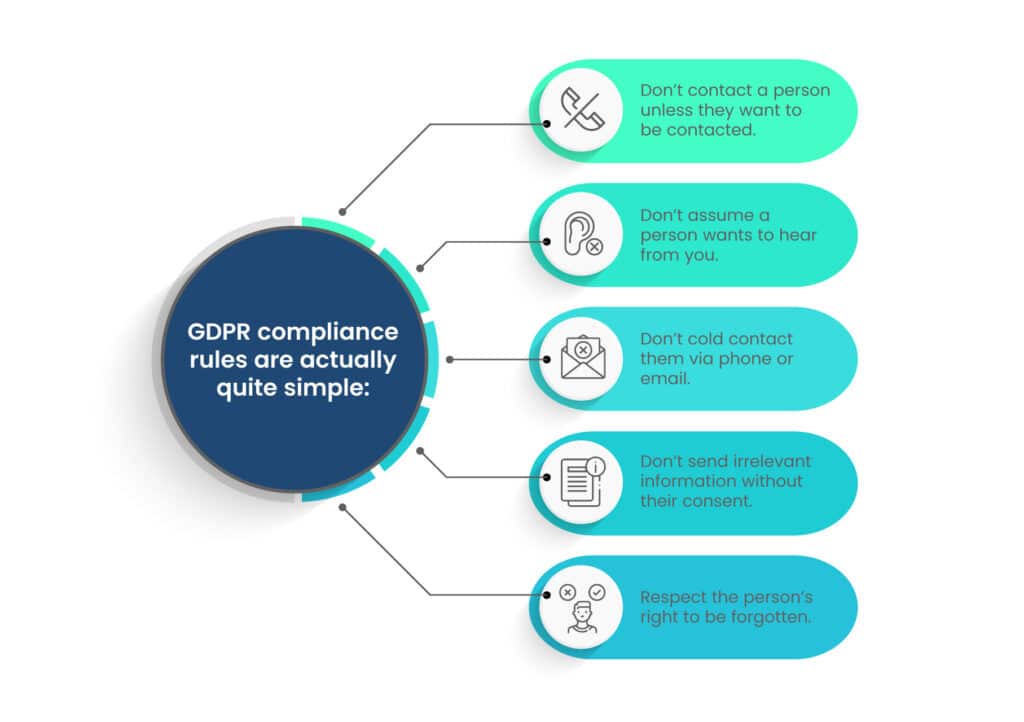
On the whole, GDPR is difficult to implement, especially for small businesses or sole proprietors. In reality, there are only 3 areas that marketers need to worry about to comply with GDPR:
Data permission
Data access
Data focus
Data permission
Data permission, in simple terms, means that the user has the choice to decide whether an organization can store or use his personal data.
From a marketing perspective, the direct impact of GDPR’s data permissions is on lead generation forms. In the pre-GDPR era, the customer had no option but to receive promotional content. But now, that’s changed.
Let’s look at two different examples of how this can manifest.
Instead of assuming that leads and customers opt for a pre-ticked box to receive marketing emails, organizations now need to ask them if they want to opt in to newsletters by selecting the signup box.
“Refer a friend to claim an offer” program helps companies get information about the friend, like their email address or phone number, without their consent. GDPR does not allow companies to store or process data to send marketing emails to these referrals without their permission. They can only notify them about being referred. On that note, no marketing emails or messages should be sent to referees.
Data access
Have you ever observed the “unsubscribe” or “manage preferences” link at the bottom of a promotional email?
“The right to be forgotten” is one of the cornerstones of the GDPR. It gives people the right to have outdated or inaccurate personal data removed from the companies’ databases.
The world’s most used search engine, Google, has been forced to remove pages/ cookies from its search engine results in order to comply with GDPR.
As a company marketer, it’s your foremost responsibility to ensure that your users can easily opt in or out of those marketing emails and messages.
It’s easy for you and the customer if you include the unsubscribe link in the marketing template so that users can manage their data preferences.
Data focus
Marketing is a data game. Marketers will always tend to collect more information than is needed. For example, does a marketer really need to know someone’s favorite color before subscribing to a newsletter?
With GDPR in place, marketers should be able to justify the collection and processing of specific personal data legally. This means that companies must stop asking for “nice to haves.”
For example, if you need to know the prospect’s favorite color, prove why you need it. Otherwise, try to avoid collecting any unnecessary data.
GDPR And marketing practices
1. GDPR’s impact on email marketing campaigns
Email marketing, a staple in any marketer’s toolkit, was not left untouched by GDPR. For B2B marketers, email addresses are the driving force behind lead generation.
The earlier pre-checked opt-in for signing up for your mailing list or downloading content is now optional.
With its focus on consent and individual rights, GDPR transformed how email campaigns are executed.
How will email marketing be affected by theEU GDPR?
Marketers can no longer rely on vague opt-ins or pre-ticked boxes to collect email addresses.
Consent must be explicit, informed, and freely given.
Emails must also clearly state the purpose of data processing and offer an easy way to opt out.
Buying an email list from third parties is strictly forbidden. That means email marketers can no longer automatically add these prospects or former customers to their mailing list.
GDPR gives email subscribers rights over their data. If a subscriber requests to be forgotten or to access their data, you need to be ready. Have processes in place to handle these requests within the stipulated time frame.
An “unsubscribe” link is no longer enough; subscribers must have easy access to managing their data and preferences. This approach not only keeps you compliant but also strengthens your relationship with subscribers.
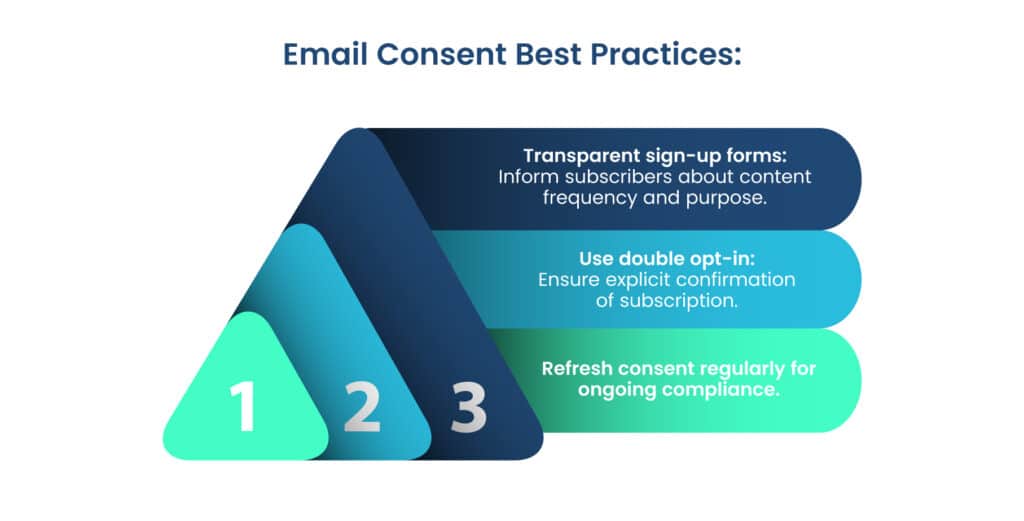
Best Practices for Obtaining and Managing Consent in Emails
Your signup forms should be transparent, informing subscribers about what they’re signing up for and how often they can expect to hear from you.
Implement a double opt-in process, where subscribers confirm their subscription to ensure explicit consent.
And remember, consent isn’t forever. Regularly review and refresh it to maintain compliance!
2. GDPR and marketing analytics
Marketing analytics provide valuable insights, but they can also involve processing personal data. With GDPR in control, marketing automation won’t be able to work as rigorously as before.
The Information Commissioner’s Office (ICO) comes into the picture and fine heavy penalties if your marketing automation system sends out emails on your CRM’s (Customer Relationship Management) behalf.
CRM is a technology and strategy that organizations use to manage interactions with current and potential customers. CRM systems help businesses streamline processes, improve customer satisfaction, and build stronger relationships by centralizing customer data, tracking interactions, and enabling personalized communication and marketing efforts.
So, ensure your CRM database has only emails of customers who have given explicit permission to receive marketing emails. If someone opts out of an automated email sequence, ensure no further emails are sent to them.
Also, with GDPR in place, having the next email already scheduled is not a valid excuse anymore.
Also, under GDPR, your analytics practices need to align with data protection principles. Ensure that the data you collect is necessary for your analysis and that you have a lawful basis for processing it. Regularly review the types of data you’re collecting to avoid overstepping boundaries.
Anonymization and pseudonymization are your allies in the world of analytics. Anonymization involves removing personally identifiable information, while pseudonymization replaces identifying data with artificial identifiers.
Both methods can reduce the risks associated with data processing while still providing valuable insights. Implementing these techniques can strike a balance between analytics and data protection.
Use of cookies
Cookies are small text files that are stored on a user’s device when they visit a website. They serve as data markers, tracking user interactions and preferences, allowing websites to remember users and personalize their experiences.
In marketing, cookies play a crucial role by enabling businesses to understand user behavior, tailor content, deliver targeted ads, and improve overall engagement through data-driven insights.
Cookies and tracking technologies are commonplace in digital marketing. However, their use must respect user privacy.
Obtain informed consent for non-essential cookies and trackers.
Implement a cookie consent banner that allows users to choose the types of cookies they want to accept.
Make sure your privacy policy provides comprehensive information about the cookies you use, their purpose, and how users can control them.
3. Public Relations (PR) and GDPR
Even with media databases such as PRweb and MyNewDesk in place, marketers still need to get the consent of the journalist before sending any marketing emails.
Journalists use platforms such as help a reporter out (HARO) and social media channels to give consent for marketers to contact them.
However, GDPR allows for communication the other way around. That is, if a journalist reaches out to you, you can pitch product releases and share company information with them.
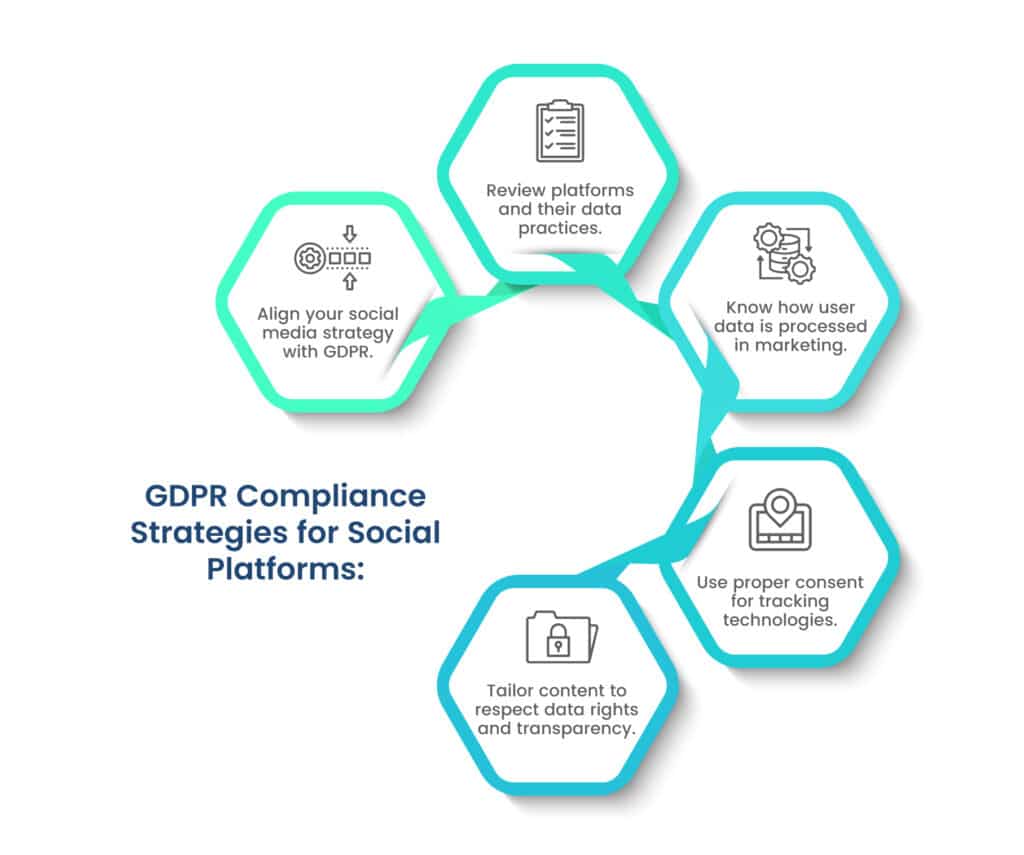
4. Social media marketing
Social media marketing provides unparalleled reach, but it also comes with a unique set of privacy considerations. Such platforms thrive on user-generated content, and behind every post, like, or share is personal data.
GDPR brings social media marketers face to face with the responsibility of respecting user rights while leveraging these platforms for engagement.
As individuals interact with your social media content, they’re exercising their data rights. Be prepared to respond to data subject requests promptly. Provide accessible ways for users to access their data or request its deletion.
Inform users about the data you collect through your social media efforts and how you intend to use it. Transparency and clear communication can foster trust and goodwill.
GDPR requirements: what marketers need to know
Although the GDPR law sounds intimidating and the fines issued by the ICO make you rethink your marketing strategy, it’s an excellent opportunity for marketers.
Now, marketers can develop targeted marketing campaigns that keep customers engaged with their brand.
Below are a few reasons why GDPR is a golden opportunity for marketers:
1. Consent Is Key
As discussed above, GDPR helps gain consent to use prospects’ or customers’ data.
Under GDPR, obtaining valid consent is a must before processing any personal data. So, no more pre-ticked boxes or vague opt-outs! Be transparent about your data collection practices, explain why you need the data, and ensure individuals freely give informed consent.
For instance, instead of bombarding the user’s screen with a ton of emails, provide them with a range of options so they can choose what kind of marketing information they are interested in.
GDPR also helps you segregate customers based on their interests and create email campaigns accordingly, rather than sending a “one size fits all” email.
2. Right to be forgotten
Individuals now have powerful data subject rights. They can request access to their data, rectify inaccuracies, and even demand erasure—the famous “right to be forgotten.”
As a marketer, you must be ready to address these requests within a specific timeframe. Under GDPR, you will be in trouble if a user opts out of emails and you still send them marketing emails.
Sometimes, we tend to store data in different places for different purposes. With GDPR in place, it’s almost mission-critical to store customer information in a single platform solution like CRM to track data permissions.
A CRM solution will create a single point of view on all customers and break down silos of customer information to be GDPR compliant.
3. Transparency
Being GDPR compliant requires you to be transparent about data access, data permission, and data focus. Being transparent in business will establish trust and improve customer engagement. Be honest with your customers about what you do.
You must demonstrate that an individual’s data is being treated with respect and held securely.
What tips and tricks can marketers use to navigate the GDPR?
GDPR is clearly influencing how businesses work. If your business is still not GDPR compliant, we have a checklist to help you meet those requirements.
1. Audit your database
Remove the users’ Personal information (PI) from your database if they opt-out from your mailing list. For new users, send an automated email to confirm their subscription.
2. Create tailored content
Create a tailored marketing strategy for prospects with lead magnets such as eBooks, PDFs, and white papers in exchange for collecting their PI. This way, you change your prospects into potential customers.
3. Flash a pop up on the website
Flash a pop-up when a person visits your website to read product launches, product news, blog posts, or company news, and record which customers engage with these pop-ups. This way, you can segregate the users and send them relevant marketing emails. Of course, send marketing emails only if you have received explicit permission.
4. Use a CRM system
Gone are the days of using Google Docs and spreadsheets to store customer information. Use a CRM system to centralize customer data and segregate customer personas based on their interests. Use these personas to develop tailored marketing campaigns.
Train your sales team: Train your sales team with new sales techniques. Train them on how they should reach new prospects on social media and how to share relevant content.
Collect only required data: What would you do with knowing customers’ favorite color until and unless you are selling something along those lines? Only collect data that is required, nothing more, nothing less.
Update your privacy policy: Review your current privacy policy and update it in accordance with GDPR requirements.
Tips for Navigating GDPR
1. Audit Database:
Remove unused emails and PI from opt-outs
Confirm subscriptions for new users via email.
2. Tailored Content:
Exchange lead magnets for PI to convert prospects.
3. Website Pop-Up:
Display pop-ups, segment engaged users.
Send emails with explicit permission.
4. Use CRM System:
Centralize data, segment based on interests.
Develop tailored marketing campaigns.
5. Train Sales Team:
Train in new techniques and social outreach.
6. Collect Required Data:
Gather only necessary information.
7. Update Privacy Policy:
Align with GDPR in your privacy policy.
The future of GDPR and its impact on marketers
Trends and developments in data protection regulation
Data protection is a swiftly evolving field, and GDPR is just the beginning. As technologies like artificial intelligence and blockchain continue to reshape our digital landscape, data protection regulations are likely to adapt.
Stay informed about emerging trends and be prepared to integrate new practices into your marketing strategies.
Preparing for potential changes in GDPR requirements
Regulations are never set in stone. GDPR itself may evolve over time as lawmakers respond to challenges and advancements.
To future-proof your marketing practices, build a flexible framework that can accommodate changes. Staying agile allows you to navigate regulatory shifts while continuing to deliver personalized, respectful experiences to your audience.
Maintaining customer trust and loyalty through GDPR compliance
GDPR compliance isn’t just about ticking checkboxes—it’s a commitment to treating your customers’ data with care and respect.
By implementing GDPR principles, you demonstrate that you value your customers’ privacy as much as you value their business. This, in turn, fosters trust and loyalty.
When your customers know you have their best interests at heart, they’re more likely to become lifelong advocates for your brand.
GDPR, with its emphasis on data protection, privacy, and individual rights, has transformed marketing into a more responsible and customer-centric endeavor.
Embracing GDPR isn’t a burden—it’s a chance to set yourself apart in a noisy digital landscape. So, by making data protection a priority, you not only adhere to legal requirements but also foster trust, solidify customer relationships, and build your brand’s reputation.
Showing that you can be trusted with data, is a priceless attribute to possess. Therefore, as you embark on your data-driven marketing journey, remember that GDPR isn’t just a regulation—it’s a compass guiding you towards ethical and enduring success.
Scrut is an innovative and radically simple governance, risk, and compliance automation platform for growing startups and mid-market enterprises. With Scrut, you can easily perfect and automate your marketing practices to align with GDPR. Schedule your demo today to see how it works.
FAQs
1. What is GDPR, and why does it matter to marketers?
GDPR stands for General Data Protection Regulation, a comprehensive data protection law enacted by the European Union (EU) in 2018. It aims to safeguard individuals’ personal data and grant them more control over how their information is used. GDPR matters to marketers because it impacts how they collect, process, and use customer data in their marketing campaigns.
2. How does GDPR affect email marketing?
Marketers now need to obtain explicit and informed consent from individuals before sending them marketing emails. This means no more pre-ticked boxes or vague opt-ins. Additionally, subscribers have the right to access, rectify, and even request the deletion of their data.
3. What are the implications of GDPR for social media marketing?
Marketers must ensure that the data collected from social media interactions complies with GDPR regulations. This includes obtaining proper consent for tracking and data processing activities. Individuals have the right to object to certain types of data processing, so it’s important to offer clear options for users to manage their data preferences.
4. How can marketers use third-party data while staying GDPR compliant?
Marketers should thoroughly vet their data vendors and partners to ensure they are GDPR compliant. Data sharing agreements must outline the purpose of the transfer and the security measures in place. Marketers are accountable for ensuring that data shared with third parties is processed in accordance with GDPR regulations.
5. How can marketers ensure GDPR compliance in cross-border marketing efforts?
Cross-border marketing requires adherence to GDPR’s cross-border data transfer regulations. Marketers need to assess the data protection regulations of each target region and ensure that data transfers outside the EU are lawful. Mechanisms like Standard Contractual Clauses (SCCs) and Binding Corporate Rules (BCRs) can help ensure compliance while transferring data across borders.
19 Sep 2022
6minutes
Authored by
Aayush Ghosh Choudhary
Co-founder & CEO at Scrut
SOC 2 criteria for beginners- How to satisfy them?
If you’ve taken the step to pursue SOC 2 compliance, you’d already be aware of the criteria you need to satisfy to accomplish it. These principles are well-drafted, keeping in mind the questions your customers may pose.
Are you safe holding your clients’ data? Do you have the right security controls in place? How are you fighting against security breaches? These questions are generally the ones you get to hear because they center around the most important thing when handling data: security.
Besides security, other trust service principles can help you create a reputable image for your organization; however, they are optional. Every company has certain criteria which help them realize which security principles apply to their firm.
So, let’s find out what they are and what each of them includes before we dwell on how to satisfy them.
What is the SOC 2 Trust Service criteria?
No two organizations have the same procedure when it comes to SOC 2 compliance, which is one of the reasons why there can not be a uniform formula when it comes to choosing the trust service principles relevant to your company for the SOC 2 examination.
Your attestation criteria which are critical for SOC 2 compliance, are based on the trust principles you select. Thereby, your selected trust service criteria must be suitable and available to report users. The AICPA or American Institute of Certified Public Accountants has listed out certain attributes that can help you select suitable criteria for your firm. They are as follows:
Relevance: The selected criteria must be relevant to the assigned subject ma
Objectivity: There should not be any bias in the selection of principles
Measurability: The principles should be responsible for measuring the subject matter, both qualitatively and quantitatively
Completeness: The appointed criteria must not disregard any relevant factors that can impact the decision-making process of users
There are 5 Trust service principles, also known as sections in SOC 2 compliance control criteria, and are used to evaluate the relevant controls for information and systems. These principles are named:
Security
Availability
Processing integrity
Confidentiality
Privacy
What does each service criteria include?
Whether or not you have to add one or more trust service principles to your attestation criteria depends on the user demands, legal requirements, as well as contractual requirements. To figure out the demand, you can first determine what each trust service principle includes in detail and assess accordingly.
1. Security
The recent and not-so-recent security breaches at Facebook, Microsoft, etc., have constantly served us reminders that no organization, no matter how secure, is immune from potential data breaches. This is why as a SaaS seller or provider, all you can do is effectively implement useful data security systems and put internal controls in place to prevent these threats.
Now comes the big guns: your customers! They are the primary reason why the Security Trust Service Principle is needed since they need evidence of these proper security systems before they can believe you and sign any deal.
‘Security’ implicates data protection during creation, gathering, storage, processing, use, and transmission. There are certain set criteria under security that determine how you audit and evaluate your security system’s effectiveness for protecting user data.
The criteria tested as part of this trust service principle are defined as the common criteria. It is mandatory to include security TSC for all SOC 2 reports.
2. Availability
This criterion is critically needed for cloud service providers who provide cloud computing or cloud data storage services since their clients want to access data during operation. Most of your clients will require you to add on the availability criteria in a SOC 2 report so that they can be assured of minimal service disruption.
This availability trust service principle largely refers to the accessibility of resources and data applicable to your systems. It also includes the services and products you provide to clients. It is responsible for assuring the clients that you will reach the required performance levels to meet their needs.
The minimum acceptable performance levels are not decided beforehand; instead, it is upon the service providers and intended users to agree on a set required level. That said, it does, however, require your systems to have the proper controls in place to allow accessibility for monitoring, operations, and maintenance.
3. Processing Integrity
Processing integrity is a crucial trust principle, especially when financial fraud such as Authorised Push Payment (APP) fraud is more evident than ever these days. If you are someone who deals in financial reporting services or eCommerce, then most of your customers will require you to add this Trust Service Principle in your SOC 2 report as evidence to showcase that your transaction processing is accurate.
For instance, if your firm provides a financial application, you need to make sure your system processing is valid, timely, complete, correct, and fully authorized to meet the set standards.
Therefore, it can be said that processing integrity helps in evaluating the security systems to decide if they perform the intended functions in an acceptable way that is free from any error, omission, and/or accidental manipulation.
4. Privacy
Privacy is an irreplaceable component in building trust with your clients. As far as SOC 2 compliance is concerned, the privacy principle refers to how your organization gathers, stores, uses, preserves, reveals, and disposes of critical personal information. It deals with personal information only, unlike confidentiality which we’ll learn soon.
Following are the areas around which privacy criteria is assessed:
Providing notices of objectives: If you send privacy notices to users, customers, and anyone who engages in your data collection.
Choice of consent: Whether you communicate about the choices of collection, use, retention, disclosure, and disposal of personal information to individuals.
Collection: Only personal information that is in line with the privacy policy.
Limiting the Usage: Setting limits for the use, retention, and disposal of personal information.
Access: If or not you provide your users and customers access to their personal information for review, correction, or updates.
Disclosure and notification: You should disclose personal information collected from the users only with their consent. You must also provide mandatory breach notification to all the affected parties.
Quality: Your company should only collect accurate, up-to-date, complete, and relevant personal information.
Monitoring and enforcement: This means that there should be monitoring compliance for privacy policies, including a segment for users and customers to address privacy-related inquiries, complaints, and disputes.
5. Confidentiality
The confidentiality trust service principle is applicable to service organizations that store and collect confidential information. Confidential information can include various types of sensitive data ranging from financial reports, passwords, and lists of potential customers to business strategies, customer data, and other intellectual property.
Adding the principle to your organization’s SOC 2 report means showcasing the ability of your company to safeguard the collected confidential information through every phase. These phases range from collection to disposal.
Examples of controls to satisfy the common criteria-security TSC
Here are certain examples using which you can satisfy the attestation of trust service principles during the SOC 2 compliance procedure. These are especially important if you are starting off with the Security TSP, which is a common criterion, to begin with.
1. Maintaining password security
You can achieve compliance with these criteria only if you have readily enforced the use of a password manager. It solves many questions that clients ask, like How safe are their passwords? Or are your employees following the password policies? Do you have any valid password policies?
2. Security awareness training
Training your employees and new hires about the proper security protocols, do’s and dont’s is very important, and so is proving that you have. The security awareness training will come in handy during the SOC 2 compliance process where your employees are also questioned. Compliance requires you to prove that you have consistent policies in place and that your employees have learned them and follow them.
3. Employee resigning controls
SOC 2 audits are very thorough in their compliance research, and they also take into regard whether or not you have controls in place to prevent security breaches once your employee who was responsible for undertaking internal controls leaves the company.
You must ensure that there are programs in place to prevent this situation in case you don’t yet.
4. Physical access controls
Controls like door locks, employee ID card requirements and security gates come under physical security controls since they have the power and responsibility to prevent potential unauthorized access to the company’s data.
Frequently Asked Questions (FAQs)
1. Does the SOC 2 audit require all trust service principles?
All the trust service principles, except Security, are optional. Security, also known as the common criteria, is mandatory and must be included in the SOC 2 audit. You can select the additional TSPs based on your company’s objectives, relevancy, measurability, and completeness.
2. What is to be done if a client asks about non-relevant criteria?
You do not need to include all trust service principles during attestation, and if a client asks you to, chances are he/she/they are unaware of what they want. In such circumstances, you may be required to explain each criterion to them in detail so that they can measure if it is really necessary or not.
Here’s how you should decide the right service criteria for your business
As has been mentioned in this article, trust service criteria must be selected on the basis of relevancy, objectivity, measurability, and completeness. However, since there are so many trust principles and categories to consider, it can be challenging to pick the criteria or criteria that are applicable to your profile.
This is where Scrut comes into the picture. Scrut Automation is a one-stop shop for compliance. Our software provides the fastest solution for achieving and maintaining SOC 2 compliance, making it an ideal choice for busy startups. Schedule your demo today to see how it works.
19 Sep 2022
6minutes
Authored by
Aayush Ghosh Choudhary
Co-founder & CEO at Scrut
8 key differences between SOC 2 and ISO 27001
Pursuing and getting compliant with a proven security control framework is very critical in today’s world. With the rise of global cyber security threats, there has been a substantial increase in data breaches, which has subsequently led customers to lose trust in many companies.
If your company deals in sensitive information or any data collection, then compliance with a widely accepted framework will benefit you immensely. Two of the most valued information security control frameworks are SOC 2 and ISO 27001. In this article, we will study both of these frameworks separately and compare them to see what sets them apart.
SOC 2
System and Organization Controls (SOC) 2 is a security control framework developed and introduced by the American Institute of Certified Public Accountants (AICPA). It aims to provide set controls to manage information security across processes, systems, and tools for a company. These are anchored on how an organization handles customers’ data.
SOC 2 audit tests a company for the operational effectiveness of the established security processes, systems, and controls. It determines how secure and safe they are based on the five trust principles: security, availability, processing integrity, confidentiality, and privacy.
Once you’ve successfully completed a SOC 2 audit, you will receive a SOC 2 report which covers the auditor’s point of view on whether your company meets the control requirements across the relevant trust criteria.
ISO 27001
ISO 27001 is an internationally accepted information security standard. It aims to guide an organization, irrespective of its size, industry, or geography, in protecting its data in a systematic way, through the adoption of an Information Security Management System (ISMS). Depending on the scope outlines, the ISMS can focus on a part of or the entirety of an organization’s operations.
ISO 27001 aims to protect sensitive information through 3 core principles: confidentiality, integrity, and availability.
Once an ISO 27001 audit is successfully completed, the organization receives a certificate that outlines the specific requirements that were met. The certificate is valid for 3 years, however annual surveillance audits are needed in the second and third years. Recertification is required every 3 years to maintain compliance.
SOC 2 vs ISO 27001
Both SOC 2 and ISO 27001 can be leveraged to demonstrate to customers that you can be trusted with their data. Both SOC 2 and ISO 27001 are time-consuming, resource-intensive, and expensive, hence it is important to weigh the pros and cons of each before opting for one.
1. Target market
The geographical location of your target customers is an essential parameter to consider while deciding which framework will be the most effective and ideal. SOC 2 is single-handedly the most used and relied upon infosec standard for assessing vendors for information security controls in the United States. However, it is not very well recognized as much outside of the United States.
If your target customers reside primarily outside of the United States, ISO 27001 is going to be a more relevant standard, ISO 27001 has become the industry standard framework for organizations across the globe.
2. Assessor requirements
Only a Licensed Certified Public Accountant (CPA) has the authority to issue a SOC 2 report. On the other hand, an ISO 27001-accredited registrar is required to perform the audit and award the organization with an ISO 27001 certification. Unlike SOC 2, t is mandatory to meet all the set requirements before the certification is issued to you, while for SOC 2, there is no certification, only a report that consists of the auditor’s opinion.
3. Flexibility
SOC 2 is anchored on 5 Trust Services Criteria (TSC) – security, availability, processing integrity, confidentiality, and privacy. Companies have the flexibility to choose which Trust Service Criteria to get audited for – and they can choose one or more of the TSCs depending on which is the most relevant for them. It is important to note that amongst these TSCs, Security is mandatory, and each company will have to be audited for security as part of its SOC 2 audit.
ISO 27001 has 7 requirements across 114 prescribed controls, spanning firewalls, encryption, physical access controls, infosec policies, and more. It is mandatory to meet all the set requirements for the certificate to be issued.
4. Auditor cost
The auditor cost can vary depending on the credentials and experience of an auditor as well as the outlined scope. However, ISO 27001 audits are known to cost significantly more than SOC 2, as ISO 27001 requires a higher degree of documentation to prove compliance.
An organization can receive a substantial discount if it decides to opt for both audits through a single auditor.
5. Audit timeline
ISO 27001 audits typically are longer than SOC 2 audits. A SOC 2 Type I audit can take 4-6 months and Type II audit can take 6-12 months (including 2-4 months of audit preparation).
For an ISO 27001 certification, audit readiness requires 4 months on average. It takes additional 6 months on average to complete Stage 1 and Stage 2 audits
6. Report type
Though both standards require an external audit, the end result is very different. Upon successfully completing an ISO 27001 audit, the auditor issues a certificate of compliance that confirms that the organization meets the (ISO) requirements for protecting information and managing risk.
On the other hand, at the end of a SOC 2 audit, the auditor will provide a SOC 2 attestation report, which covers the auditor’s opinion on the sufficiency and efficiency of the organization’s security controls to satisfy the relevant Trust Services Criteria.
7. Penetration testing requirements
ISO 27001 audits require that penetration testing be done as a part of certification. SOC 2 audits, on the other hand, have more flexibility on the topic. For the Type I audit, you don’t require penetration testing, but for the Type II audits, you may be demanded as a part of the procedure.
Penetration testing requirements vary widely based on the auditor, the needs of the intended customer, and the nature of the environment.
8. Renewal procedure or recertification
Both the frameworks require regular renewals to remain compliant. ISO 27001 requires recertification once every three years, with annual surveillance audits in between. On the other hand, SOC 2 reports need to be renewed annually
Here’s a table summarizing the important determinants of both the security frameworks for you.
Variables
SOC 2
ISO 27001
Nature of compliance
Audit Framework
Certification
Geographical preference
US-based (North America)
International
Time to complete
6-12 months
6-24 months
Average audit cost
$10-60K
$20-70K
Subject matter
Type I assesses the design of controls at a specified date and Type II measures the effectiveness of the controls over a period of time
It assesses the design (Stage 1) and operating effectiveness (Stage 2) of the ISMS or information security management system at a point in time
CIA Triad: Confidentiality, Integrity and Availability (All mandatory)
Control requirements
80-100 controls only for the common criteria (security), increasing depending on the TSCs chosen for the audit
80-100 controls only for the common criteria (security), increasing depending on the TSCs chosen for the audit
Accreditation body
AICPA also known as the American Institute Of Certified Public Accountants
ANAB or ANSI- ASQ National Accreditation Board
Audit result
SOC 2 attestation report
ISO report and certification
Renewal duration (Expiration)
Annual renewal
Recertification every 3 years, with recommended annual surveillance audits in between
Which is better for your company: SOC 2 or ISO 27001?
Both ISO 27001 and SOC 2 frameworks are industry-standard security frameworks that will fortify customer trust in your organization’s infosec posture. The critical parameter for deciding between SOC 2 and ISO 27001 boils down to what your customers expect and require. Many companies outside of the United States will accept a SOC 2 report. Similarly, a lot of companies in the United States will accept an ISO 27001 certification. You should also consider the scope of controls, cost, and project timelines.
As your company scales, it is highly likely that you will need to undergo both audits to comply with the needs of your target customers. The great news is that according to the AICPA-developed mapping spreadsheet of SOC 2 vs ISO 27001 controls, there’s almost an 80% overlap between SOC 2 and ISO 27001 criteria.
As such, many organizations opt for getting audited for both SOC 2 and ISO 27001 together – given most of the controls are similar. This can reduce the cumulative effort the organization has to spend, as well as the corresponding auditor costs.
Frequently Asked Questions (FAQs)
1. How is the target market influenced by the kind of framework you choose?
The target market is a deciding factor for which out of ISO 27001 and SOC 2 frameworks you go for. Getting SOC 2 report will imply you are working with US companies since it is more accepted in North America, while ISO 27001 excels internationally.
2. What is the difference between the time duration of ISO 27001 certification and SOC 2 compliance?
While SOC can take up to 12 months for the final SOC 2 report to be issued, ISO 27001 is a little longer compared to it and can take almost 24 months to complete certification.
3. Do ISO 27001 and SOC 2 overlap a lot?
Yes, both ISO 27001 and SOC 2 are security control frameworks and overlap with their aims and objectives, yet they have differences that set them apart.
Start your compliance process with us!
Scrut Automation is an innovative and radically simple governance, risk, and compliance automation platform for growing startups and mid-market enterprises. With Scrut, compliance teams can reduce ~70% of their manual effort in continuously maintaining compliance towards SOC 2, ISO 27001, GDPR, PCI DSS, HIPAA, and CCPA. Schedule your demo today to see how it works.