Authored by

Aayush Ghosh Choudhary
Co-founder & CEO at Scrut

Choosing the right SOC 2 certification: Type I or Type II

In the modern business world, data security and privacy have become paramount concerns for businesses of all sizes and industries. Customers, partners, and stakeholders increasingly demand transparency and assurance that their data is handled with the utmost care and security. This is where SOC 2 certification comes into play.

SOC 2 certification serves as a crucial validation that a service organization has implemented robust controls to protect sensitive data, ensuring it meets industry standards and regulatory requirements.

In our earlier blogs, we saw the process of the SOC 2 audit,  how to accelerate the process of the SOC 2 audit, and everything about the SOC 2 Type II audit. In this one, we will help you differentiate between SOC 2 Type I and Type II certifications and the similarities between them. We will also help you determine the circumstances that dominate the selection of one over the other.

What is SOC 2 certification?
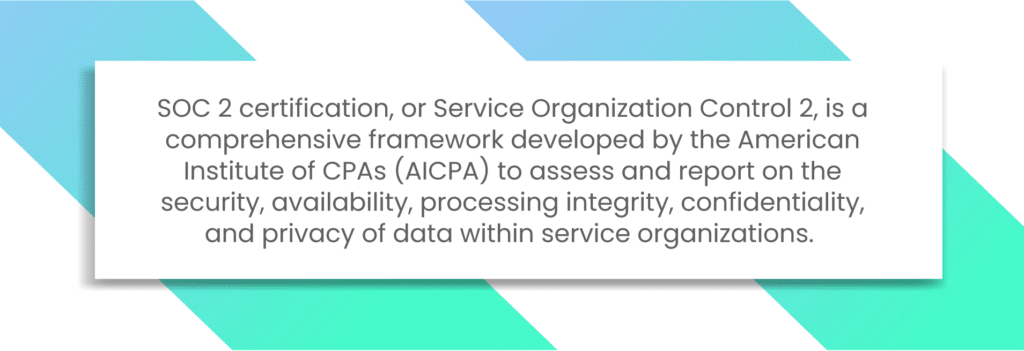
This certification is essential for businesses that provide services involving the storage, processing, or transmission of sensitive customer data.

SOC 2 certification involves a rigorous audit process conducted by independent third-party auditors who evaluate a service organization’s control environment. The objective is to ensure that the organization has implemented adequate controls to protect data from unauthorized access, security breaches, and other risks.

The different types: Type I and Type II

SOC 2 Type I report:

  • A SOC 2 Type 1 report evaluates the suitability of an organization’s controls as of a specific date.
  • It provides a snapshot of an organization’s control environment at a single point in time.
  • Type I reports are often used as a starting point for businesses looking to assess and demonstrate their commitment to security and compliance.

SOC 2 Type II report:

  • A SOC 2 Type 2 report assesses the effectiveness of an organization’s controls over a period of time, typically six months or more.
  • It offers a more comprehensive evaluation by verifying that controls are not only in place but also operating effectively.
  • Type II reports provide a higher level of assurance to stakeholders, making them the preferred choice for businesses aiming to demonstrate a consistent commitment to security and compliance.

Why choosing the right type matters

Selecting the right type of SOC 2 report is crucial for businesses, as it directly impacts the level of assurance provided to customers, partners, and other stakeholders. Let’s compare SOC2 type 1 vs type 2 certification to know more.

  • SOC 2 Type I: This report is beneficial if your organization wants to establish its commitment to security and compliance quickly. It can serve as a foundation for future Type II certification. However, it may not provide the same level of assurance as a Type II report because it only assesses controls at a specific point in time.
  • SOC 2 Type II: This report is the gold standard for SOC 2 certification. It offers a more comprehensive assessment of controls over an extended period, demonstrating a sustained commitment to security and compliance. It’s often a requirement for businesses that handle sensitive data and want to win the trust of clients and partners.

Ultimately, the choice between Type I and Type II depends on your business’s needs, the expectations of your stakeholders, and the level of assurance you want to provide. In the next sections of this blog series, we’ll delve deeper into the specific criteria and processes involved in each type of SOC 2 report, helping you make an informed decision about which is right for your organization.

SOC 2 Type I certification

1. An in-depth explanation of SOC 2 Type I

SOC 2 Type I certification is the first level of certification within the SOC 2 framework. It provides a snapshot assessment of a service organization’s controls at a specific point in time, typically as of a specific date. Here’s an in-depth explanation of Type I certification:

Snapshot assessment 

Firstly, Type I certification evaluates the suitability of an organization’s controls at a particular moment. It focuses on whether the controls are designed effectively to meet the specified criteria.

Report contents

Secondly, a SOC 2 Type 1 compliance report contains a description of the service organization’s systems and controls, an assessment of whether these controls are suitably designed to meet the criteria (known as the Trust Services Criteria or TSC), and an opinion from an independent auditor.
2. Key features and benefits

Understanding the key features and benefits of SOC 2 Type 1 compliance certification is crucial for organizations considering this level of assessment. We will explore the scope, timeframe, and level of assurance it offers, helping you make an informed decision.

Scope

Type I certification assesses controls in place at a single point in time.

Objectives

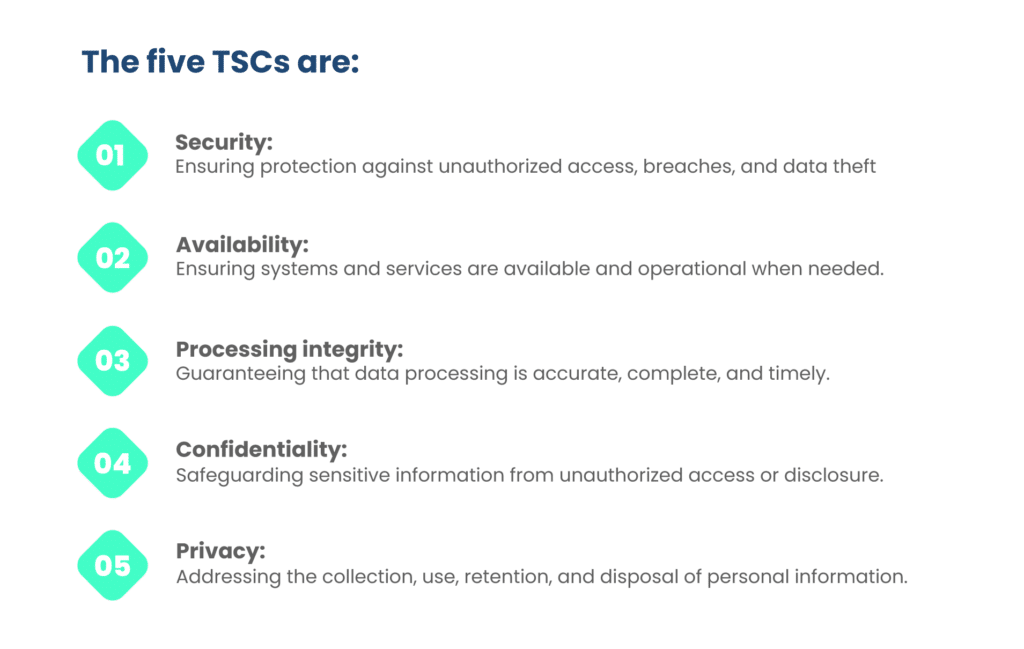
The objective is to determine whether controls are appropriately designed to meet the trust services criteria, which encompass security, availability, processing integrity, confidentiality, and privacy.

Duration

The audit process for SOC 2 Type 1 compliance certification usually covers a shorter period than Type II, focusing on the controls in place as of a specific date.

Assurance level

While Type I certification demonstrates a commitment to security and compliance, it offers a lower level of assurance compared to Type II because it doesn’t assess how controls operate over time.

3. Suitable scenarios for Type I certification
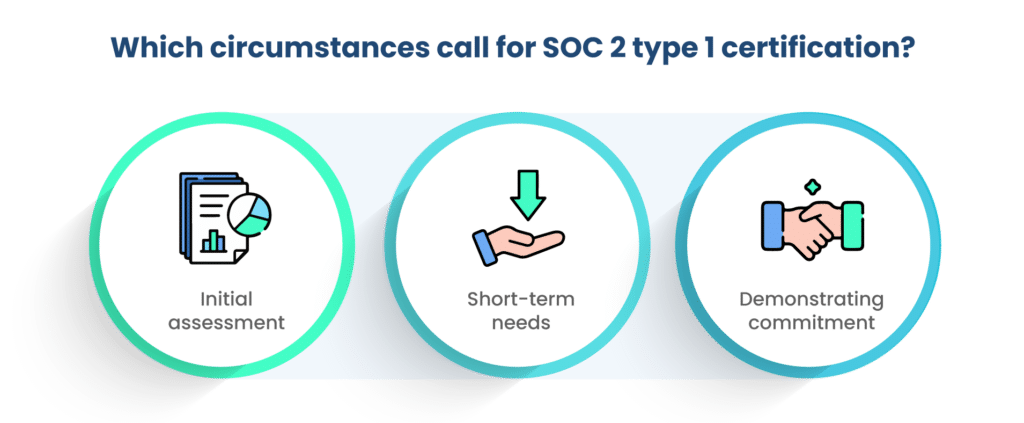
Not every business situation calls for the same level of SOC 2 certification. In this section, we will explore the scenarios where SOC 2 Type I certification is the most fitting choice, highlighting the contexts in which it provides the most value.

Initial assessment

Organizations new to SOC 2 certification may start with Type I as a foundational step to assess the suitability of their controls.

Short-term needs

Businesses with short-term contractual obligations or compliance requirements may find Type I certification sufficient to meet those demands.

Demonstrating commitment

Type 1 compliance certification can help organizations show their commitment to data security and compliance, even if they plan to pursue Type II certification in the future.

4. Real-world examples and use cases

To provide practical insights, we will present real-world examples and use cases of organizations that have leveraged SOC 2 Type I certification. These case studies will showcase how different businesses have utilized this certification to achieve their goals and enhance their security posture.

SaaS startups

A startup offering Software as a Service (SaaS) may opt for Type I certification to assure early customers of their commitment to data security while they work towards a more robust Type II certification.

Data centers 

Data center providers might undergo Type I certification to demonstrate their data security controls to potential clients before entering into long-term contracts.

Short-term projects

Organizations involved in short-term projects that require compliance may choose Type I certification to meet immediate contractual obligations.

SOC 2 Type 2 compliance

1. An in-depth explanation of SOC 2 Type II

SOC 2 Type 2 is a widely recognized auditing standard developed by the American Institute of Certified Public Accountants (AICPA) to assess and report on the controls and processes of service organizations. Mainly, it specifically focuses on the security, availability, processing integrity, confidentiality, and privacy of customer data. Here’s an in-depth explanation:

Control trust principles or criteria

SOC 2 Type 2 compliance evaluates controls related to five trust principles, called TSC, as described above.

Assessment period

SOC 2 Type 2 certification involves an extended audit period, usually spanning at least six months or longer. During this time, an independent auditor assesses the effectiveness of the controls in place.

Testing of controls

Auditors conduct rigorous testing of controls over an extended period, examining not only their existence but also their operational effectiveness.

Reporting

Once the audit is complete, the service organization receives a SOC 2 Type 2 compliance report. This report includes a detailed description of the controls tested, the auditor’s findings, and an opinion on whether the controls were suitably designed and effectively operated throughout the assessment period.

2. Key features and benefits

Understanding the key features and benefits of SOC 2 Type 2 compliance certification is essential for organizations considering or currently undergoing the certification process. In this section, we will explore the scope, objectives, timeframe, and ongoing compliance requirements of SOC 2 Type II, highlighting how it offers a high level of assurance to customers and contributes to trust-building.

Scope

SOC 2 Type 2 compliance focuses on a service organization’s systems and the controls relevant to the selected trust principles.

Objectives

The primary objective is to provide assurance to customers and stakeholders that the organization’s controls are effective in safeguarding their data and ensuring service reliability.

Timeframe

The audit period for Type II certification typically covers a minimum of six months.

Ongoing Compliance: Organizations must continuously maintain and improve their controls to ensure ongoing compliance and renewal of certification.

Assurance level

SOC 2 Type II provides a high level of assurance regarding the service organization’s controls, making it a valuable trust-building tool for customers.

3. Suitable scenarios for Type II certification

SOC 2 Type II certification is suitable for service organizations, such as data centers, cloud service providers, SaaS companies, and managed service providers, where data security, availability, and processing integrity are critical. It is often sought by organizations handling sensitive customer information or providing critical infrastructure services.

4. Real-world Examples and Use Cases

Real-world examples and use cases provide tangible evidence of the benefits and applications of SOC 2 Type II certification. In this section, we will explore instances where prominent organizations have obtained Type II certification, showcasing its practical relevance in ensuring data security, availability, and integrity for various industries and service providers.

Cloud service providers

Companies like Amazon Web Services (AWS) and Microsoft Azure obtain SOC 2 Type II certifications to assure customers that their cloud infrastructure meets stringent security and availability standards.

Data centers

Colocation data centers, like Equinix, undergo SOC 2 Type II audits to demonstrate their commitment to protecting customer data and ensuring uninterrupted service.

SaaS providers

SaaS companies, such as Salesforce, seek SOC 2 Type II certification to give their clients confidence in the security and privacy of their data stored and processed in the cloud.

Managed service providers

Organizations offering managed IT services, like Rackspace, use SOC 2 Type II certification to prove their commitment to maintaining the integrity and availability of their clients’ systems.

SOC 2 Type 1 vs Type 2

The difference between SOC 2 type 1 and type 2 reports is shown in the table below:

AspectSOC 2 Type 1SOC 2 Type 2
ObjectiveAssesses controls at a specific point in time to provide assurance about their design and implementation.Assesses controls over a period (typically 6-12 months) to provide assurance about their design, implementation, and effectiveness.
TimeframeSnapshot assessment, usually for a single date.Continuous assessment over a defined period, typically months.
SOC 2 Type 2 report contentProvides an opinion on the suitability of control design as of a specific date.Provides an opinion on the suitability of control design, implementation, and operating effectiveness over a specified period.
FocusEmphasizes control design and whether controls are in place.Emphasizes control design, implementation, and how controls operate over time.
Use casesTypically used for initial assessments or when a client or partner wants to evaluate control design.Often used when ongoing monitoring and assurance are required, especially for critical services or sensitive data handling.
FrequencyTypically conducted annually or as needed.Conducted at least annually but can cover a more extended period for a deeper evaluation.
Assurance levelLower level of assurance, as it doesn’t assess control effectiveness.Higher level of assurance, as it assesses control design, implementation, and effectiveness.
Cost and effortGenerally less costly and less time-consuming than Type 2.Requires more effort, resources, and time due to the continuous assessment.
Client confidenceProvides some level of assurance but may not be sufficient for clients with stringent security requirements.Provides a higher level of assurance and is often preferred by clients with strict security demands.
Continuous improvementLimited insights into ongoing control effectiveness.Provides valuable insights for continuous improvement by identifying control weaknesses and trends.

SOC 2 Type 1 vs Type 2 – How to decide?

In the realm of data security and compliance, the choice between SOC 2 Type I and Type II certification is pivotal. To aid this decision, we’ll explore key factors: industry standards, client expectations, regulatory compliance, budget considerations, and risk tolerance. Each factor plays a vital role in guiding you toward the right certification path, aligning with your organization’s specific needs and long-term goals. So, let’s compare SOC 2 type 2 vs type 1.

1. Assessing business needs

To make an informed decision between SOC 2 Type I and Type II certification, it’s crucial to begin by assessing your organization’s business needs.

Industry standards

  • Consider the specific standards and best practices within your industry. Some sectors may have stringent requirements for data security and privacy that align with SOC 2 Type II certification.
  • Evaluate whether SOC 2 certification is common or expected in your industry. If it’s a standard practice, it may be necessary to remain competitive.

Client and stakeholder expectations

  • Engage with your clients and stakeholders to understand their expectations regarding security and compliance.
  • Assess whether your clients require SOC 2 reports, and if so, which type (Type I or Type II) they prefer or mandate. Aligning with client expectations can be crucial for business relationships.

2. Regulatory compliance

Ensuring compliance with relevant regulations is a cornerstone of any certification decision, including SOC 2 Type I vs. Type II.

Meeting legal requirements

  • Investigate the legal and regulatory requirements relevant to your industry and geographic location. Plus, some regulations may specifically require SOC 2 certification, and others may have broader compliance requirements.
  • Ensure that your chosen SOC 2 certification aligns with and helps fulfill your legal obligations.

Future-proofing your compliance efforts

  • Consider the potential for future regulatory changes. SOC 2 Type II, with its focus on ongoing control effectiveness, can provide a more robust compliance framework that adapts to evolving regulations.
  • Think about how your compliance efforts today can help you stay compliant with future requirements.

3. Budget and resource allocation

Budget considerations and resource allocation are pivotal factors to weigh when determining the most suitable SOC 2 certification type for your organization.

  • Assess your budget and resource constraints. SOC 2 Type II certification typically requires more time, effort, and financial investment than Type I.
  • Consider whether your organization can allocate the necessary resources for a Type II audit, including staffing, technology, and external audit fees.

4. Risk Tolerance

Understanding your organization’s risk tolerance is fundamental in choosing between SOC 2 Type I and Type II certification, as it directly impacts the level of assurance provided.

  • Evaluate your organization’s risk tolerance. SOC 2 Type II provides a higher level of assurance due to its assessment of controls over an extended period.
  • If your organization has a lower risk tolerance and wants to minimize the risk of control failures, Type II may be the better choice.

To sum up

In summary, choosing between SOC 2 type 1 vs SOC 2 type 2 certification depends on your organization’s specific needs, industry standards, client expectations, regulatory compliance, budget, and risk tolerance. 

Type I is suitable for initial assessments and short-term needs, while Type II offers continuous assurance and is ideal for critical services or strict security requirements. Consider these factors to make an informed decision that aligns with your goals: safeguarding data and building trust in today’s data-centric business landscape.

Ready to secure your data and earn trust with SOC 2 compliance? Connect with Scrut today and take the first step toward safeguarding your organization’s sensitive information. Get started now!

FAQs

1. Is SOC 2 compliance mandatory for all businesses?

SOC 2 compliance is not mandatory for all businesses, but it may be required or expected in certain industries or by specific clients. It depends on your industry, regulatory environment, and the contractual obligations you have with clients or partners.

2. What are the common challenges in achieving SOC 2 compliance?

Common challenges include identifying and implementing necessary controls, ensuring consistent control operation over time, and navigating the audit process. Resource allocation and documentation can also be challenging aspects.

3. What are some tips for selecting the right SOC 2 auditor or assessor?

When selecting an auditor or assessor, consider their experience, reputation, industry knowledge, and their ability to communicate effectively with your organization. References and referrals can also be helpful in making the right choice.
Authored by

Aayush Ghosh Choudhary
Co-founder & CEO at Scrut

5 infosec compliance questions to ask potential SaaS vendors

Deloitte reported that organizations that excelled in performance were 59% more inclined to report favorable outcomes when they proactively engaged in cybersecurity initiatives within their partner ecosystems. Additionally, Deloitte’s research revealed that a substantial 85% of highly cyber-mature organizations had established cybersecurity risk programs dedicated to overseeing and assessing the security status of their partners and suppliers.

One of the pivotal contributors to an organization’s success is its software as a service (SaaS) vendors. This article will delve into the five critical information security compliance inquiries that large enterprises should pose to prospective SaaS vendors.

What is infosec compliance?

Infosec compliance can be defined as following industry-specific laws, regulations, and standards for protecting an organization’s information. Infosec compliance is based on three principles – confidentiality, integrity, and availability, collectively known as the CIA triad. The CIA triad ensures that the information is readily available to authorized persons when they need it, and they can rely on the integrity of this information.

5 infosec compliance questions large enterprises must ask potential SaaS vendors

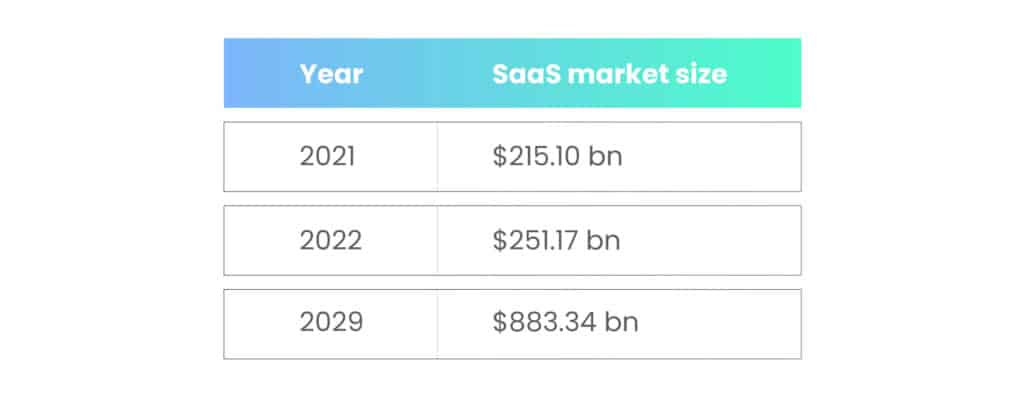
Fortune Business Insights predicted the compound annual growth rate (CAGR) of the SaaS market to be 19.7% during the forecast period of 2022 to 2029. The market is expected to grow from $251.17 billion in 2022 to $883.34 billion in 2029.

In the coming years, the dependency of organizations – large and small – on SaaS vendors will increase considerably. On average, a large organization (with revenue of $5 billion or more) spends $250 million or more on the cyber landscape (Deloitte). This amount includes the money spent on cybersecurity initiatives in partner ecosystems.

As an organization moves towards finalizing its partnership  with a SaaS vendor, it must assess whether the vendor follows stringent infosec compliance policies by asking the following questions.

1. Which infosec regulations and standards do you comply with?

An organization is expected to follow multiple security regulations, like GDPR, HIPAA, and CRPA, as well as infosec standards, such as SOC 2, ISO 27001, and NIST series. The regulations are mandatory to follow if they apply to the company, while the standards are recommendatory. Regulations and standards can improve the cybersecurity posture of the organization.

You must ask your SaaS provider which regulations and standards they follow. Regulations and standards provide a framework for the organization to develop information security policies and procedures. If your SaaS vendor follows standards, they will have a report or a certificate indicating that they have cleared the required audits. 

2. What does your infosec protocol look like?

The software and the behavioral rules defined by the organization to access, handle, use, and transfer data are called the infosec protocol. You must ask the organization you are interviewing whether they have an infosec protocol and, if yes, what the details are. If they don’t have an infosec protocol, you must reconsider working with them, as they can put your data at risk. 

A typical infosec protocol consists of rules to set passwords, use multi-factor authentication (MFA), control the flow of information, use virtual private networks (VPNs), secure data storage, and use SSL/TLS certificates to secure data in transit.

3. Do you assess your employees’ infosec knowledge? And how?

For an organization’s information security, having the perfect policies just framed is not adequate. The management must know if the policies are followed throughout the organization. In addition to a reliable infosec protocol, your SaaS vendor must also have implementation and assessment policies.

You must ensure that your SaaS vendor takes adequate steps to impart cybersecurity knowledge to their employees. Once the employees have been trained, the SaaS vendor must ensure that the implementation is done right. 

The employees should be tested regularly on their cybersecurity knowledge in different ways, including simulation techniques, quizzes, or written tests. Repeating training after unsatisfactory assessments can enhance the cybersecurity knowledge of the employees.

4. What steps do you take to protect customer data?

One way to secure customer data is to separate it from the main network. So even if your vendor’s main network is breached, your data remains safe. Check with your vendor about how they store your data. It is preferable if they use a single-tenant cloud for better security. 

Ask your SaaS vendor if they restrict access to your data to the people who really need it for processing. Using MFA to verify the employee’s identity before granting access can ensure the security of your data.

5. What are your incident response plans?

Incident response plans refer to an action plan in case of a security incident or a data breach. It includes the first response, actions taken to quarantine the affected area, steps taken to control the attack’s spread, informing the relevant parties, and restarting the business. 

A strong incident response plan can not only limit the spread of a cyber-attack but also helps in fulfilling compliance requirements. It can help the customers (in this case, you) know that your data has been breached. The SaaS vendor has an obligation to inform you of the breach and recommend a plan of action to move forward.

Conclusion

Information security compliance revolves around safeguarding an organization’s data as well as the data of its customers. Non-compliance by your SaaS vendor with relevant regulations and standards can potentially jeopardize your data. It’s essential to determine whether your SaaS vendor implements sufficient safeguards to secure their information network, thereby ensuring an extended layer of security for your data as well.

Scrut Automation is an innovative and radically simple governance, risk, and compliance automation platform for growing startups and mid-market enterprises. With Scrut, compliance teams can reduce ~70% of their manual effort in continuously maintaining compliance towards SOC 2, ISO 27001, GDPR, PCI DSS, HIPAA, and CCPA. Schedule your demo today to see how it works.

FAQs

1. What are the key compliance questions you should ask your vendors?

The key compliance concerns to address with your vendor are the infosec regulations they follow, the things included in their infosec program, their employee’s infosec awareness, the steps they take to protect customer data, and their incident response plan.

2. What is an incident response plan?

An incident response plan refers to the documented procedure to be followed in case of a data breach or cybersecurity incident. It includes all the actions the organization must take to mitigate the effects of the breach, stop the lateral movement of the attacker, take corrective actions, and restart the business of the organization after the breach.

3. What are the consequences of not asking compliance questions to a potential SaaS vendor?

Not asking questions about a SaaS vendor’s compliance posture can increase the cybersecurity risk of an organization. Regulatory bodies can also find the organization to be in  non-compliance with regulations, leading to fines and penalties.

Authored by

Aayush Ghosh Choudhary
Co-founder & CEO at Scrut

9 easy steps to review a vendor’s SOC 2 report

When it comes to being compliant, reviewing your organization’s security program alone is not enough. You will also have to review the security measures employed by all the third-party vendors that you engage. 

A vendor can change the way your organization is perceived. After all, you are the company you keep (or in the case of multiple vendors–the companies you keep).

Vendors also pose risks to the security of your organization. If any one of your vendors suffers a data breach, the sensitive data of your organization may also be exposed.

This makes vendor risk management a crucial part of your organization’s security program. 

But how can an organization examine the inner workings of its vendors to determine the risk posed by them? One effective way of doing this is by reviewing their SOC 2 report. 

A Systems and Organization Controls 2 (SOC 2) report is a comprehensive internal controls report that focuses on how a company protects customer data and assesses the effectiveness of the controls that it uses.

This blog will help you understand what these reports entail and how you can effectively review the SOC 2 reports of your vendors.

What is a SOC report?

System and Organization Controls (SOC) reports are a series of auditing reports that provide detailed information about the controls and processes implemented by an organization. 

These reports are designed to evaluate and communicate the effectiveness of the organization’s controls in ensuring the security, availability, processing integrity, confidentiality, and privacy of customer data.

What are the types of SOC reports?

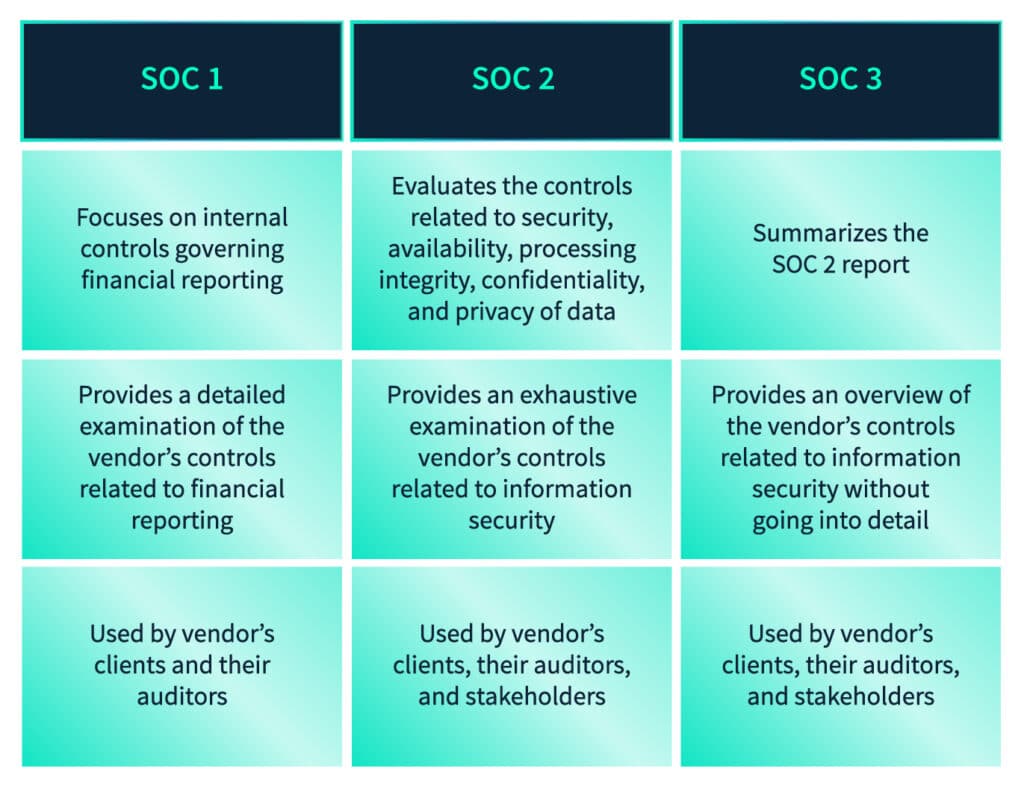
There are three types of of SOC reports; SOC 1 report, SOC 2 report, and SOC 3 report. Each of these reports assesses and analyses a separate factor, and their details are listed as follows. 

What is a SOC 2 report?

SOC 2 is a voluntary compliance standard developed by the AICPA in 2010 to define data security standards for organizations.

It is usually requested by customers to evaluate the security and compliance practices of service organizations.

SOC 2 reports assess the controls related to security, availability, processing integrity, confidentiality, and privacy of data. They have a broader scope than SOC 1.

There are two types of SOC 2 reports:

Type I

It evaluates the vendor’s controls related to security on a specific date without checking operational effectiveness. It is usually done to gain a rough idea of the vendor’s compliance.

Type II 

It assesses the vendor’s controls related to security over a period of time, and it also gauges operational effectiveness.

What are its Trust Principles?

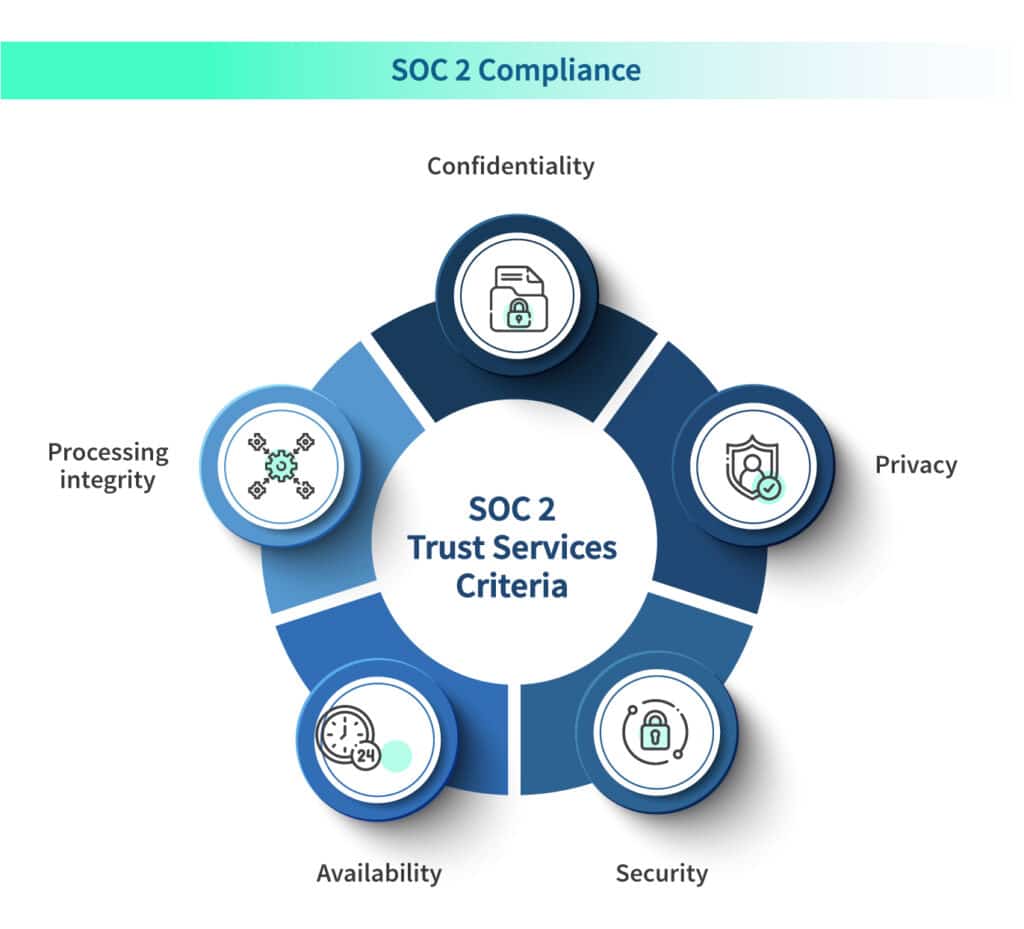
SOC 2 reports analyze whether vendors process data securely. The AICPA prescribes five Trust Principles or Trust Services Criteria (TSC) based on which the vendor’s controls are evaluated. The five principles are security, availability, confidentiality, processing integrity, and privacy.

  1. Security: Security refers to the protection of data from unauthorized access.
  2. Processing integrity: This principle ensures that the system works as per design without delay, bugs, or errors. It ensures that data is not tampered with.
  3. Privacy: Vendors should have stringent security standards in place. They must adhere to the privacy regulations of the enterprise, government, and other regulatory authorities. Customer data, especially sensitive personally identifiable information (PII), should not be shared without the customer’s explicit permission.
  4. Confidentiality: Customer data, including PII, should be encrypted while in transit and at rest. The data should be available only to authorized users and only when needed.
  5. Availability: The availability principle ensures that data is available to every authorized user when it is needed to perform specific duties.

What does a SOC 2 report contain?

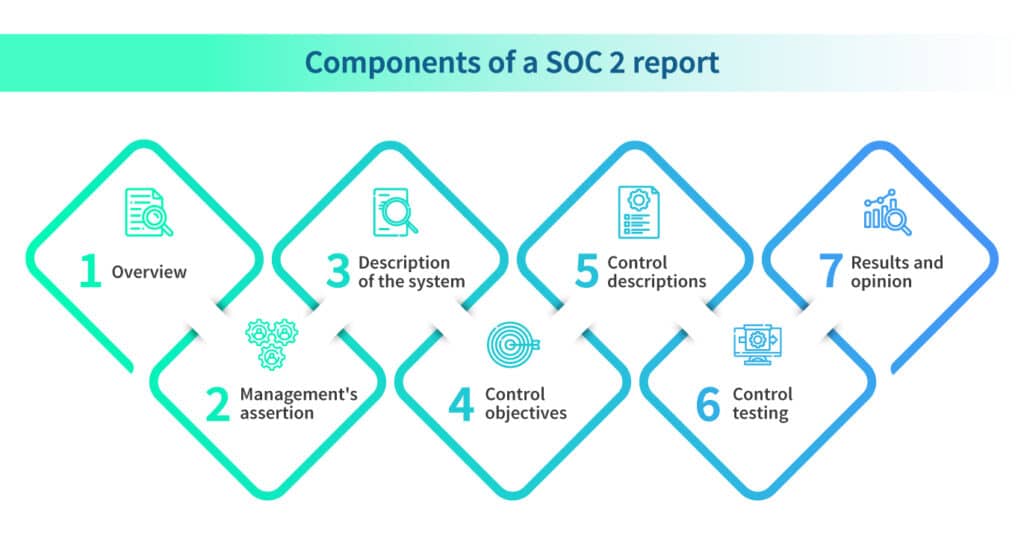
Independent auditors verify the implementation of the SOC 2 standard in an organization. A SOC 2 report contains the following:

1. An overview of the report

This includes the purpose, scope, and objectives of the assessment.

2. Management’s assertion

The vendor’s management provides a statement asserting its commitment to meeting the relevant TSC.

3. Description of the system

This part of the report details the system and services provided by the organization, including its infrastructure, software applications, and processes involved.

4. Control objectives 

The control objectives that the service organization aims to achieve are listed in the report. These objectives align with the criteria specified in the TSC.

5. Control descriptions

Detailed descriptions of the controls implemented by the service organization to achieve the control objectives are also included. 

6. Control Testing

The testing procedures employed by the auditor are described in the report. This includes the methods used to test the effectiveness of the controls, sample sizes, and the results of the testing. 

7. Results and opinion

The auditor records their assessment of the controls based on the testing performed. Their report concludes whether the controls meet the TSC or if they fail to do so. 

Why is it important to review your vendors’ SOC 2 reports?

SOC 2 reports determine whether your vendors are taking adequate steps to protect your data. If any one of your vendors’ databases gets breached, your organization stands the risk of a secondary breach that could lead to financial and reputational damages. 

Therefore, an organization can benefit from reviewing its vendor SOC report and knowing the level of trust it can place in the vendor’s information security systems.

Here are some reasons why it is important to review your vendor’s SOC 2 reports.

1. It assesses the vendor’s security and compliance

SOC 2 reports allow you to evaluate the effectiveness of your vendor’s security controls and assess their compliance with industry standards and regulatory requirements. They help you determine if the vendor has implemented appropriate measures to protect data and mitigate security risks. This ensures that they do not pose a threat to your organization’s security and compliance.

2. It supports vendor selection and due diligence

SOC 2 reports can help in the process of vendor selection. You can determine if a vendor aligns with your organization’s security and compliance needs by reviewing their SOC 2 report. By demonstrating SOC 2 compliance vendors prove that they are committed to protecting customer data and have adequate security measures in place.

3. It helps manage risk

SOC 2 reports help you evaluate the potential risks associated with engaging a vendor. Any control deficiencies in the vendor’s SOC 2 report can warn you against potential risks that they could pose to your organization. 

4. It ensures data protection and privacy

SOC 2 vendor management reports evaluate a vendor’s controls related to data protection and privacy. Reviewing the report helps in determining if the vendor is well-equipped to safeguard sensitive information. This helps in ensuring the protection and privacy of your organization’s data.

5. It secures trust and reputation

Reviewing a vendor’s SOC 2 report helps in gauging their commitment to security, compliance, and risk management. By engaging trustworthy vendors, your organization demonstrates its own dedication to data protection and privacy to its customers, regulators, and stakeholders.

How do you review your vendor’s SOC 2 reports?

Now that we’ve established the importance of reviewing a vendor’s SOC 2 report, let’s take a look at how to effectively review vendor’s SOC reports. The process of reviewing involves a systematic approach to comprehensively understand the report and its implications for your organization. 

Here are some steps that will help you review a vendor’s SOC 2 report effectively.

Step 1: Familiarize yourself with the scope and objectives

The first step involves understanding the scope of the vendor’s SOC 2 report, including the systems, services, and processes covered. You will then need to go through the control objectives listed in the report. It is important to ascertain if the controls meet the TSC and other objectives listed in the report.

As we mentioned earlier, there are two types of SOC 2 reports: Type I and Type II.  While carrying out the review of the vendor, an organization must focus on the type of report the vendor possesses. 

Type II reports are more exhaustive and provide a clearer picture of the vendor’s compliance. They are useful for the organization’s customers and stakeholders, as they demonstrate that it follows the SOC standards consistently.

Step 2: Assess the auditor’s opinion

The section that documents the auditor’s opinion will provide an overall assessment of the vendor’s controls. It is crucial to consider any qualifications, exceptions, or deficiencies noted by the auditor. The auditor’s findings will give you an idea about the vendor’s ability to meet your organization’s requirements.

Step 3: Evaluate control descriptions

It is important to assess whether the vendor’s controls align with your organization’s security and compliance requirements. This is why it is necessary to carefully review the control descriptions provided in the SOC 2 report. Make sure to check for specific controls related to security, availability, processing integrity, confidentiality, and privacy.

Step 4: Validate control effectiveness

SOC 2 Type II reports assess the operating effectiveness of the controls. If you are reviewing this type of report, search for evidence such as testing procedures and results to support the vendor’s claims about control effectiveness. It is critical to pay attention to any control deficiencies or exceptions identified and gauge their significance and impact.

Step 5: Analyze complementary user entity controls 

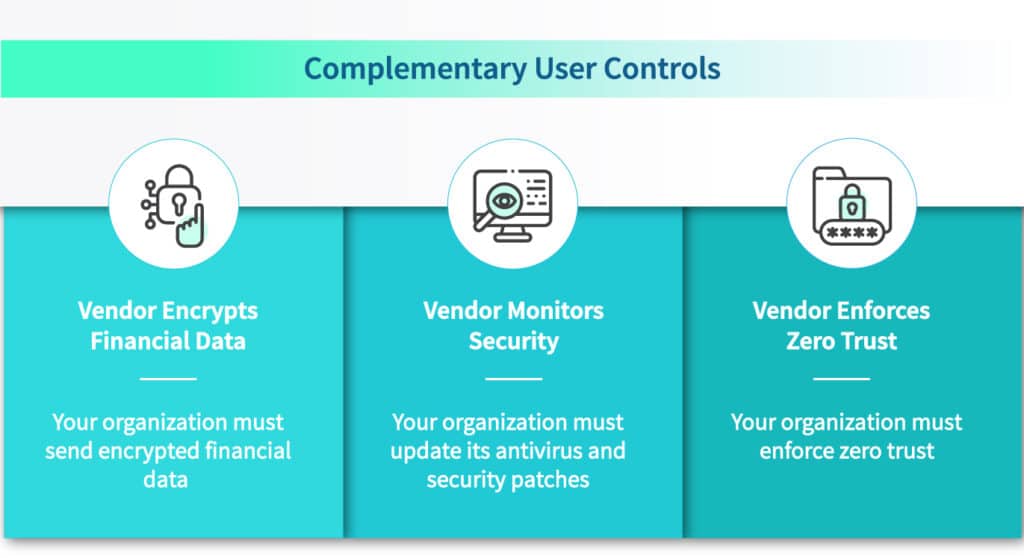
It is not rare for SOC 2 reports to mention the need for Complementary User Entity Controls (CUECs). Some vendors expect their customers to have these controls in place to complement their own controls. For instance, the vendor may encrypt their financial data and expect their customers to do the same. 

So, it is necessary to go through the SOC 2 report to assess whether your organization has the appropriate CUECs in place.

Step 6: Evaluate monitoring and incident response

Reviewing the vendor’s processes for monitoring, incident response, and security event management is crucial for evaluating their security. While going through the report, it is important to look for evidence of incident response testing, monitoring tools, and security incident handling procedures. You will need to assess the effectiveness of these procedures to determine whether the vendor is well prepared in the event of a security breach.

Step 7: Seek clarifications and additional information

If you have any doubts regarding any section in the report, make sure that you reach out to the vendor or the auditor who prepared the SOC 2 report. Requesting additional information regarding specific controls is important to avoid overlooking potential security risks.

Step 8: Assess alignment with your organization’s requirements

Determining if the findings in the vendor’s SOC 2 report align with your organization’s security, compliance, and risk management requirements is an important step. It is crucial to assess the vendor’s controls and processes in relation to the services they provide and the sensitivity of the data involved.

Step 9: Take action based on the audit report

There are three basic types of audit reports: unqualified, qualified, and adverse. 

An unqualified report indicates that the vendor’s internal controls are satisfactory and in tune with the SOC 2 standard.

A qualified report, on the other hand, implies that the internal controls are adequate but have a lot of scope for improvement.

Finally, an adverse report indicates that the internal controls do not meet SOC 2 standards.

If your vendor has an adverse report, doing business with them may not be the best idea. When it comes to vendors with a qualified report, it is necessary to assess their controls relating to customer data before engaging them.

Final thoughts

Regularly reviewing SOC 2 reports is one of the best ways to assess the security of your vendors and make informed decisions about conducting business with them. 

By staying up-to-date with your vendors’ security posture through these reviews, you can effectively monitor their performance and mitigate risks associated with their services.

Adopting SOC 2 standards is beneficial for both your organization and its vendors. It guarantees compliance and adequate security for your company and all its third-party associates.

Scrut simplifies SOC 2 compliance with its prebuilt controls and continuous compliance monitoring. To discover how Scrut can streamline the compliance process for your organization, schedule a demo today!

FAQs

1. What is a SOC 2 report?

A Systems and Organization Controls 2 (SOC 2) report is a comprehensive internal controls report that focuses on how a company protects customer data and assesses the effectiveness of the controls that it uses.

2. What are the types of SOC reports?

There are three types of SOC reports: SOC 1, SOC 2, and SOC 3:
• SOC 1 focuses on internal controls governing financial reporting.
• SOC 2 evaluates the controls related to security, availability, processing integrity, confidentiality, and privacy of data.
• SOC 3 summarizes the SOC 2 report.

3. What are the types of auditors’ opinions in SOC 2?

There are three types of auditors’ opinions – unqualified, qualified, and adverse.
• An unqualified report indicates that the vendor’s internal controls are satisfactory and in tune with the SOC 2 standard.
• A qualified report implies that the internal controls are adequate but have a lot of scope for improvement.
• An adverse report indicates that the internal controls do not meet SOC 2 standards.

Authored by

Aayush Ghosh Choudhary
Co-founder & CEO at Scrut

SOC 2 checklist: Prepare for your SOC 2 audit with these steps

SOC 2 compliance is considered to be the gold standard of data security, and rightfully so.  It showcases organizations have adequate controls to avoid and protect against data breaches. However, to comply with SOC 2, organizations need to complete a rigorous process of testing implemented controls known as the SOC 2 audit. 

The success of the SOC 2 audit also depends on the organization’s knowledge of information security standards and its efforts to meet compliance requirements. 

Preparing for SOC 2 is undoubtedly challenging, which is why a SOC 2 compliance checklist is what you need. 

In this article, we will address some questions, recommendations, and the industry’s best practices giving you a ready reckoner to know whether your organization is prepared for a SOC 2 audit or not. 

What is a SOC 2 report, and why is it important? 

SOC 2 is a security compliance standard created by the American Institute of Certified Public Accountants (AICPA). Once compliant, organizations can share the SOC 2 report with their clients to demonstrate that their business has adequate controls with regard to the five TSCs; security, availability, processing integrity, confidentiality, and privacy. 

 To receive the SOC 2 report, however, organizations must undergo the audit process. A SOC 2 report is issued by a third-party auditor at a licensed CPA firm. The auditor conducts a detailed review of an organization’s information security management system. 

Types of SOC 2 Audits

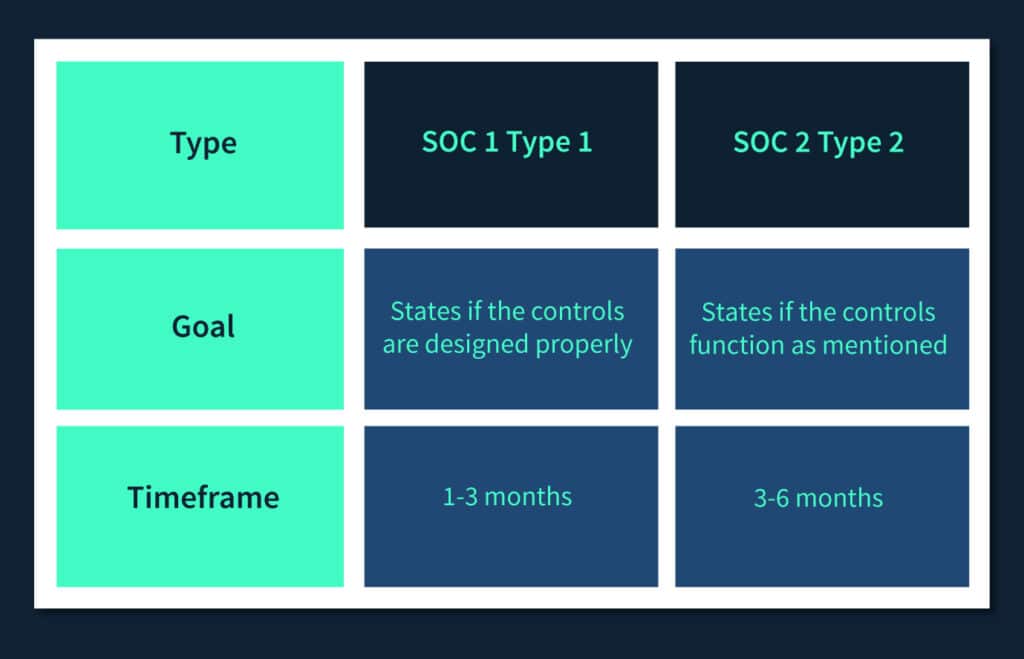
There are two types of SOC 2 audits, as shown in the infographic below. 

Difference between SOC 1 Type 1 and SOC 2 Type 2

A SOC 2 report benefits organizations in many ways, but it primarily focuses on testing the design and operating effectiveness of controls to outline any potential risks for customers or partners who wish to work with the organization.

How to prepare for a SOC 2 audit? 

As we have discussed the importance of the SOC 2 reports in demonstrating security to prospective clients and stakeholders, it is crucial to ensure that an organization obtains  reports successfully. To do this, preparing for the SOC 2 audit is critical. 

A SOC 2 audit can be long-winded since it is both time and resource-consuming. Organizations must follow SOC 2 compliance checklist to complete the certification successfully. Below are some points that will help you break down the SOC 2 audit process into easy-to-follow steps, along with some helpful questions you can address.

Step 1: Pick the type of SOC 2 report you want to pursue

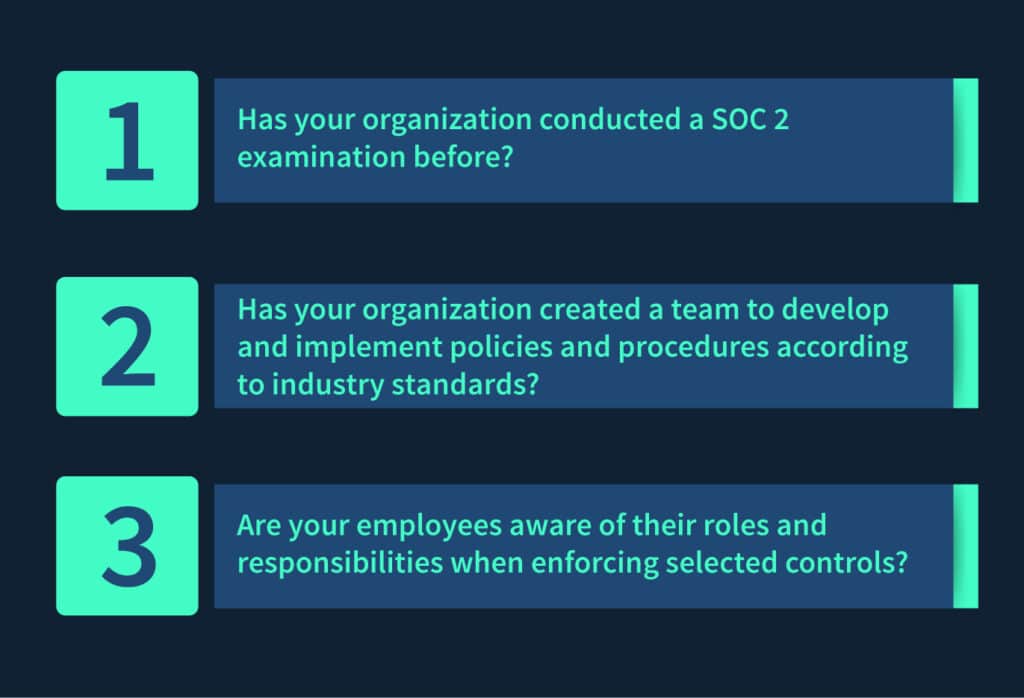
As we mentioned above, SOC 2 report is divided into two types, Type 1 and Type 2. Before you plan the audit process and start developing teams and tasks, among other things., it is imperative to decide and select the type of SOC 2 report your organization wants to pursue. 

If your answer to most of the questions mentioned below is “NO,” then we recommend you begin with a SOC 2 Type 1 report. 

The type of SOC 2 report you want to pursue

Step 2: Determine the scope of the SOC 2 audit and define its objectives

SOC 2 audits are all-encompassing, with divided attention between infrastructure, employees, data, risk management policies, and security controls, which is why it is essential to determine what will be included in the audit for your organization. 

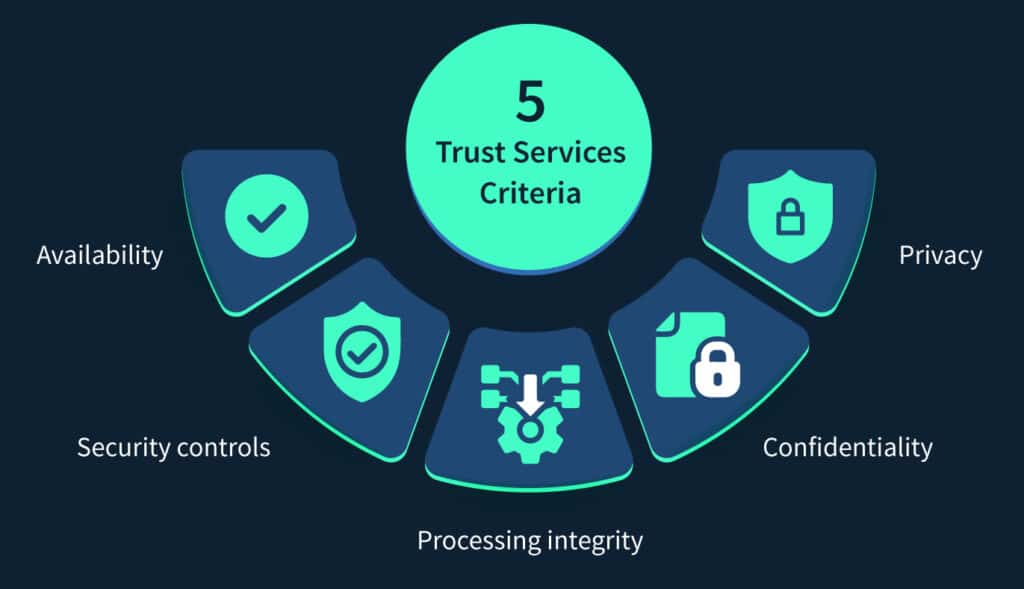
You can also start by determining which of the four Trust Services Criteria (TSC) – availability, processing integrity, confidentiality, and privacy, you want to include in your audit. Security, the fifth TSC, is a mandatory requirement for every SOC 2 audit. 

5 Trust Services Criteria (TSC)

Below we have listed the elements included in each Trust Service Criterion, along with some questions that will help you select which principle is best suited for your organization. 

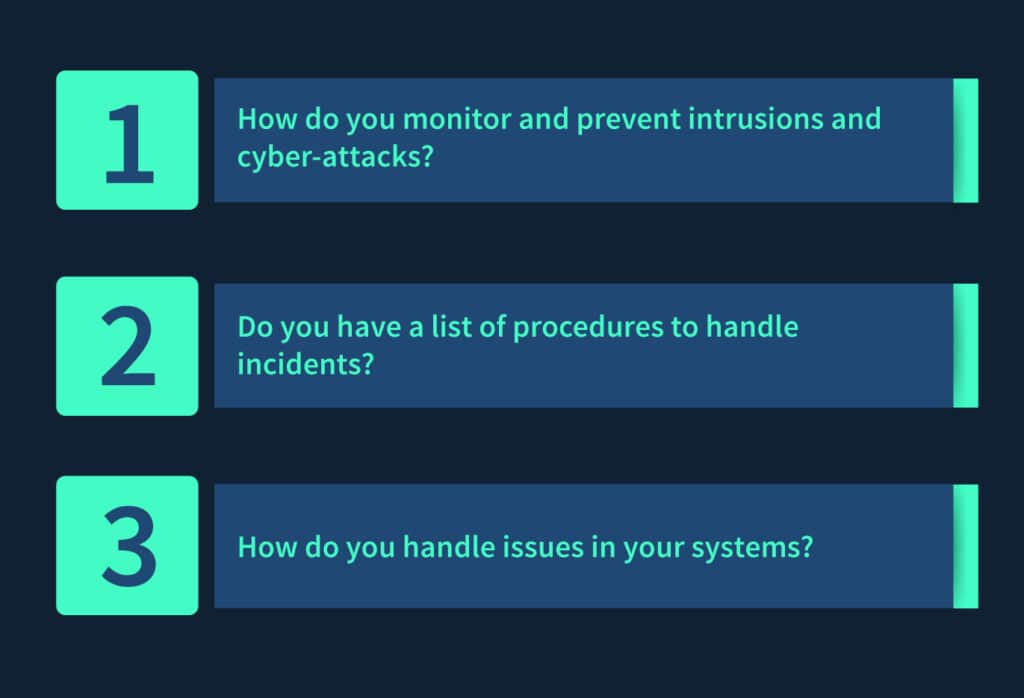
Security controls are designed to include an array of risk-mitigating solutions, such as endpoint protection and network monitoring tools. The security trust criterion helps in protect information throughout its lifecycle in an organization and protects the data from unauthorized access and disclosure.

Security controls Questions

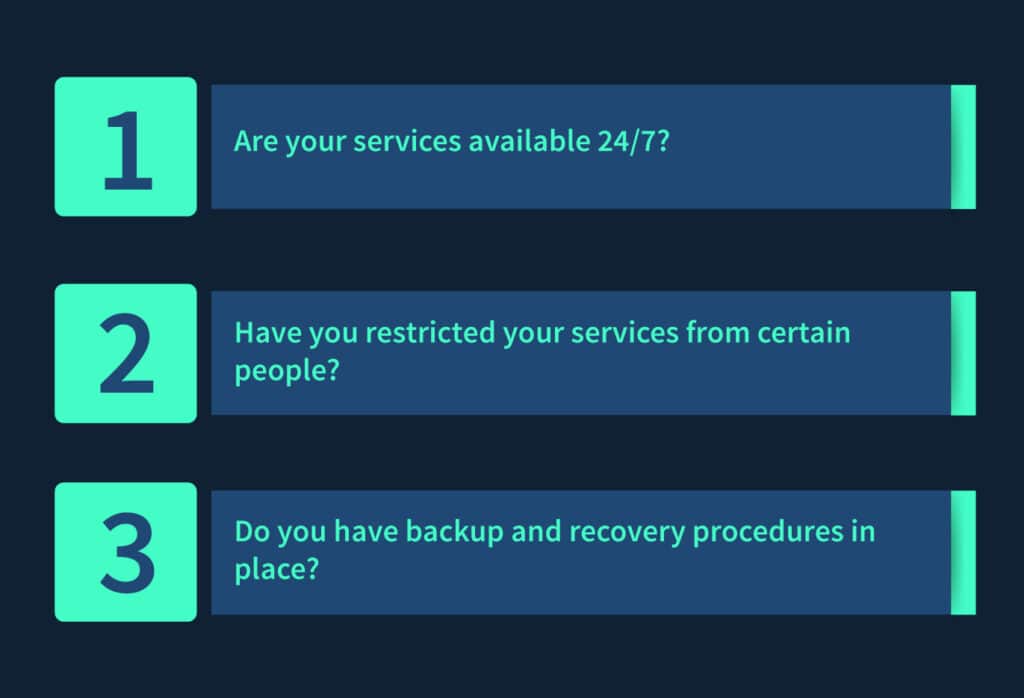
Availability addresses whether systems include controls to support accessibility for operation, monitoring, and maintenance.

Availability questions

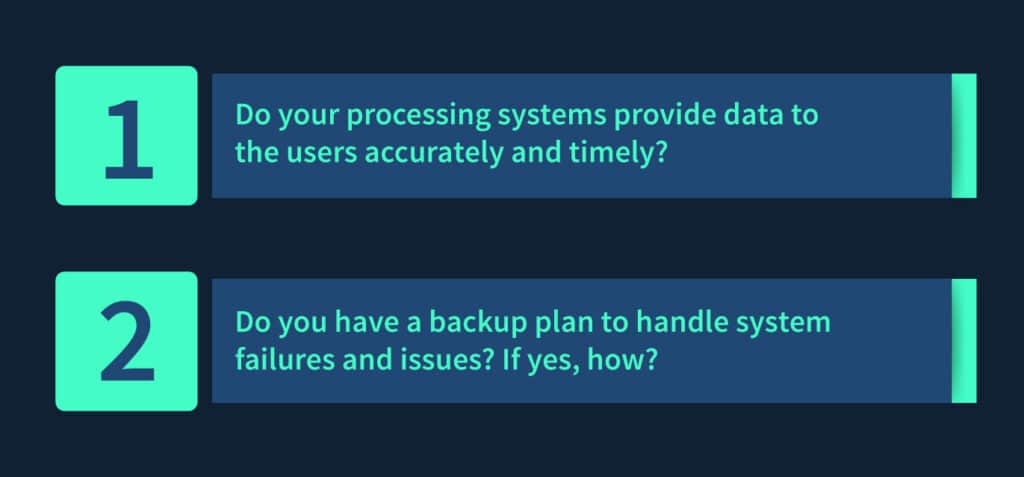
Processing integrity focuses on data accuracy and the completeness of the end-to-end process to ensure applications function without delay, error, omission, or accidental data manipulation.

Processing integrity questions

Confidentiality evaluates how organizations protect confidential information – limit access, storage, and use. It ensures that only authorized individuals can view sensitive information like legal documents or Personally Identifiable Information (PII).

Confidentiality questions

Privacy assesses how, why, and when an organization shares information like name, address, email, or any other personal information.

Privacy questions

If you have limited resources for the audit, choose criteria that offer the highest potential ROI or the one you can test without a lot of additional work.

Step 3: Do an internal risk assessment

Performing a risk assessment is the next step in the SOC 2 compliance checklist. This step is equally important as the final certification, primarily because it assists organizations in identifying any risks connected to expansion, location, or infosec best practices, internally. 

These risks must be documented and consequently mitigated by assigning an impact and likelihood rating. Any errors, omissions, or missed opportunities in risk assessment at this point could significantly increase your vulnerabilities.

Some questions to consider during this step are:

internal risk assessment questions

Step 4: Perform gap analysis 

After conducting the internal risk assessment, your organization needs to perform a gap analysis. This is another important step of the SOC 2 compliance checklist because it examines existing procedures, rules, and controls to assist you in better understanding your present security posture and which measures you still need to implement to meet the Trust Services Categories’ applicable criteria.

Following the completion of your gap analysis, you need to work with teams across the organization, examining policies, formalizing procedures, making necessary software changes, and any further steps, such as integrating new tools and workflows. This will allow you to take the necessary steps to close the gaps before the audit.

Take into account the following questions while performing the gap analysis:

Perform gap analysis questions

Step 5: Conduct a readiness assessment 

A readiness assessment helps you determine your preparedness for a SOC 2 final audit. You can perform a readiness assessment independently or engage an auditing firm to complete your review. But it is highly recommended to use a third-party auditor during a readiness audit so that you can pressure test controls, which the internal teams can miss. 

In this assessment, the auditor walks through the systems, processes, and controls that will  be in the audit. At the end of the audit, the company receives a detailed report covering any weaknesses or gaps and recommendations to fix them.

While no organization can technically ‘fail’ a SOC 2 audit, you must address errors to guarantee you obtain a satisfactory report. 

Step 6: Final SOC 2 audit 

After finding the right SOC 2 auditor for your organization, you can finally test for a SOC 2 audit and receive the SOC 2 report. 

To do so, you must provide your auditor with all of the essential information so that they can analyze evidence for each in-scope control, verify information, schedule any walkthroughs, and give you the final report.

SOC 2 Type 2 audits can either take 2 weeks or 6 months, depending on the volume of corrections or issues raised by the auditor. Type 1 audits, on the other hand, are less intrusive and require you only to provide evidence of the various checks and systems you have in place to meet the SOC compliance checklist requirements.

The auditor may ask the following questions:

Final SOC 2 audit questions

Step 7: Monitor controls to maintain compliance 

Compliance is a continuous journey, so SOC 2 compliance doesn’t end once you complete the audit, get certified, and receive the SOC 2 report. 

Because security is an ongoing effort, receiving the report is only the beginning. As SOC 2 audits occur on an annual basis, it will help you to build a strong continuous monitoring approach. You can do this by investing in vulnerability scanners, incident management systems, security measure updates, and pen testing, among other things.

There are some factors that you should consider while setting up your monitoring approach, such as:

Monitor controls to maintain compliance

Conclusion 

Every organization has the liberty to select the Trust Service Criteria barring security, which is mandatory. This also means that the SOC 2 compliance journey for every organization will be different. That said, this SOC 2 compliance checklist template is a useful guide for organizations looking to get SOC 2 certified, despite their separate choice of controls. 

AICPA does not provide clear guidelines with respect to the controls an organization must have in place to be SOC 2 compliant. What works for one organization might not necessarily work for others and vice versa.  We recommend you get in touch with a compliance officer or work with a compliance automation platform like Scrut to get started with SOC 2.

Scrut Automation is a smart and radically simple Governance, Risk, and Compliance automation platform for growing startups and mid-market enterprises. With Scrut, Compliance teams can reduce ~70% of their manual effort in continuously maintaining compliance towards SOC 2, ISO 27001, GDPR, PCI DSS, and privacy laws like HIPAA, GDPR, and CCPA. Schedule your demo today to see how it works.

Frequently Asked Questions (FAQs)

1. Who can perform a SOC Audit?

Only an auditor employed by a certified public accounting firm, particularly one with an emphasis on information security, is qualified to conduct a SOC 2 audit. 

2. What are the SOC 2 trust service criteria? 

There are five SOC 2 TSCs, namely, security, availability, processing integrity, confidentiality, and privacy. Organizations have the right to select which criteria they want to test for, except security, which is a mandatory requirement for all SOC 2 audits. 

3. Where can I find a SOC 2 compliance checklist template? 

This article covers all the essential points that you will need to cover while preparing your organization for a SOC 2 audit. You can also find a SOC 2 compliance checklist pdf to navigate through the compliance journey seamlessly.

Authored by

Aayush Ghosh Choudhary
Co-founder & CEO at Scrut

4 of the biggest misconceptions with SOC 2

This article will discuss a few common misconceptions about SOC 2. It will also establish how these misconceptions can impact organizations heavily when they remain unresolved.

What is SOC 2? Why was it established?

Throughout America, numerous businesses and institutions work as service providers. Then some vendors function as third parties in any business or service. These individuals or business entities are often privy to sensitive information, some of which is personally identifiable to other citizens and organizations.
SOC 2, or Service Organisation Control, is a standard of an audit by the American Institute of Certified Public Accountants (AICPA) to protect such information. The AICPA has made this audit mandatory for all businesses and organizations to ensure that private information remains private and does not get leaked out or reach the hands of people who could misuse it.

Primarily, it aims to determine if the description of a particular system installed in an organization matches the criteria laid out in the SOC 2 standard. It also verifies whether the organizational controls are designed so that its service requirements and commitments meet the applicable trust services criteria.

What are the common misconceptions about SOC 2?

The most common myth that organizations have in their mind about SOC 2 is that it is a certification – which we will discuss later in this article. There are other common myths and misconceptions, too, which organizations commonly believe in.

SOC 2 audit is a technical examination

Most organizations equate the SOC 2 audit to a technical examination. This audit does test and inspects your IT controls, but it is not an examination by itself. It merely looks for and verifies conditions related to information flow control. This includes verifying the presence of firewalls on your office/cloud servers, the kind, and level of encryption you use, whether your software is prone to malware and associated attacks/endpoint data security, and similar criteria.

It is an unnecessary expenditure

Organizations feel that the SOC 2 audit is an unnecessary expenditure and is not an investment at all. However, this is not true. Firms and companies that have undergone the SOC 2 and full SOC 2 audits usually see faster growth than unaudited ones. New prospects and customers typically have queries regarding how safe and secure confidential company information is on their systems. Therefore, having a SOC audit will help organizations close deals faster.

It is just another audit

Third and one of the most common misconceptions among organizations is that it is merely a formality that needs to be done. A good SOC 2 audit result is incredibly beneficial for your organization.

It enables better coordination between your IT systems and the core aspect of your organization like manufacturing, marketing, etc. All your stakeholders receive information and communications from your business more transparently. The SOC 2 audit enables risk mitigation and enhances control levels through monitoring programs. Most importantly, such an audit ensures that any change to the information systems does not adversely impact all available data integrity, privacy, and security.

SOC 2 is not a certification

Now, let’s talk about the most crucial misconception businesses have in their minds concerning SOC 2 audits. According to Troy Fine, a Cybersecurity Compliance professional, it can’t be repeated enough that SOC 2 is “not” a certification. It is merely an audit performed by a Certified Public Accountant in America that will result in an attestation at the end of the audit.

This means an authority (the public accountant, in this case) is verified as authentic. It attests to specific facts relating to control and compliance to certain standards as laid down by the AICPA.

How does SOC 2 work?

All data and information secured on all businesses’ IT systems, servers, and machines must be safe and secure, and their integrity maintained. The SOC 2 does just that; it verifies that the IT systems and any other place where information is stored are safe by way of adequate and capable encryption, the presence of firewalls, and software that cannot be easily compromised by malware and such.

But mere adherence to these standards and their compliance does not provide any organization with any kind of certificate. A report at the end of the SOC 2 audit describes some parameters and criteria and verifies if and to what extent they were met. Such a report is called an ‘attestation,’ and it provides some opinions regarding the effectiveness of control systems in the organization. Four results or opinions are passed at the audit’s end: unqualified, qualified, adverse, and disclaimer.

Hence, there is neither a certificate provided at the end of the audit nor is there any certification period. Companies merely need to take the exam once a year and get a favorable audit result – especially one with an ‘unqualified’ opinion among the above four opinions.

Closing thoughts

The SOC 2 audit evaluates the safety and security of an organization’s IT systems. It improves the coordination and functioning of your IT systems with the fundamental components of your organization, such as production and marketing, and other areas like HR, finance, and operations. Monitoring programs can help to increase the degree of control and security of your organization.

Scrut Automation is an innovative and radically simple governance, risk, and compliance automation platform for growing startups and mid-market enterprises. With Scrut, compliance teams can reduce ~70% of their manual effort in continuously maintaining compliance towards SOC 2, ISO 27001, GDPR, PCI DSS, HIPAA, and CCPA. Schedule your demo today to see how it works.

Authored by

Aayush Ghosh Choudhary
Co-founder & CEO at Scrut

Why does your company need SOC reports?

The increase in the use of software technology is directly proportional to the unfortunate rise in data breaches. Data breach statistics show that hackers are motivated by money to acquire data, and personal information is a highly valued type of data to compromise. Thus, organizations choose to work with service providers that are secure and reliable. How do service providers prove their reliability? With the help of SOC reports. These reports allow service organizations to assure their customers that their data is being safely handled.

Before we dive into the benefits and importance of SOC reports, let’s first understand in detail what they are.

What are SOC reports?

SOC reports are designed by the American Institute of Certified Public Accountants (AICPA). These reports aim to help service organizations that provide services to other entities build trust and confidence. They prove that they have reliable controls and security services through a report performed by an independent CPA or Certified Public Accountant.
The SOC report is one of many compliance requirements for IT-related services provided to clients. Having a SOC compliance report can be a helpful marketing tool for organizations that want to reassure clients that they can be trusted. While it’s not required by law, large enterprises request potential vendors to provide a SOC report to prove that they can keep their data safe and secure.
There are three types of SOC reports: SOC 1, SOC 2, and SOC 3

A SOC 1 report is based on the SSAE 18 standard. It reports on the effectiveness of internal controls at a service organization relevant to the client’s internal control over financial reporting (ICFR).
A SOC 2 report evaluates internal controls, policies, and procedures that directly relate to the security of a system at a service organization. The SOC 2 report was designed based on 5 Trust Service Criteria: security, availability, processing integrity, confidentiality, and privacy.

Like SOC 2, the SOC 3 report has been developed based on AICPA’s 5 Trust Service Criteria. It is a public report of internal controls over security, availability, processing integrity, and confidentiality.

What is a SOC 1 report?

SOC 1 compliance secures a service organization’s interaction, transmission, or storage of users’ financial statements. A SOC 1 report helps management, investors, auditors, and customers evaluate internal controls over financial reporting within guidelines laid out by the AICPA.

SOC 1 report consists of two types: SOC 1 Type 1 and SOC 1 Type 2.

SOC 1 Type 1 audit evaluates an organization’s systems and produces a point-in-time assessment of the controls on a specific date. In comparison, a SOC 1 Type 2 audit covers the operating effectiveness of the controls over a particular period.

Benefits of SOC 1 report:

  • It helps organizations to verify that they have appropriate controls to deliver high-quality services.
  • It helps in identifying vulnerabilities in systems and provides remediation for the same.
  • It evaluates the policies and procedures.
  • It strengthens the infosec posture and minimizes the risk of data breaches.
  • It builds trust between service providers and the organization.
  • It strengthens the organization’s environment and ensures they adopt industry best practices.

What is a SOC 2 report?

SOC 2 audit ensures service providers securely manage customers’ data. It was developed by the American Institute of Certified Public Accountants (AICPA).

SOC 2 report consists of two types: SOC 2 Type 1 and SOC 2 Type 2.

A SOC 2 Type 1 report typically says if an organization’s system controls are correctly designed, whereas a SOC 2 Type 2 report says if those controls function as intended over a specific period.

SOC 2 reports differ from other information security standards and frameworks as it is based on the 5 Trust Service Criteria developed by the AICPA – security, availability, processing integrity, confidentiality, and privacy.

Benefits of SOC 2 report:

  • It builds brand reputation – SOC 2 report is evidence that the organization has taken all necessary measures to prevent a data breach.
  • It provides organizations an edge over others in the industry.
  • It increases transparency and visibility for customers, thus unlocking infinite sales opportunities.
  • It gives valuable insights into your organization’s risks like security posture, vendor management, internal controls, governance, and regulatory oversight.

What is a SOC 3 report?

Like SOC 2, SOC 3 reports on controls based on 5 Trust Service Criteria (TSC) – security, availability, processing integrity, confidentiality, and privacy. The only difference is that SOC 3 reports are written in a way intended for people with a general interest in the service organization without getting into the specific details.

SOC 3 reports can be distributed publicly, and audited companies can use them for marketing purposes.

Benefits of SOC 3 report:

  • It proves that your business properly invests in security measures.
  • It shows customers that you’re transparent about your practices.
  • It outperforms competitors who haven’t had a third-party evaluation.
  • It helps to build trust with both new and old clients.
  • It is a positive report that demonstrates you have a professional team.
  • It reassures customers that your prices won’t increase if there are new security threats.

Why does your company need SOC reports?

Let’s assume you are a service provider that offers payroll or medical claims processors, data center firms, loan services, and Software as a Service (SaaS) providers that may handle, store, process, or affect financial or sensitive data of their user entities or customers. In that case, SOC 2 report is a must for your organization.

How do I get started?

Getting SOC certification takes time and resources. We recommend you get in touch with a CPA firm or use an automation tool like Scrut to get started.

Scrut Automation is an innovative and radically simple governance, risk, and compliance automation platform for growing startups and mid-market enterprises. With Scrut, compliance teams can reduce ~70% of their manual effort in continuously maintaining compliance towards SOC 2, ISO 27001, GDPR, PCI DSS, HIPAA, and CCPA. Schedule your demo today to see how it works.

Authored by

Aayush Ghosh Choudhary
Co-founder & CEO at Scrut

SOC 2 audit process: How does it work?

SOC 2 audits, short for Service Organization Control 2 audits, are a critical component of ensuring the security and reliability of service organizations in today’s digital world. These audits are designed to evaluate and report on the controls in place at a service organization that are relevant to the security, availability, processing integrity, confidentiality, and privacy of customer data. SOC 2 audits are conducted by independent auditors and result in a detailed report that provides valuable insights into an organization’s data protection practices.

The significance of SOC 2 audits cannot be overstated. In an era where data breaches and cybersecurity threats are on the rise, customers, and partners are increasingly concerned about the safety of their data when working with service providers. 

SOC 2 audits provide a level of assurance and transparency regarding an organization’s data handling practices. They demonstrate a commitment to safeguarding sensitive information and maintaining the highest standards of data security.

In this blog, we will explore the intricacies of SOC 2 audits, including the criteria used for evaluation, the SOC 2 audit process itself, and the benefits that organizations can derive from undergoing these assessments.

What is SOC 2?

SOC 2, or Service Organization Control 2, is a framework for evaluating and reporting on the controls and practices of service organizations related to the security, availability, processing integrity, confidentiality, and privacy of customer data. It is a widely recognized standard for assessing the effectiveness of an organization’s data protection measures, particularly those that involve third-party service providers.

A brief overview of the SOC 2 framework

Here’s a brief overview of the SOC 2 framework:

Trust services criteria (TSC)

SOC 2 is built around the Trust Services Criteria, which are a set of principles developed by the American Institute of CPAs (AICPA). These criteria serve as the foundation for evaluating controls in areas such as security, availability, processing integrity, confidentiality, and privacy.

Applicability

SOC 2 is typically used by service organizations that provide services involving the storage, processing, or transmission of sensitive customer data. This includes data centers, cloud service providers, Software as a Service (SaaS) companies, and many others.

Independent audits

What is SOC 2 audit? SOC 2 audits are conducted by independent third-party auditors who assess whether the organization’s controls and processes align with the Trust Services Criteria. The goal is to provide assurance to customers and stakeholders that the service provider has effective controls in place to protect data.

Types of SOC 2 reports

There are two types of SOC 2 reports:

Type I Report

This report provides a snapshot of the organization’s controls at a specific point in time. It assesses whether the controls are suitably designed to meet the TSC. It does not evaluate the effectiveness of these controls over an extended period. Type I reports are useful for demonstrating that controls are in place, especially during the early stages of compliance efforts.

Type II Report

A Type II report goes a step further by evaluating not only the design of controls but also their operating effectiveness over a minimum testing period of six months. This report provides a more comprehensive view of how well the controls are working in practice and whether they are consistently applied. Type II reports are considered more comprehensive and provide a higher level of assurance.

Why does SOC 2 compliance matter?

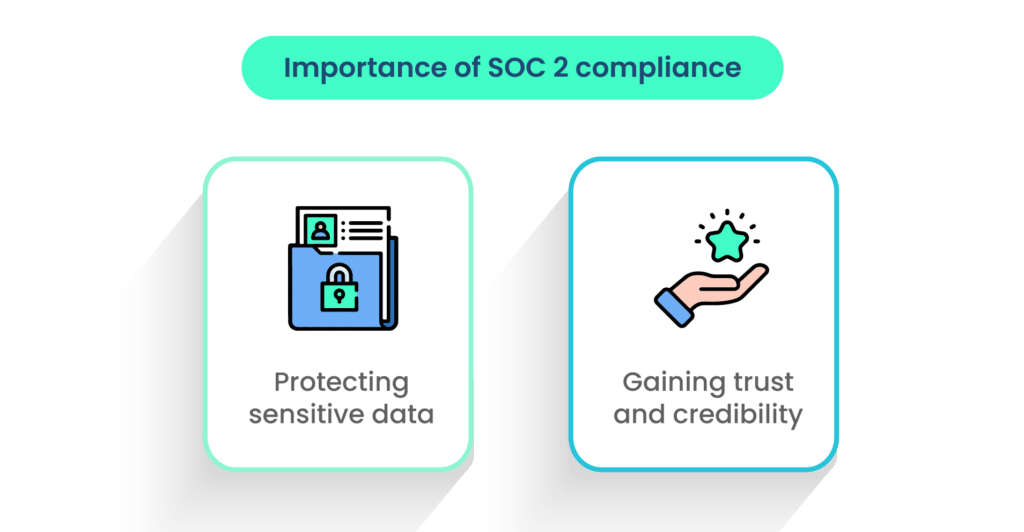
SOC 2 compliance is not only about protecting sensitive data but also about gaining trust and credibility in a competitive business environment. It demonstrates an organization’s commitment to data security and provides reassurance to customers and stakeholders, ultimately contributing to the organization’s long-term success. Let’s see how:

1. Protecting sensitive data

SOC 2 compliance is paramount for organizations that handle sensitive customer data, and here’s why it matters:

  • Data security: SOC 2 focuses on controls related to data security, among other areas. Compliance ensures that an organization has robust measures in place to protect sensitive information from unauthorized access, breaches, or theft.
  • Legal and regulatory obligations: Many industries are subject to specific data protection regulations, such as GDPR, HIPAA, or CCPA. SOC 2 compliance helps organizations meet these legal and regulatory obligations by demonstrating their commitment to safeguarding customer data.
  • Risk mitigation: Data breaches can have severe financial and reputational consequences. SOC 2 compliance helps mitigate these risks by reducing the likelihood of data breaches and the associated legal liabilities and fines.

2. Gaining trust and credibility

SOC 2 compliance goes beyond just protecting data; it also plays a crucial role in building trust and credibility with customers, partners, and stakeholders:

  • Customer expectations: In today’s data-driven world, customers expect the organizations they work with to have robust data protection practices in place. SOC 2 compliance assures customers that their data is in safe hands, fostering trust.
  • Competitive advantage: Being SOC 2 compliant can give an organization a competitive edge. It sets them apart from competitors who may not have undergone the rigorous audit process. Potential clients are more likely to choose a service provider with proven security controls.
  • Third-party assurance: SOC 2 compliance provides an independent assessment of an organization’s controls by a qualified auditor. This external validation adds credibility to the organization’s claims about its data protection measures.
  • Reduced due diligence: When organizations can present a SOC 2 report, it can streamline the due diligence process for potential clients or partners. They can review the report to understand the controls in place, reducing the need for extensive audits and questionnaires.
  • Supplier relationships: Many larger organizations require their suppliers and vendors to be SOC 2 compliant as part of their risk management strategy. Achieving compliance can open doors to partnerships and contracts with these organizations.

Industries that benefit from SOC 2 compliance

SOC 2 compliance benefits a wide range of industries and organizations that handle sensitive customer data or rely on secure and reliable services. Here are examples of industries and their specific use cases for SOC 2 compliance:

SectorUse caseExamples
Technology and SaaS companies:Technology companies, especially those offering Software as a Service (SaaS), benefit significantly from SOC 2 compliance. They can assure customers that their data will be handled securely and reliably.Cloud service providers, online collaboration platforms, data analytics services.
Healthcare and healthcare ITThe healthcare industry has stringent regulations like HIPAA. SOC 2 compliance helps healthcare providers and health IT companies demonstrate their commitment to protecting patients’ sensitive health information.Hospitals, electronic health record (EHR) vendors, and telemedicine platforms.
Financial servicesFinancial institutions handle vast amounts of financial data, making them a prime target for cyberattacks. SOC 2 compliance helps build trust with clients and regulators by demonstrating strong security controls.Banks, credit unions, payment processors, fintech companies.
Data centers and hosting providersData centers and hosting providers store and manage critical data for organizations. SOC 2 compliance ensures the security and availability of these services.Data centers, web hosting companies, cloud infrastructure providers.
Legal and professional servicesLaw firms and professional services companies handle sensitive client information, including legal documents. SOC 2 compliance demonstrates their commitment to confidentiality and data protection.Law firms, accounting firms, consulting firms.
E-commerce and retailE-commerce companies collect and process customer payment information and personal data. SOC 2 compliance assures customers that their financial and personal details are secure.Online retailers, e-commerce platforms.
Education and edtechEducational institutions and technology providers in the education sector handle student and academic data. SOC 2 compliance is crucial for maintaining data privacy and security.Schools, universities, online learning platforms.
Manufacturing and supply chainManufacturing companies often collaborate with suppliers and partners. SOC 2 compliance ensures the security of supply chain data and intellectual property.Manufacturers, suppliers, logistics companies.
Media and entertainmentMedia companies collect user data for personalized content and advertising. SOC 2 compliance helps them protect user privacy and meet legal requirements.Streaming platforms, media networks, advertising agencies.
Government and public sectorGovernment agencies and public sector organizations handle citizens’ sensitive information. SOC 2 compliance is essential to maintain trust and comply with data protection regulations.Government agencies, municipal services, public utilities.

Preparing for a SOC 2 audit

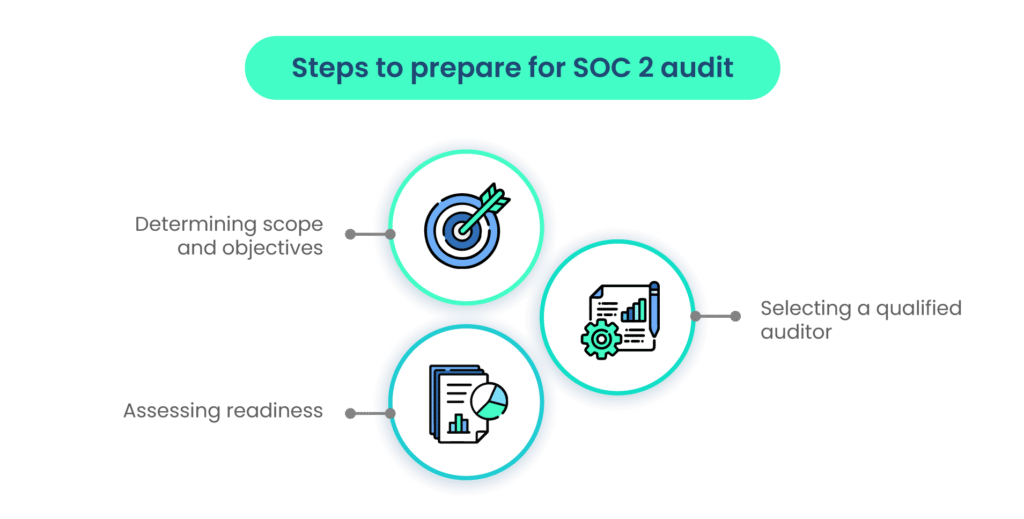
Preparing for a SOC 2 audit is a meticulous process that involves careful planning and assessment of an organization’s controls and practices. Here’s a breakdown of the key steps involved:

A. Determining scope and objectives:

  1. Scope definition: Define the scope of your SOC 2 audit. Determine which systems, processes, and services will be included in the audit. Ensure that you clearly understand which Trust Services Criteria (e.g., security, availability, confidentiality) are relevant to your organization.
  1. Objective setting: Clearly define the objectives you want to achieve through the SOC 2 audit. For example, you may aim to demonstrate data security to gain customer trust or meet regulatory requirements.

B. Selecting a qualified auditor:

1. Qualifications and credentials to look for:

  • CPA designation: Ensure that the auditor holds a Certified Public Accountant (CPA) designation, as this is typically required for SOC 2 audits.
  • Experience: Look for auditors or audit firms with experience in conducting SOC 2 audits for organizations in your industry or with similar service offerings.
  • Reputation: Research the reputation of potential auditors or audit firms. Seek referrals and read client reviews or testimonials.
  • Industry knowledge: An auditor with industry-specific knowledge can better understand the unique challenges and risks in your sector.

2. Interviewing potential auditors:

  • Ask about experience: In the interview, inquire about their experience with SOC 2 audits, especially in your industry. Ask for references from previous clients.
  • Audit approach: Understand their audit methodology, including how they plan to assess controls, conduct testing, and provide recommendations.
  • Timeline and costs: Discuss the estimated timeline for the audit and the associated costs. Ensure transparency in pricing.
  • Communication: Assess their communication style and responsiveness. Effective communication throughout the audit process is crucial.

C. Assessing readiness:

1. Identifying gaps and weaknesses:

  • Current controls: Conduct a thorough assessment of your organization’s existing controls and practices. Identify areas where you may have gaps or weaknesses.
  • Risk assessment: Prioritize identified gaps based on their potential impact on security, availability, confidentiality, and other relevant criteria.
  • Documentation review: Review your existing documentation, policies, and procedures to ensure they align with the Trust Services Criteria.
  • Testing internal controls: Perform internal control testing to validate the effectiveness of your controls. This can help identify areas that may need improvement.

2. Developing a remediation plan:

  • Prioritize remediation: Based on the identified gaps and weaknesses, create a remediation plan that outlines specific actions, responsible parties, and timelines for addressing each issue.
  • Policy and procedure updates: Revise and update policies and procedures to align with the Trust Services Criteria and industry best practices.
  • Training and awareness: Implement training and awareness programs to ensure that employees understand and follow the updated controls and procedures.
  • Testing and validation: Test and validate remediated controls to ensure they are effective and meet the SOC 2 requirements.
  • Continuous monitoring: Establish ongoing monitoring processes to maintain and improve control effectiveness over time.

In conclusion, preparing for a SOC 2 audit requires careful planning, including defining scope and objectives, selecting a qualified auditor, assessing readiness, and developing a comprehensive remediation plan. This thorough preparation is essential to ensure a successful SOC 2 audit and the demonstration of robust data security and privacy controls.

The SOC 2 audit process

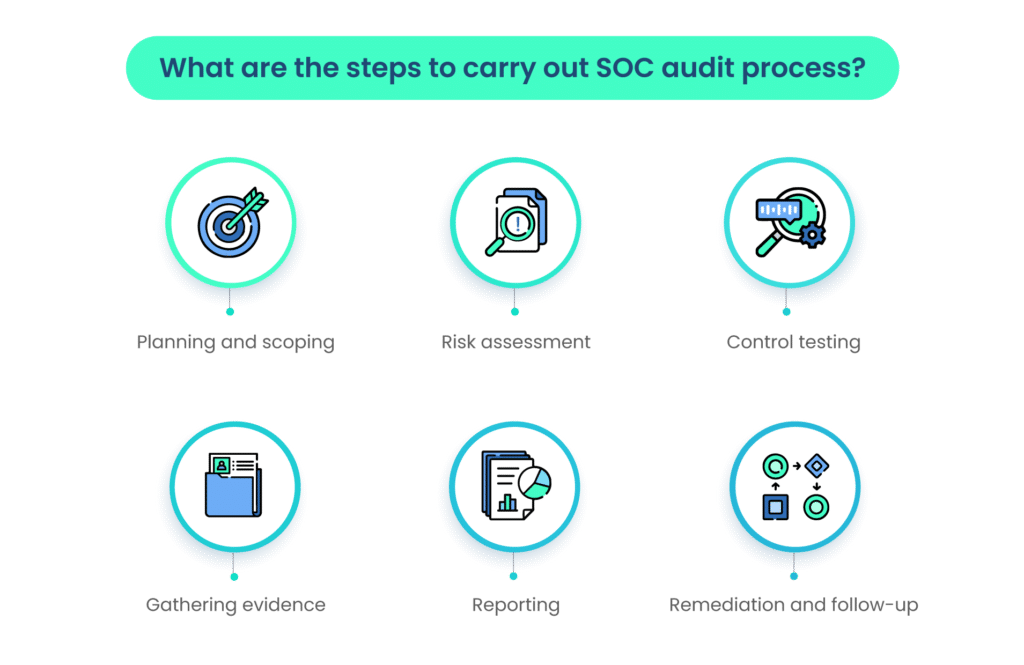
The following are the steps for carrying out the SOC 2 audit process:

A. Planning and scoping

The first step in the SOC 2 audit process is planning and scoping.

1. Defining the audit scope

  • Clearly define the scope of the SOC 2 audit, including the systems, processes, and services to be assessed. Ensure alignment with the Trust Services Criteria that are relevant to your organization.
  • Identify the specific controls and control objectives that will be evaluated during the audit.

2. Establishing the audit timeline

  • Work with the auditor to set a realistic timeline for the audit process. Consider factors such as the complexity of your organization, the scope of the audit, and the availability of key personnel.
  • Define milestones and deadlines for each phase of the audit.

B. Risk assessment

After the first step of planning, the organization should carry out a risk assessment for the SOC 2 audit process.

1. Identifying key risks

  • Conduct a thorough risk assessment to identify potential threats and vulnerabilities related to the Trust Services Criteria.
  • Consider internal and external factors that could impact data security, availability, processing integrity, confidentiality, and privacy.

2. Documenting risk mitigation controls

  • Document the controls and safeguards you have in place to mitigate the identified risks. These controls should align with the TSC and be designed to address specific threats and vulnerabilities.
  • Include policies, procedures, technical safeguards, and physical security measures in your SOC 2 audit checklist.

C. Control testing

Control testing is the next step in the SOC 2 audit process.

1. Evaluating the design and effectiveness of controls

  • Assess the design of controls to ensure they are suitably designed to achieve their objectives. This involves reviewing policies, procedures, and system configurations.
  • Evaluate the operating effectiveness of controls to determine if they are consistently applied and achieve their intended results.

2. Sample selection and testing procedures

  • Select a representative sample of control activities or transactions for testing. The sample should be sufficient to provide assurance about control effectiveness.
  • Conduct testing procedures, which may include examining documents, observing processes, and reviewing system logs.

D. Gathering evidence

The forth step in the SOC 2 audit process is gathering evidence.

1. Documentation and data collection

  • Gather and organize documentation that supports the existence and operation of controls. This may include policies, procedures, logs, and incident reports.
  • Ensure that evidence is well-documented, traceable, and accessible for the auditor’s review.

2. Interviewing employees

  • Interview key personnel to gain insights into control operations and verify that employees are aware of and adhere to security protocols.
  • Document the outcomes of these interviews to provide additional evidence of control effectiveness.

E. Reporting

Reporting is a crucial step in the SOC 2 audit process.

1. Preparing the SOC 2 report

  • Collaborate with the auditor to draft the SOC 2 report, which will typically include an opinion letter from the auditor and a description of the organization’s controls.
  • The report should also detail any identified control deficiencies and their severity.

2. Types of information included

  • The SOC 2 report typically includes an auditor’s opinion on the fairness of management’s description of controls and the suitability of the design and operating effectiveness of those controls.
  • It may also include a description of the scope, the results of control testing, and any recommendations for improvement.

F. Remediation and follow-up

The last step in the SOC 2 audit process is remediation and follow-up.

1. Addressing identified issues

  • Develop and implement remediation plans to address any control deficiencies or weaknesses identified during the audit.
  • Ensure that corrective actions are taken promptly and document the resolution of issues.

2. Continuous improvement

  • Use the insights gained from the audit to drive continuous improvement in your organization’s control environment.
  • Regularly review and update policies and procedures to adapt to changing threats and risks.

Tips for a successful SOC 2 audit

By following the tips given below, organizations can foster a culture of compliance, engage employees in the compliance process, maintain thorough documentation practices, and leverage technology to enhance their readiness for a successful SOC 2 audit. A proactive and collaborative approach to compliance not only ensures audit success but also strengthens an organization’s overall security posture.

A. Building a culture of compliance

  1. Leadership commitment: Start at the top. Ensure that senior leadership is fully committed to compliance efforts and actively communicates the importance of SOC 2 compliance throughout the organization.
  1. Training and awareness: Provide regular training and awareness programs to educate employees about SOC 2 requirements and their role in compliance. Encourage a culture of security and accountability.
  1. Clear policies and procedures: Develop and maintain clear and comprehensive policies and procedures that align with the Trust Services Criteria. Ensure that employees understand and follow these guidelines.
  1. Monitoring and reporting: Implement continuous monitoring mechanisms to detect and address compliance issues proactively. Encourage employees to report any potential concerns or breaches promptly.

B. Engaging employees in the process

  1. Cross-functional teams: Form cross-functional teams that include representatives from IT, security, legal, and other relevant departments. This collaborative approach ensures a holistic view of compliance efforts.
  1. Communication channels: Establish open lines of communication where employees can ask questions, seek clarification, and report potential issues without fear of reprisal.
  1. Ownership and accountability: Assign ownership of specific compliance tasks and controls to responsible individuals or teams. Clearly define roles and responsibilities.
  1. Incentives and recognition: Recognize and reward employees who actively contribute to compliance efforts. This can foster a sense of ownership and pride in maintaining security controls.

C. Documentation best practices

  1. Version control: Maintain version control for policies, procedures, and documentation. Clearly label and date each revision to ensure that the most up-to-date information is used.
  1. Centralized repository: Create a centralized and easily accessible repository for compliance-related documents. This facilitates document retrieval and audit readiness.
  1. Record keeping: Keep detailed records of all compliance-related activities, including control testing, risk assessments, and employee training. These records serve as evidence during the audit.
  1. Regular review: Periodically review and update the documentation to reflect changes in regulations, technology, or business processes. Ensure that documentation remains accurate and relevant.

D. Leveraging technology for compliance

  1. Security tools: Implement security and compliance tools that help automate and streamline control monitoring and reporting. These tools can aid in continuous monitoring and alerting.
  1. Data encryption: Use encryption technologies to protect sensitive data at rest and in transit. Ensure that encryption protocols align with SOC 2 requirements.
  1. Access control: Implement robust access control mechanisms to restrict data access to authorized personnel only. Regularly review and update access privileges.
  1. Audit trails: Maintain comprehensive audit trails that log and monitor critical events and changes in your IT environment. These logs can be valuable for demonstrating control effectiveness.
  1. Vulnerability management: Utilize vulnerability scanning and patch management solutions to proactively identify and address security vulnerabilities.

Common challenges and how to overcome them

ChallengeDescriptionSolution
Lack of awareness and understanding
Many organizations may lack awareness of SOC 2 and may not fully understand its significance or requirements.Education and training: Invest in training programs to educate key personnel about SOC 2, its objectives, and its relevance to your organization.
Engage experts: Seek guidance from experienced consultants or auditors who can explain the requirements in a clear and understandable manner.
Internal communications: Foster open communication channels to ensure that all employees understand the importance of SOC 2 compliance and their roles in achieving it.
Resource constraintsResource limitations, including budget and staffing, can hinder an organization’s ability to prepare for and undergo a SOC 2 audit.Prioritization: Prioritize compliance efforts based on risk and criticality. Focus resources on the most critical controls and systems first.
Efficiency tools: Utilize technology and automation to streamline compliance tasks and reduce the burden on staff.
Outsourcing: Consider outsourcing specific compliance tasks or engaging third-party experts to conduct assessments, which can be cost-effective.
Evolving regulatory landscapeThe regulatory landscape is constantly changing, with new laws and regulations impacting data security and privacy.Continuous monitoring: Establish a robust monitoring system to stay informed about regulatory updates. Subscribe to industry newsletters and government notifications.
Legal counsel: Engage legal counsel with expertise in data protection and compliance to provide ongoing advice and guidance.
Scalable framework: Develop a compliance framework that is flexible and scalable, allowing you to adapt to new regulations as they emerge.

To refer to our article on seven ways to accelerate your SOC 2 compliance process, click here.

Conclusion

In summary, SOC 2 audits are crucial for ensuring data security and reliability in today’s digital age. They provide assurance to customers, partners, and stakeholders about an organization’s commitment to safeguarding sensitive data.

SOC 2 compliance matters because it protects data, ensure legal adherence, mitigates risks, and builds trust and credibility. It benefits a wide range of industries, from technology and healthcare to finance and government.

Preparing for a SOC 2 audit involves careful planning, selecting auditors, assessing readiness, and creating remediation plans. A proactive approach to compliance, involving a culture of compliance, engaged employees, thorough documentation, and technology, is essential for success.

Ready to fortify your data security and gain trust through SOC 2 compliance? Connect with Scrut today and take the first step towards safeguarding your organization’s sensitive data.

FAQs

1. What is SOC 2 compliance, and why is it important?

SOC 2 compliance is a framework for evaluating and reporting on the controls and practices of service organizations related to data security, availability, processing integrity, confidentiality, and privacy. It’s essential because it demonstrates an organization’s commitment to protecting sensitive data, which is crucial in an era of increasing data breaches and cybersecurity threats.

2. Who needs SOC 2 compliance?

Organizations that handle sensitive customer data or rely on secure and reliable services can benefit from SOC 2 compliance. This includes data centers, cloud service providers, SaaS companies, healthcare providers, financial institutions, and many others.

3. What are the key components of a SOC 2 audit report?

A SOC 2 audit report typically includes an auditor’s opinion on control design and effectiveness, a description of the scope, results of control testing, and any identified control deficiencies. It may also provide recommendations for improvement.

Authored by

Aayush Ghosh Choudhary
Co-founder & CEO at Scrut

SOC 1 vs SOC 2 vs SOC 3

Due to the newfound emergence of cloud computing and data centers, organizations rely on service providers to streamline their day-to-day operations and ensure continued functionality. However, with the ease and convenience of these third-party service providers, the degree of inherent risk has also increased.

Last year, Volkswagen Group of America had a data breach. Over 3 million customers were affected, and 97% were Audi customers and potential buyers. They later revealed that one of their vendors had left unsecured data on the internet.

Security incidents like this can negatively impact a third-party service provider by causing ripple effects that last for months or even years. To ensure the internal controls are operative and effective, all third-party services must conduct a System and Organization Controls (SOC) audit.

The American Institute of Certified Public Accountants (AICPA) has designed SOC reports – SOC 1, SOC 2, and SOC 3 – wherein an independent CPA evaluates the organization. This is aimed to help organizations build trust and confidence in their services. Before comparing each type of report, let’s find out what they stand for.

What are SOC 1, SOC 2, and SOC 3 reports?

A SOC 1 report is based on the SSAE 18 standard. It reports on the effectiveness of internal controls at a service organization relevant to the client’s internal control over financial reporting (ICFR).

A SOC 2 report evaluates internal controls, policies, and procedures that directly relate to the security of a system at a service organization. This report was based on 5 Trust Service Criteria: security, availability, processing integrity, confidentiality, and privacy.

Similar to SOC 2, the SOC 3 report has been developed based on AICPA’s 5 Trust Service Criteria. It is a public report of internal controls over security, availability, processing integrity, and confidentiality.

Below is a tabular summary of usage, control objectives, and distribution of SOC 1, SOC 2, and SOC 3 reports.

Report TypeUseControl objectives Distribution 
SOC 1Systems processing transactions that affect their customers Internal Controls over Financial Reporting. Ex: Payroll processingDefined by service organization Users of the system and their auditors
SOC 2Systems processing transactions that affect the security, availability, processing integrity, confidentiality, and privacy of customer data. Ex: Cloud services & SaaS providersDefined by the AICPA as Trust Services CriteriaUsers of the system and their auditors
SOC 3This functions the same way as a SOC 2 report, the only difference is that it can be used for marketing compliance to the general public. Ex: Cloud services & SaaS providersDefined by the AICPA as Trust Services CriteriaAnyone

To properly distinguish between the three types of SOC reports, it is imperative to have a detailed understanding of each.

SOC 1 report: Overview

SOC 1 compliance secures a service organization’s interaction, transmission, or storage of users’ financial statements. A SOC 1 report helps management, investors, auditors, and customers evaluate internal controls that pertain to financial reporting based on the guidelines laid out by the AICPA.

This report consists of two types: SOC 1 Type 1 and SOC 1 Type 2

SOC 1 Type 1 audit evaluates an organization’s systems and produces a point-in-time assessment of the controls on a specific date.

In comparison, a SOC 1 Type 2 audit covers the operating effectiveness of the controls over a specific period.

A SOC 1 audit is conducted by an independent and licensed Certified Public Accountant to examine the service organization’s system-level and entity-level controls. The auditor determines whether the organization has defined its structure and if it has performed formal risk assessments. It also cross-checks if the organization has implemented policies and procedures to address all mentioned controls.

Who is SOC 1 audit for?

Here is a list of types of organizations that SOC 1 audit is applicable for (but not limited to)

  • Cloud service providers
  • Data centers
  • SaaS companies
  • Payroll administrators
  • Collection agencies
  • Fulfillment companies
  • Loan processors
  • Medical claim processors
  • Accounting and financial services

Why is SOC 1 report important?

Achieving SOC 1 compliance shows that organizations can securely interact with, transmit, and store the financial statements of customers. It shows the management, auditors, investors, and clients that the organization’s internal controls meet AICPA’s guidelines.

Benefits of SOC 1 report:

  • Helps the organizations to verify that they have appropriate controls to deliver high-quality services.
  • Helps in identifying vulnerabilities in systems and provides remediation for the same.
  • Evaluates the policies and procedures.
  • Strengthen infosec posture and minimize the risk of data breaches.
  • Builds trust between service providers and the organization.
  • Strengthens the organization’s environment and ensures they adopt industry best practices.

SOC 2 report: Overview

A SOC 2 audit is responsible for ensuring whether service providers are securely managing customers’ data. Like SOC 1, this report is also divided into two types: SOC 2 Type 1 and SOC 2 Type 2

  • A SOC 2 Type 1 report determines if an organization’s system controls are correctly designed.
  • A SOC 2 Type 2 report, on the other hand, checks if those controls function as intended.

SOC 2 reports differ from other information security standards and frameworks. They are based on 5 Trust Service Criteria – security, availability, processing integrity, confidentiality, and privacy – developed by the AICPA. It means that any service organization can choose to demonstrate they have controls in place to mitigate risks to the service they provide. Among the 5 TSCs, all the SOC 2 reports must include a security trust service. The other 4 TSCs are optional and can be added to the examination at the discretion of management.

Who is SOC 2 audit for?

Here is a list of types of organizations that can apply for SOC 2 audit (but not limited to);

  • SaaS providers
  • Cloud service providers
  • Managed IT and security service providers
  • Organizations that store customer’s information in the cloud
  • Organizations that provide business intelligence, analytics, and management services

Why is SOC 2 audit important?

A SOC 2 audit is conducted by an independent, licensed Certified Public Accountant (CPA) to evaluate if the organizations adhere to best practices when securing sensitive internal and customer data.

Benefits of SOC 2 report:

  • It builds brand reputation – SOC 2 report is evidence that the organization has taken all necessary measures to prevent a data breach.
  • Having a SOC2 report gives organizations an edge over others in the industry.
  • It increases transparency and visibility for customers, thereby unlocking infinite sales opportunities.
  • Provides valuable insights into your organization’s risks like security posture, vendor management, internal controls, governance, and regulatory oversight.

What are SOC 2 Trust Service Criteria (TSC)?

To achieve SOC 2 reportnd meet the latest SOC 2 report framework standards, organizations must implement Trust Service Criteria (TSC). TSC is a framework for designing, implementing, and evaluating information system controls. There are five trust service criteria, and they are as follows;

  • The security trust criteria help in protecting information throughout its course in an organization. It protects the data from unauthorized access or disclosure.
  • The availability of trust criteria determines whether the organization’s employees, clients, and partners can rely on its systems to do their work.
  • The processing integrity trust criteria is focused on data accuracy and the completeness of the end-to-end process of ensuring that applications function without delay, error, omission, or accidental data manipulation.
  • The confidentiality trust criteria evaluate how organizations protect confidential information – limit access, storage, and use. It ensures that only authorized individuals can view sensitive information like legal documents or Personally Identifiable Information (PII).
  • The privacy trust service criteria evaluate how organizations protect customers’ personal information like name, address, email and any other identification info.

Cyber security culture requires management and employees to speak the same language and have a shared knowledge of their company’s business and goals. Transparency will be essential. That is why a cyber security culture must be established with people rather than imposed upon them. The program’s management team must include a mix of technical, administrative, and other expertise. They must be thoroughly aware of the firm, its goals, and the dangers it faces. It is valid for both minor threats and focused assaults.

SOC 3 report: Overview

Similar to SOC 2, SOC 3 reports are for reporting on controls based on 5 Trust Service Criteria (TSC) – security, availability, processing integrity, confidentiality, and privacy.

However, they are written for people with a general interest in the service organization without getting into the specific details about the controls. Unlike SOC 1 and SOC 2, SOC 3 reports can be distributed publicly, and the audited companies can use them for marketing purposes.

Who is SOC 3 audit for?

Here’s a list of organizations that are applicable to the SOC 3 audit (but not limited to);

  • Cloud service provider
  • Data center colocation facility
  • IT systems management who want to communicate controls effectively minus the complexity of a SOC 2 report.

SOC 1 and SOC 2: Differences

A SOC 1 report is for organizations whose internal security controls impact a customer’s financial statements. It assures customers that their information is handled securely.

On the other hand, SOC 2 reports are used to meet the needs of a broad range of users who are involved with the service organization’s controls relevant to the Trust service criteria (TSCs) outlined by the AICPA.

Both SOC 1 and SOC 2 reports help the organizations attest that their security controls are in place. SOC 1 and SOC 2 both offer Type I and Type II reports.

SOC 2 and SOC 3: Differences

Since the same AICPA standards govern SOC 2 and SOC 3 reports, the audit performed by the CPA for these two reports is quite similar.

The only difference between these two reports is the information that goes within the report.

SOC 2 reports are restricted reports intended for the use of the service organization’s management, auditors, and customers. Whereas SOC 3 report is a general use report that can be distributed freely by the organization.

SOC 3 reports do not have detailed descriptions of the controls tested by the auditor. Thus, the test procedures and the results of the test procedures are publicly available.

What are the best ways to accelerate the SOC 2 audit process?

SOC 2 audit can be a long-winded process, but here are a few steps your organization can take to accelerate it.

  • Avoid Analysis paralysis
  • Select SOC 2 report type
  • Find an auditor
  • Choose TSCs
  • Create Timelines
  • Choose the right project manager
  • Get executive buy-in

You can find more details on ways to accelerate the SOC 2 audit process here.

Closing thoughts

It can be difficult for organizations to choose which SOC audit to go for, and understandably so. Which is why, we recommend you get in touch with experts at Scrut to understand what SOC audit works best for your organization and why.

Scrut Automation is an innovative and radically simple governance, risk and compliance automation platform for growing startups and mid-market enterprises. With Scrut, compliance teams can reduce ~70% of their manual effort in continuously maintaining compliance towards SOC 2, ISO 27001, GDPR, PCI DSS, HIPAA, and CCPA. Schedule your demo today to see how it works.

Authored by

Aayush Ghosh Choudhary
Co-founder & CEO at Scrut

How to develop an effective vendor management policy?

Vendor management is one of the most overlooked facets of risk management. Incidentally,  these vendors become an entry point for hackers. Organizations need to be aware of how many vendors and their employees have access to the organization’s sensitive data.

Keeping this in mind, organizations are making data secure yet accessible to vendors by creating a vendor management policy (VMP). As the term suggests, the primary goal of vendor management policies is to manage and assess vendors to safeguard the sensitive information in the organization’s network. 

That said, many elements go into creating an effective, applicable, and useful vendor management policy. So, sit tight as we walk you through the entire vendor management process, including how to use the vendor management policy and its best practices. 

What is a vendor management policy? 

Vendor Management Policy (VMP) is a method for organizations to identify and prioritize vendors that pose a risk to an organization’s business.

Through this policy, organizations prescribe controls to identify vendors to minimize risk and ensure compliance with popular information security frameworks like SOC 2. Vendor Management Policies play a vital role in maintaining an organization’s overall compliance risk management strategy. So, it would be wrong to assume that VMPs are a simple addition to your journey toward compliance.

But this apart, why do organizations need a vendor management policy? 

Why do organizations need a vendor management policy? 

Why do organizations need a vendor management policy?

A vendor management policy aims to pinpoint which vendors constitute a risk to your organization and then specify procedures to reduce the identified third-party risk. While that is a huge reason organization should implement a vendor risk management policy, there are more benefits organizations can reap. 

1. Ensure legal compliance

Each industry, be it finance, healthcare, retail, energy, and even others, have its legal compliance requirements. If these compliance requirements are not timely and duly satisfied, an organization might face trouble in terms of revenue loss, fines, and/or data breaches. 

Regulators will not oversee whether you or your vendor made a mistake; non-compliance could result in lawsuits for both parties involved. With a vendor management policy in place, you will be safe from legal complications by assessing the security posture of vendors beforehand.

2. Secure sensitive data

If your organization stores, uses, or accesses clients’ personal data, you should be concerned about the exposure of said data, especially with vendors. Most organizations outsource part/s of their operations to vendors to save costs or to leverage the expertise that they have after working in the industry. 

For this to be done successfully, sharing company data and, often, customer data is inevitable. However, one misstep from either of your vendors can put your customers’ data at risk and expose your organization to hackers and cyber-criminals. A vendor management policy acts as a combat against this while onboarding vendors. 

3. Improve visibility into the vendor network

Organizations should be aware of the security vulnerabilities third-party vendors bring into the organization. A proper vendor management policy enables an organization to know, prepare and reduce the related risks. 

It also allows organizations to understand whether vendors are enhancing the security posture, thereby solidifying or eliminating their position in the vendor network. 

4. Minimize data breach costs

Data breaches are costly, and it is important to prevent them. Vendors are/can be the primary source of data breaches. An optimized vendor management policy can save the day. Not only can IT vendor management policy effectively limit data breach costs, but it can also reduce the likelihood of data breaches. 

How to create an effective vendor management policy? 

To create an effective vendor management policy, organizations should follow these steps. 

1. Putting together a team 

It is the first step to developing a successful vendor management policy and controlling your third-party relationships. The main idea is to have a well-established team with members from different departments such as IT and security, finance, legal, and compliance.

connect the members from different departments to give the idea that they belong to one team

2. Vendor evaluations are a must 

Moving ahead with vendor management policy is credible only when you have an insight into the current vendors. By including vendor evaluations in your vendor management strategy, your firm can better understand the risks associated with using a vendor’s product or service.

3. Audit your existing vendor relationships

The next step is auditing your existing vendor relationships, which includes identifying all current contractors, suppliers, and other third parties in business with any part of your organization. 

Audit your existing vendor relationships

Asking these questions will provide you with the resources to understand the scope and magnitude of risk posed by your vendors. Once that information is attained, you can create a third-party vendor management policy. 

What should be included in the vendor management policy? 

Vendor management is more than a one-stop finish process. To ensure that you are effectively managing your vendors, here are a few elements you should consider incorporating while creating and implementing a vendor management policy in your organization. 

1. Purpose of the policy

This will provide an overview of what the management policy will consist of. You can consider this section as a thesis statement or a description that holds the list of all elements that are to be included in the vendor management policy. 

2. The audience and scope of the policy

The second element is that organizations must clearly define who falls under the jurisdiction of the vendor management policy. Create a master list of all your current vendors and potential future acquisitions, using which you can carve out the audience and scope of your vendor management policy. 

3. Division of roles and responsibilities

Most organizations divide their employees into two groups; one group enforces the vendor management policy, and the other reviews and updates it. You can assign specific roles and responsibilities within these broad groups for a clear understanding. 

Division of roles and responsibilities

4. Add precise terminology

Prepare a formal glossary of terms that your organization uses in the policy. This will benefit your organization in two ways; firstly, the meaning of terms for anyone reviewing the policy in the future will be evident and apparent, and secondly, it will present your understanding of the third party in clear and structured terms.

5. Include the vetting process

This section of the policy specifies the processes used by your organization to assess and study a vendor before dealing with them. It primarily includes information on non-disclosure agreements between the parties, details on the data access provided to the vendors, what will entail if vendor assessment provides high-risk results and how many times vendor assessment will take place.

6. Enlist all vendor management information

All processes involved, from the onboarding of a new vendor to the deboarding of a current vendor, must be specified under this section. You can include statements concerning minimum information requirements, instructions for destroying or disposing of the organization’s data, and incident response criteria.

7. Enforcement of the policy

One of the last elements that you must include to make your vendor risk management policy effective is enforcement. Along with the details of policy execution, this section should also spell out the ramifications of a vendor’s failure to follow the policy. It might entail contract termination, access privileges withdrawal, or other civil or criminal sanctions.

How to use the vendor management policy to assess new vendors? 

Many organizations do not have the bandwidth to overlook third parties, which helps them go under the radar and conduct harmful practices. Your networks could be compromised by their security procedures, subjecting your organization to financial, legal, and regulatory repercussions.

vendor management policy

Therefore, each organization must assess whether a potential vendor satisfies an acceptable risk threshold before closing a deal with them. The vendor management team will have to conduct an assessment in accordance with the vendor management policy.

The level of risk connected with the vendor’s participation will determine how in-depth this assessment needs to be. Vendors with restricted access to networks or data may not pose a significant risk and would only need to answer a short questionnaire.

On the other hand, high-risk suppliers who interface their systems with your networks or access personal identifying information (PII) and sensitive information from your firm will require a thorough examination. They may be required to submit to security audits, penetration tests, and other means of verifying their security posture and integrity.

Best practices to follow to improve vendor management 

Whether you operate with a single vendor or many, failing to have a vendor management policy puts your company at risk. To avoid putting your organization at the threshold of third-party threats, you must follow some best practices to develop or improve your existing vendor management policy. 

  • Have a contingency plan in place in case of vendor service failures: Your organization must be ready to act wisely in case a vendor exposes your networks to threats. Assign duties and responsibilities to employees and create an incident response plan beforehand by studying the impact of the vendor’s product in different sectors of your firm. 
  • Dedicate a full-time manager for vendor relationships: As you expand your management team, you should aim to assign a dedicated manager to each of your vendors. This will be advantageous from a managerial standpoint, especially in the long term.
vendor relationships manager
  • Keep your policy simple and straightforward: A vendor management policy should provide a general picture of how you intend to manage vendors. 
  • Ensure that all vendors are held to the same standards: It’s critical that all of your vendors have the same set of rules when it comes to risk management. Those posing major hazards should receive additional attention from stakeholders.
  • Keep your policy up to date: As business processes evolve, ensure that your vendor management policy is updated on a regular basis. If quarterly or semi-annual updates aren’t practicable, strive to update your vendor management policy at least once a year.

Is simply implementing a vendor management policy in my organization enough to tackle third-party risks? This is a question most organizations ask themselves, and rightfully so because vendor management policies help in bringing third-party risk under control, but they are only successful if you have the systems or tools to monitor vendor compliance continuously. This is where Scrut comes in! 

Scrut is an innovative and radically simple governance, risk, and compliance automation platform for growing startups and mid-market enterprises. With Scrut, compliance teams can reduce ~70% of their manual effort in continuously maintaining compliance towards SOC 2, ISO 27001, GDPR, PCI DSS, HIPAA, and CCPA. Schedule your demo today to see how it works.

Frequently Asked Questions (FAQs)

1. What are the consequences of not having an effective vendor management policy in place? 

In the absence of a vendor management policy, organizations may have to spend a lot of resources to remediate damage caused by cyberattacks, with third parties being some of the most common sources. Aside from monetary penalties, a security breach can have long-term legal and regulatory consequences for your company, not to mention reputational damage and loss of customer trust.

2. What are critical vendors, and how can organizations manage them? 

A critical vendor is any vendor who can expose an organization to significant risk if the third party fails to meet expectations or has a significant impact on customers. Organizations must pay close attention to these vendors and manage their security practices constantly. Having an incident response plan is essential when critical vendors are involved. 

3. What is a good vendor risk management policy example? 

Every organization has its own network of vendors, which they substantially manage and control. A good vendor management policy example will involve a procedure where all the elements mentioned in the article above are included and implemented, such as purpose, scope, division of roles and responsibilities, vetting requirements, and enforcement.

Authored by

Aayush Ghosh Choudhary
Co-founder & CEO at Scrut

Cultivating a Culture of Cybersecurity Awareness

In today’s increasingly digital world, the significance of cybersecurity culture cannot be overstated. It goes beyond just implementing robust technical solutions and firewalls. 

Cyber threats continue to evolve, and a strong defense requires more than just technology; it demands a change in organizational culture. 

An effective cybersecurity culture ensures that every employee, from the C-suite to the interns, is aware of the role they play in safeguarding sensitive information. It’s a proactive approach to security that fosters an environment where security is not just the responsibility of the IT department but a collective commitment. 

In this blog, we’ll explore why cybersecurity culture is crucial and how to cultivate it within your organization.

Understanding the security mindset

A security mindset is a fundamental component of a robust cybersecurity culture. It represents the organization’s collective attitude and approach to cybersecurity, emphasizing that security is everyone’s responsibility. 

It goes beyond compliance checklists and delves into the realm of active vigilance, where employees are not only aware of potential threats but are also prepared to respond to them. 

Having a security mindset means being cautious, informed, and willing to take the necessary actions to protect sensitive data. It’s about fostering a culture where cybersecurity is integrated into daily operations, becoming second nature to employees, much like workplace safety practices. This security mindset creates a dynamic defense against ever-evolving cyber threats.

Components of a security mindset-cybersecurity culture

Building a strong cybersecurity culture requires a deep understanding of the key components that form the foundation of a security mindset within an organization. 

1. Cybersecurity risk mitigation strategies 

A security mindset forms the foundation for implementing effective cybersecurity risk mitigation strategies. When employees understand and embrace their role in safeguarding the organization, the likelihood of cyber threats causing significant damage is greatly reduced.

2. Data protection

In an era where data is an invaluable asset, a security-conscious workforce plays a pivotal role in data protection. A security mindset ensures that employees prioritize data security and handle sensitive information with the utmost care.

3. Regulatory compliance

Compliance with cybersecurity regulations is non-negotiable for many industries. A security mindset ensures that all employees are aware of these regulations and actively adhere to them, reducing the risk of legal complications.

4. Employee training and awareness

The foundation of a strong cybersecurity culture is the awareness and training of employees. Security training programs equip your workforce with the knowledge and skills to recognize potential cybersecurity threats and respond appropriately. 

This includes understanding the dangers of phishing attacks, recognizing suspicious behavior, and knowing how to report security incidents. By investing in ongoing security awareness training, you empower employees to become the first line of defense against cyber threats. 

Additionally, regular training sessions can help keep employees updated on emerging threats and best practices, ensuring that cybersecurity remains a top priority.

5. Leadership commitment

Building a cybersecurity culture starts at the top. Senior management should lead by example when it comes to cybersecurity. When leaders demonstrate a strong commitment to security, it sets a powerful precedent for the entire organization.

Leadership commitment is paramount for fostering a security-focused environment. When leaders prioritize and actively support cybersecurity initiatives, it sends a clear message throughout the organization. It demonstrates that cybersecurity is not just an IT concern but a fundamental business objective. 

Leaders can set an example by adhering to security policies, engaging in training, and openly discussing the importance of cybersecurity. Their commitment reinforces the security mindset and motivates employees to follow suit.

6. Open communication channels

Effective communication channels and reporting mechanisms are integral to a cybersecurity culture. Employees need to feel comfortable reporting potential security incidents or concerns without fear of repercussions. 

Establish a clear process for reporting incidents, and ensure that it is well-communicated throughout the organization. Open lines of communication foster transparency, allowing issues to be addressed promptly. 

Moreover, regularly sharing information about the latest threats and best practices keeps employees informed and alert.

Encourage employees to report cybersecurity incidents or express concerns without fear of repercussions. Accessible communication channels can be the first line of defense.

7. Shared responsibility

Promote the concept that security is everyone’s responsibility. Employees should understand that their actions directly impact the organization’s cybersecurity posture.

8. Recognition and rewards

Recognize and reward employees who exemplify a strong security mindset. Incentives, acknowledgments, or cybersecurity certifications can motivate individuals to stay vigilant.

9. Clear policies and procedures and regular updates

Well-defined security policies and procedures provide employees with a roadmap for safeguarding sensitive information. These documents outline expectations, responsibilities, and consequences for non-compliance. 

Clear policies help standardize security practices across the organization, ensuring everyone is on the same page. Employees should be aware of the policies that govern their use of technology and the handling of data. 

Regular reviews and updates of these policies are essential to adapting to evolving threats and technologies.

Keep cybersecurity policies, protocols, and cybersecurity mitigation strategies up-to-date. The digital landscape evolves rapidly, so it’s crucial that your security measures evolve with it.

How to build cybersecurity awareness

Building cybersecurity awareness includes several measures:

A. Ongoing employee training

Employee training is the cornerstone of building cybersecurity awareness within your organization. It equips your workforce with the knowledge and skills they need to recognize and respond to cyber threats effectively. 

Training should cover a wide range of topics, from understanding phishing attacks to practicing secure password management. Moreover, it should be an ongoing process, as the cybersecurity landscape is continuously evolving. 

Regular training sessions keep employees informed about emerging threats and reinforce the importance of their role in the organization’s security. A well-trained workforce serves as a vital layer of defense against cyberattacks.

B. Raising cybersecurity awareness among leadership

Cybersecurity awareness should extend to all levels of your organization, including leadership. Leaders set the tone and direction for the entire workforce, and their commitment to cybersecurity initiatives is crucial. 

By engaging leadership in cybersecurity training and discussions, you ensure that security is a top-down priority. Leadership should not only support cybersecurity but actively participate in discussions and initiatives. This approach reinforces the importance of cybersecurity and encourages employees at all levels to follow suit.

C. Develop and communicate security policies

Well-defined security policies are the guiding principles of your cybersecurity culture. These policies outline the expectations, responsibilities, and best practices for safeguarding sensitive information. However, having policies alone is not enough; they must be effectively communicated throughout the organization. 

Employees should be aware of the policies that govern their use of technology and data handling. Regular reviews and updates of these policies ensure that they remain relevant and adaptable to emerging threats and technologies.

D. Encourage reporting of security incidents

Encouraging the reporting of security incidents is a vital component of building cybersecurity awareness. Employees need to feel comfortable reporting potential security threats or concerns without fear of reprisal. 

Establish a clear process for reporting incidents and ensure that it is well-communicated throughout the organization. 

An open reporting culture promotes transparency and allows issues to be addressed promptly. It also serves as a valuable feedback loop, helping organizations identify areas that require additional training or security measures.

Challenges encountered when nurturing a security mindset

Nurturing a security mindset is a crucial aspect of safeguarding an organization’s digital assets, yet it is not without its challenges. 

A. Employee resistance to cybersecurity initiatives

Resistance to cybersecurity initiatives can be a common challenge in building a culture of cyber awareness. Some employees may view these initiatives as cumbersome or intrusive, potentially leading to resistance. 

Overcoming this resistance requires effective communication and leadership support. Explain the rationale behind cybersecurity measures, emphasizing their role in protecting sensitive data and the organization’s reputation. Show employees that these measures are not just for compliance but are fundamental to safeguarding the organization and their jobs.

B. Human error and negligence elements in security risks

Human error and negligence are significant contributors to security risks. Despite the best technical safeguards, individuals can inadvertently compromise security through actions such as clicking on malicious links or mishandling data. 

To address this challenge, organizations should focus on comprehensive security awareness training. Educate employees about the potential consequences of their actions and how they can actively mitigate security risks.

C. Ongoing effort required to maintain a culture of cyber awareness

Maintaining a culture of cyber awareness is an ongoing effort. It requires continuous reinforcement and adaptation to evolving threats. 

One common pitfall is assuming that once a cybersecurity culture is established, it will sustain itself. To maintain the culture, organizations should regularly update training, policies, and communication strategies. 

Additionally, the cybersecurity culture should align with the organization’s overall mission and values, emphasizing that security is a shared responsibility for all employees.

In the upcoming sections, we’ll explore each of these components and challenges in more detail, offering insights and strategies to nurture a culture of cybersecurity awareness.

Measuring success of cybersecurity culture in an organization

Identifying and measuring the right key metrics is indispensable when evaluating the effectiveness of a cybersecurity culture in an organization, providing valuable insights into its security practices and overall preparedness.

Key metrics for evaluating cybersecurity culture

Measuring the success of your organization’s cybersecurity culture is essential to ensuring its effectiveness. Key metrics help assess the impact of your cybersecurity initiatives and employee engagement. These metrics may include:

What are some good cyber security habits?
Cyber hygiene workshops: Organize engaging workshops to teach employees the basics of cyber hygiene and reward those who excel.
Cybersecurity champions: Appoint experts as cybersecurity champions who can guide and educate their teams.
Security task force: Create a task force to discuss threats, vulnerabilities, and solutions through cross-departmental collaboration.
Phishing drills: Conduct surprise drills to test employees’ ability to spot phishing emails.
Reporting culture: Encourage a culture of incident reporting without fear of repercussions, making it easy and anonymous.

Examples of successful cybersecurity cultures

Examining organizations with successful cybersecurity cultures can provide valuable insights into what works. Several renowned companies have excelled at nurturing a strong culture of cyber awareness. 

For instance, Microsoft is known for its robust security culture, which encompasses regular training, strict policies, and a strong incident response framework. 

Google is another example, emphasizing cybersecurity as a shared responsibility and fostering a culture of continuous improvement. 

By studying these success stories, organizations can adapt best practices and cybersecurity strategies to enhance their own cybersecurity cultures.

Cisco Systems is renowned for its holistic approach to cybersecurity culture, emphasizing education and shared responsibility. 

Adobe Systems is another company that consistently invests in cybersecurity training and communication, empowering employees to actively participate in security efforts. By learning from these examples, organizations can gain insights on the practical steps and initiatives that contribute to robust cybersecurity cultures.

Strategies for building and sustaining cyber awareness

Building and sustaining cyber awareness requires a strategic approach. To help organizations in this endeavor, experts recommend:

Building a cybersecurity culture: An ongoing journey

Nurturing a cybersecurity culture is an ongoing journey, not a one-time project. Organizations must commit to continuous improvement, adapt to emerging threats, and refine their strategies for building awareness. Success in this endeavor significantly contributes to overall cyber resilience and data protection.

Cybersecurity is not solely the responsibility of IT departments but a shared duty that spans across all employees. By prioritizing cyber awareness and investing in training, policies, and a vigilant workforce, organizations can better protect themselves from cyber threats and maintain the trust of their stakeholders.

Wrapping up

Cultivating a security mindset is an ongoing process that requires unwavering commitment from an organization. By fostering a culture where cybersecurity is embedded in the organizational DNA, organizations can significantly mitigate cybersecurity risk and ensure the safety of sensitive data. 

In an era where cyber threats are ever-looming, developing good cybersecurity habits and actively nurturing a cybersecurity culture is not an option but a necessity. 

In doing so, you empower your workforce to be the first line of defense against cyber adversaries, bolster your cybersecurity risk management strategies, and fortify your organization’s cybersecurity posture.

Scrut can help you with aspects of cybersecurity like employee awareness and risk management. Schedule a demo today to see how it works!

Frequently Asked Questions

1. What is a cybersecurity culture, and why is it essential for organizations?

A cybersecurity culture refers to the shared values, attitudes, and behaviors within an organization that prioritize and promote cybersecurity awareness and best practices. It is essential because it empowers employees to actively participate in protecting the organization from cyber threats.

2. What are the key components of a cybersecurity culture?

The key components include employee training and awareness, leadership commitment, clear policies and procedures, and effective communication and reporting mechanisms. These elements collectively contribute to a strong culture of cyberawareness.

3. How can organizations raise cybersecurity awareness among employees and leadership?

Organizations can raise awareness through continuous training and education programs tailored to different roles. Leadership plays a crucial role by actively supporting cybersecurity initiatives and demonstrating their commitment to a secure environment.

4. What challenges and common pitfalls should organizations be aware of when building a cybersecurity culture?

Common challenges include resistance to cybersecurity initiatives, addressing the human element in security risks, and maintaining a culture of cyber awareness over time. Organizations should be aware of these challenges to effectively address them.

5. What metrics and examples can be used to measure the success of a cybersecurity culture?

Measuring success can involve tracking metrics like phishing resilience, incident reporting rates, policy adherence, and response times. Real-world examples of companies with strong cybersecurity cultures, such as Microsoft and Google, can serve as inspiration for organizations aiming to achieve similar success.