A step-by-step guide to third-party incident response management
An organization that engages multiple vendors has to have a solid vendor management program in place. This includes implementing the right security controls, following the necessary as well as recommended standards, and enforcing the best protocols for safety.
Does all this guarantee business continuity? Not necessarily. Though your company may do everything in its power to prevent vendor-related issues, there are certain things that are beyond its control. Or anyone’s for that matter.
For instance, a storm could force your vendor to shut down for a few days. This is something that could not have been prevented. Since we can’t control the weather, there is not much that could have been done. But what we can control is how we deal with the aftermath.
This is where third-party incident response management comes in.
What is third-party incident response management?
Third-party incident response management refers to the processes and strategies implemented by an organization to systematically identify, investigate, and respond to data breaches and other disruptive external events that are brought on by its vendors and other associated third parties.
The main objective of third-party incident response management is to ensure the continuity of operations and speed up recovery when disruptions occur within the vendor ecosystem or supply chain.
Why is third-party incident response management necessary?
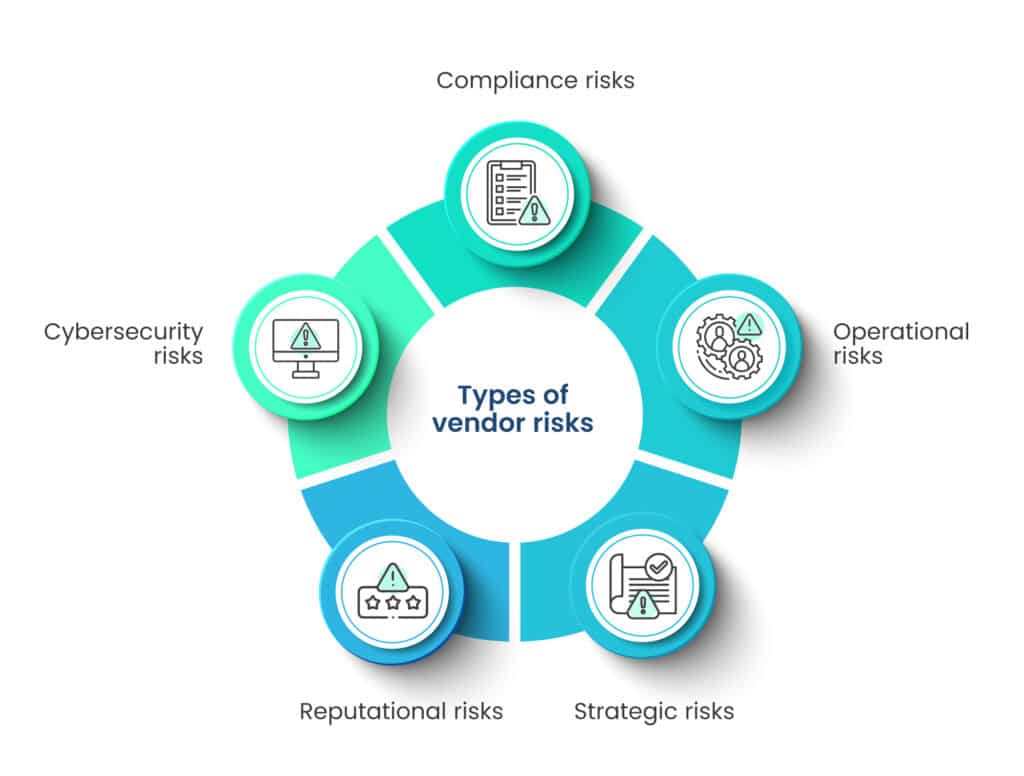
Since there are so many different kinds of vendor risks, ranging from cybersecurity risks to strategic risks that can strike at any time without warning, it is important to have a good third-party incident response plan.
Also, as organizations increase their use of multi-cloud solutions provided by various vendors, they open more doors to unforeseen risks by increasing their attack surface.
Here is a look at why third-party incident response management is a requisite for effective third party risk management.
Mitigates operational disruptions
Third-party incidents can cause severe operational disruptions. Without a well-defined incident response plan, your organization may not be able to promptly identify and respond to a security breach involving a vendor.
An incident response management plan will enable your organization to establish clear communication channels, define roles and responsibilities, and outline a step-by-step process for mitigating the impact of such incidents. This proactive approach minimizes downtime, reduces financial losses, and ensures swift restoration of normal business operations.
Protects sensitive data
When working with third-party vendors, your organization’s sensitive data may be exposed to additional vulnerabilities. An incident response management plan includes measures to safeguard your data by defining security controls, encryption standards, and access protocols.
It also outlines procedures for incident identification, containment, and investigation. This ensures that immediate action is taken to minimize data exposure.
Safeguards reputation and customer trust
In the aftermath of a security incident involving a third-party vendor, your organization’s reputation may be at stake. Public perception of your brand and trust from customers can be severely impacted by data breaches or prolonged disruptions caused by a vendor’s security incident.
By having a well-prepared incident response plan, you can demonstrate your commitment to security, transparency, and responsible vendor management. Timely and effective response actions, including communication strategies, can help maintain customer trust, minimize reputational damage, and enhance brand resilience.
Regulatory compliance and legal protection
The number of regulations that safeguard data keeps increasing with the times. Non-compliance with these regulations could lead to financial penalties and legal repercussions.
Third-party incident response management will make sure that your organization is prepared to meet regulatory obligations when working with vendors. It helps define processes for incident reporting, data breach notifications, and compliance assessments, reducing the risk of non-compliance and protecting your organization from legal liabilities.
Strengthens vendor relationships
An incident response management plan is not only beneficial for your organization but also for your relationships with third-party vendors. By clearly articulating expectations, responsibilities, and incident-handling procedures, you establish a foundation of trust and collaboration with your vendors.
The plan facilitates constructive discussions on security measures, incident response capabilities, and continuous improvement, leading to stronger partnerships that prioritize security and risk mitigation. This makes incident response management vital for third party vendor risk management.
A step-by-step guide to effective third-party incident response management
Effective third-party incident response management equips an organization to proactively identify, respond to, and mitigate incidents involving third-party vendors.
It minimizes the potential damage to the organization’s operations, data, reputation, and customer trust resulting from incidents involving third-party vendors.
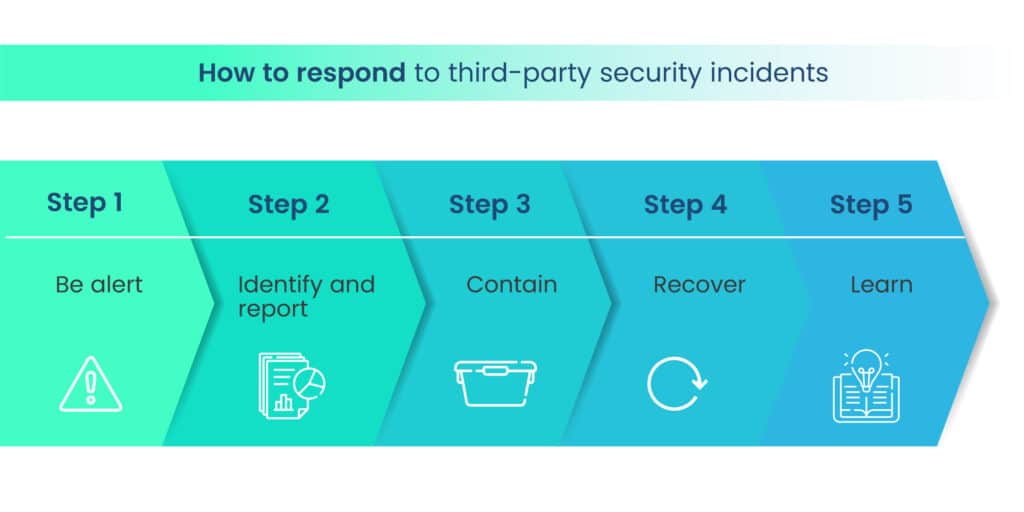
Here is a step-by-step guide to effective third-party incident response management.
Step 1: Establish a comprehensive third-party risk management program
Before diving into incident management, your organization should have a robust third-party risk management program in place.
This program should include due diligence, vendor risk assessments, contract reviews, and ongoing monitoring procedures. It sets the foundation for identifying and managing potential incidents.
Step 2: Define incident identification and reporting mechanisms
Clear mechanisms should be implemented to identify and report third-party incidents. A centralized reporting system where employees can raise concerns or suspicions related to vendor activities should be created.
Encouraging a culture of vigilance and providing training to employees on recognizing and reporting potential incidents should also be encouraged.
Step 3: Promptly assess and prioritize incidents
Upon receiving incident reports, a prompt and thorough assessment of the situation should be conducted.
Incidents should be prioritized based on their potential impact, criticality, and regulatory requirements and categorized into different levels of severity to determine the appropriate response and allocation of resources.
Step 4: Activate the incident response team
An incident response team comprising representatives from relevant departments, such as IT, legal, compliance, and vendor management should be created.
Roles, responsibilities, and communication channels within the team have to be clearly defined to ensure a coordinated and effective response.
Step 5: Contain and investigate the incident
Once an incident is identified, immediate steps should be taken to contain it and prevent further damage. Affected systems have to be isolated, compromised accounts should be disabled, and vendor access may have to be suspended if necessary.
A comprehensive investigation should be initiated to determine the root cause, extent of impact, and potential vulnerabilities within the vendor ecosystem.
Step 6: Engage with the vendor
It is important to communicate with the vendor promptly and transparently. They should be notified about the incident immediately. Your organization must collaborate with them to address the situation.
Engaging in a constructive dialogue will help in understanding their response capabilities, verifying their incident response plans, and jointly developing a remediation strategy.
Step 7: Remediation and preventive measures
A remediation plan should then be developed based on the investigation findings. Corrective actions to address identified vulnerabilities and prevent similar incidents in the future have to be implemented.
Post the incident, it is necessary to strengthen security controls, update contracts to include incident response obligations, and conduct periodic assessments to monitor the vendor’s compliance with security requirements. Using a third party risk management software will help with this.
Step 8: Learn and improve
Conducting post-incident reviews will help in assessing the effectiveness of your incident response process.
Areas for improvement should be identified and incident response plans should be updated to enhance your company’s overall third party risk management program based on lessons learned.
Your organization’s incident management practices should be honed continuously to strengthen its resilience.
Conclusion
Implementing a robust third-party incident response management process is essential to protect your organization from the potential risks associated with vendor relationships.
A well-prepared incident management approach enhances your organization’s operational resilience, safeguards sensitive data, and preserves its reputation.
Third-party incident response management should leave no stone unturned when it comes to taking prompt action to remediate a security incident.
Using a tool like Scrut will boost your organization’s vendor risk management program by effectively evaluating, monitoring, and managing your vendor risks. Schedule a demo today to learn more.
FAQs
1. What is third-party incident response management?
Third-party incident response management refers to the processes and strategies implemented by an organization to systematically identify, investigate, and respond to data breaches and other disruptive external events that are brought on by its vendors and other associated third parties.
2. What are the components of third-party incident response management?
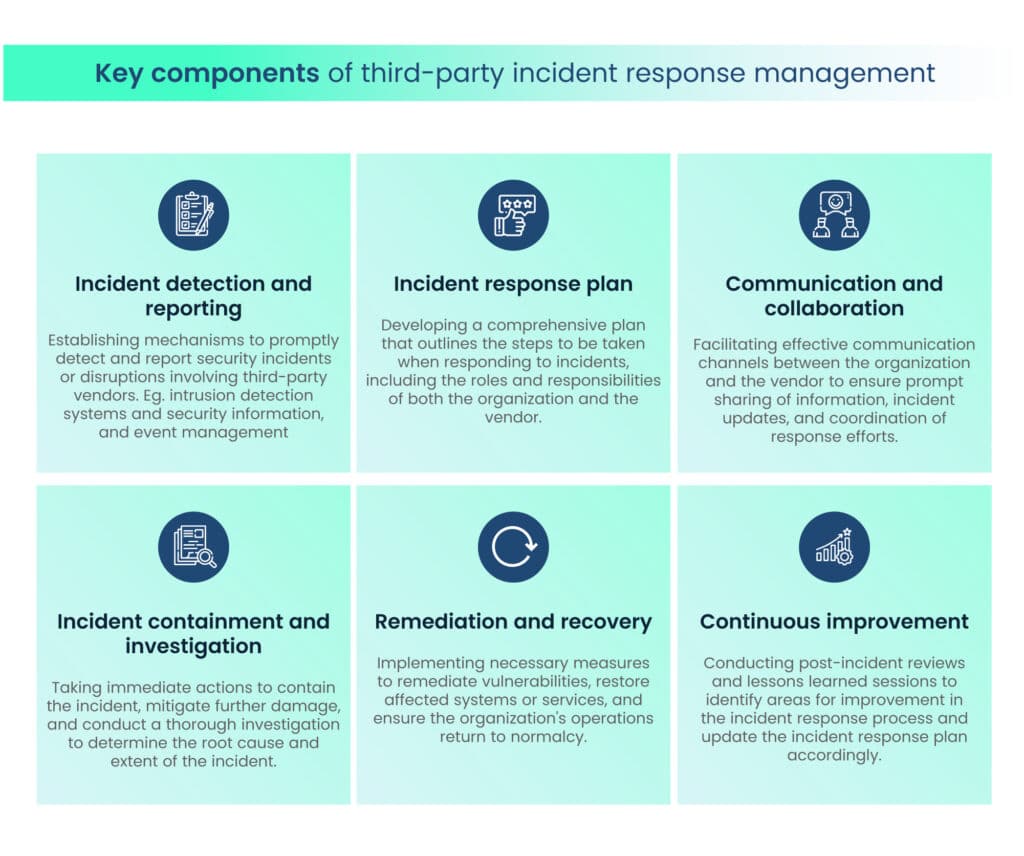
The components of third-party incident response management are: – Incident detection and reporting – Incident response plan – Communication and collaboration – Incident containment and investigation – Remediation and recovery – Continuous improvement
What are the steps involved in third-party incident response management?
The steps involved in third-party incident response management are: – Establishing a comprehensive third party risk management program – Defining incident identification and reporting mechanisms – Promptly assessing and prioritizing incidents – Activating the incident response team – Containing and investigating the incident – Engaging with the vendor – Enforcing remediation and preventive measures – Learning and improving
10 Aug 2023
9minutes
Authored by
Aayush Ghosh Choudhary
Co-founder & CEO at Scrut
How to distinguish between SCRM, TPRM, and VRM
As organizations scale and grow, their dependency on external vendors to fulfill certain tasks increases. Though this boosts efficiency and productivity, it also opens doors to security risks posed by their vendors.
This has resulted in vendor risk management being indispensable for organizations that engage multiple vendors.
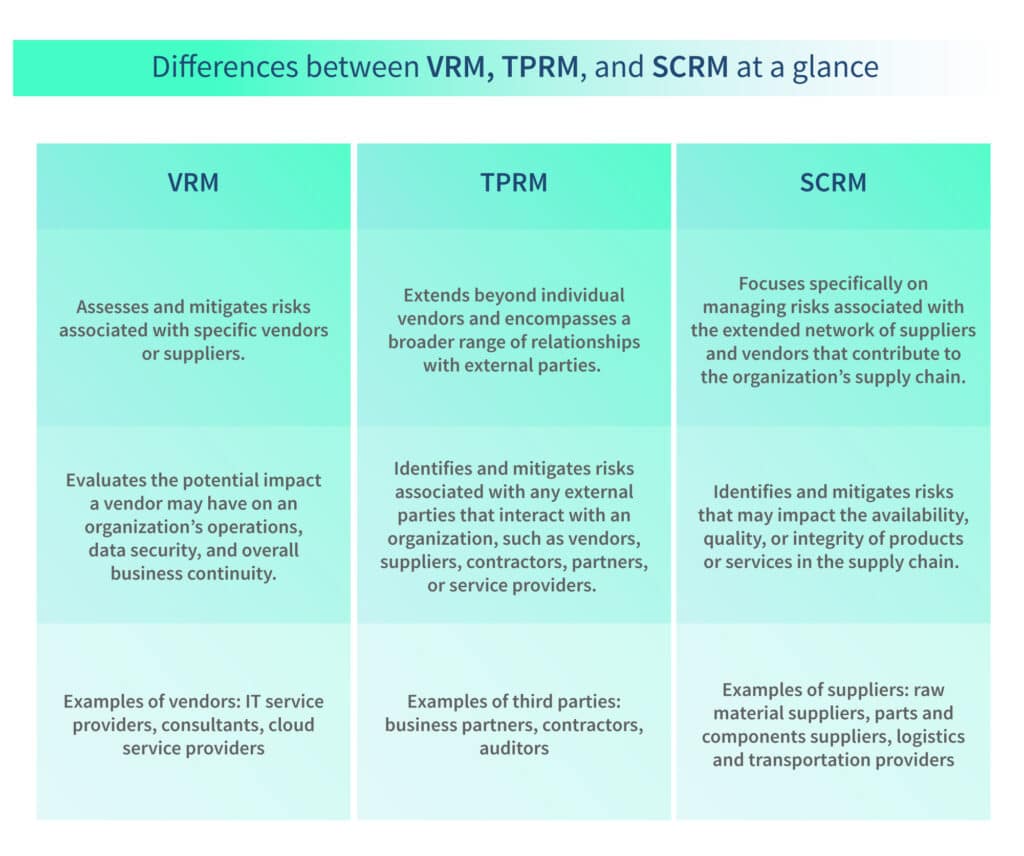
Vendor risk management (VRM) is often confused with Third-Party Risk Management (TPRM) and Supply Chain Risk Management (SCRM).
Though VRM, TRPM, and SCRM have the same ultimate goal—protecting the data of an organization—they have some key differences.
In this blog, we will shed light on all three terms and explore their differences by understanding how they approach external risks and what their objectives are.
Common terms associated with VRM
Before we dive into the differences between VRM, TRPM, and SCRM, let’s take a look at some terms that help understand the inner and outer circles of an organization.
First party
The term first party refers to your organization and all its systems and resources.
Second party
The second party is formed by your customers and their information systems.
Third party
The third party comprises people, organizations, and information systems that have access to your company’s data, excluding the first party and second party. These include the vendors that your organization uses.
Fourth party
Fourth parties or n-parties refers to people, organizations, and information systems that do not have access to your data and are indirectly associated with your organization through the third parties it associates with. In other words, they are the third-party associates of your third-party associates.
What is VRM?
Vendor Risk Management focuses on assessing and mitigating risks associated with specific vendors or suppliers. It involves evaluating the potential impact a vendor may have on an organization’s operations, data security, and overall business continuity.
Types of Vendors
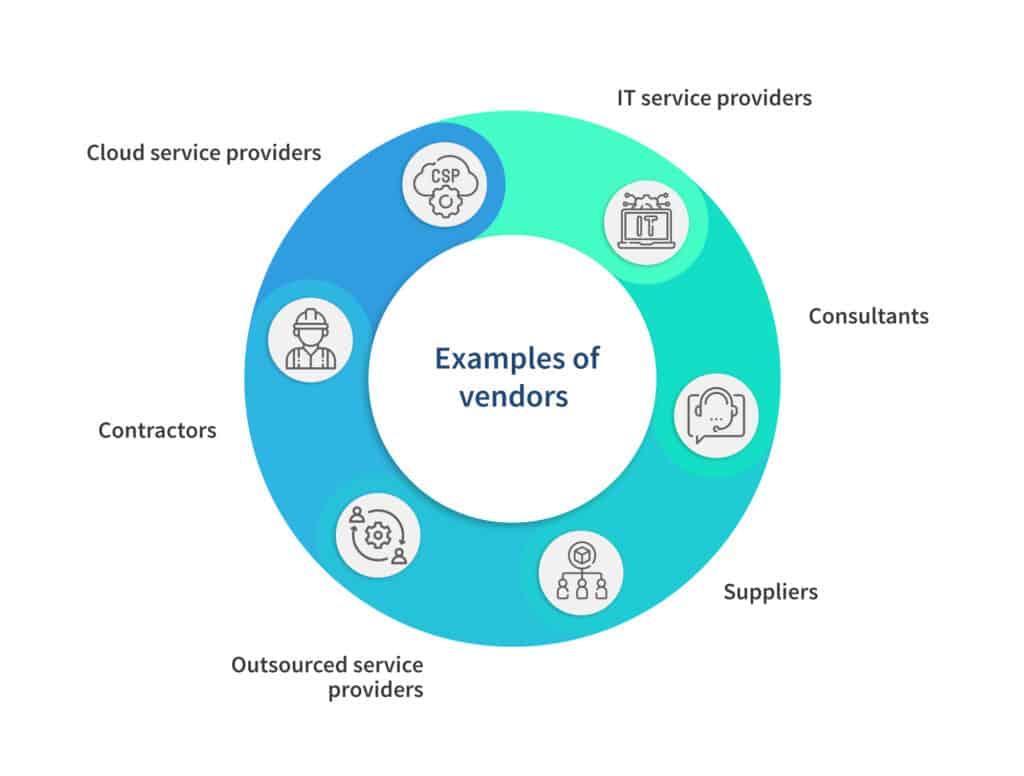
Here are some types of vendors that organizations commonly hire:
1. IT service providers
These providers offer services such as software development, network infrastructure management, cloud computing, cybersecurity, data storage, and technical support.
2. Consultants
Organizations hire management consulting firms, financial consultants, legal consultants, or subject matter experts to provide specialized services and advice.
3. Suppliers
Suppliers encompass manufacturers, wholesalers, retailers, and distributors that provide raw materials, components, equipment, or finished goods used by an organization for its operations.
4. Outsourced service providers
Organizations often outsource certain functions or processes to specialized vendors, such as customer support, marketing, or accounting services, to improve efficiency.
5. Contractors
Organizations hire contractors to fulfill specific requirements that they may not have the time or expertise to handle, such as construction companies or maintenance services.
6. Cloud service providers
Vendors offering cloud-based services like Infrastructure as a Service (IaaS), Platform as a Service (PaaS), and Software as a Service (SaaS) are commonly hired by organizations to enhance their business operations.
What does VRM entail?
VRM is a comprehensive process that effectively manages an organization’s relationships with its vendors. Here are some of its key processes:
1. Vendor assessment
Organizations assess potential vendors based on various criteria such as financial stability, reputation, track record, compliance with regulations, and adherence to industry standards.
This assessment helps determine the suitability of vendors and their alignment with the organization’s values and requirements.
2. Risk identification
VRM identifies and assesses potential vendor risks. Data breaches, service disruptions, compliance violations, or any other risks that may arise from the vendor’s operations or relationship with the organization are what it watches out for.
3. Due diligence
This step involves conducting thorough due diligence on selected vendors. It includes background checks, reviewing vendor contracts, and evaluating security controls and practices.
The organization should ensure that vendors meet the necessary risk and security requirements and can provide the expected level of service and protection.
Assessing the vendors’ SOC 2 reports can help in evaluating the risks they pose.
4. Ongoing monitoring
VRM is not a one-time activity. It requires continuous monitoring of vendor performance.
This monitoring helps identify any changes in vendor risk levels, performance issues, or emerging concerns that need to be addressed. Using vendor risk management software helps in this pursuit.
What is TPRM?
All vendors are third parties, but all third parties are not vendors. Third-Party Risk Management extends beyond individual vendors and encompasses a broader range of relationships with external entities.
Apart from dealing with paid vendors, third-party risk management also manages risks posed by unpaid parties such as development partners and open-source software providers. It is harder to exert control over them since they are not paid for their services.
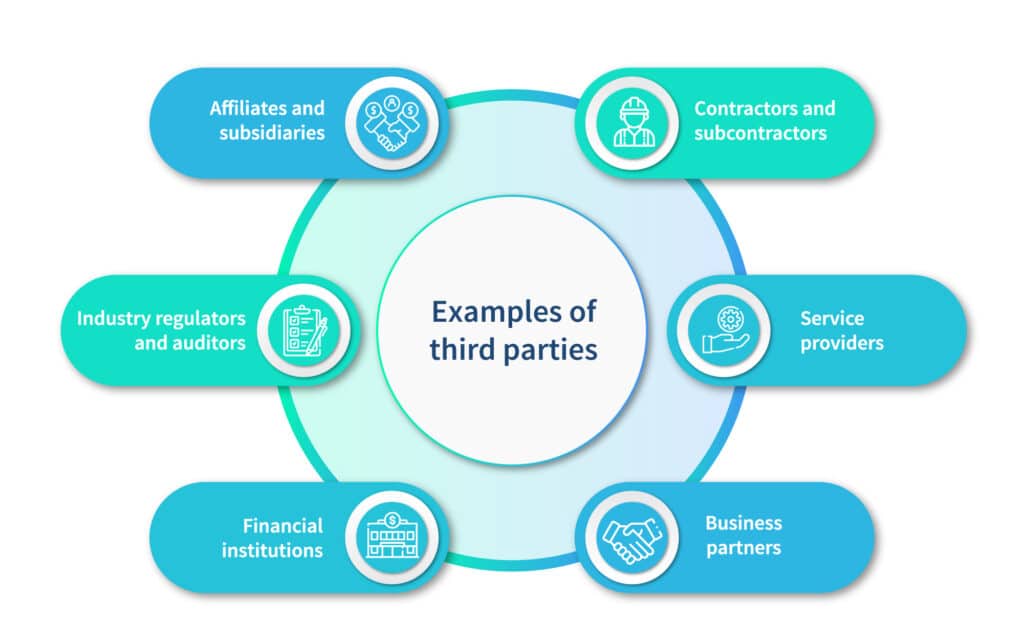
Types of Third Parties
Here is a list of third parties that an organization commonly engages with:
1. Contractors and subcontractors
These third parties may include construction companies, consultants, or freelancers hired for temporary or specialized work.
2. Service providers
They provide outsourced services to support an organization’s operations. This can include IT-managed service providers, cloud service providers, marketing agencies, or legal firms.
3. Business partners
Business partners are parties with whom an organization has established a strategic alliance or partnership. Joint ventures, co-marketing agreements, or collaborations to develop and deliver products or services are examples of such alliances.
4. Affiliates and subsidiaries
Affiliates and subsidiaries are separate legal entities that are related to the organization through ownership or control. They may share resources or have common goals but are still considered third parties for risk management purposes.
5. Industry regulators and auditors
Regulatory bodies, government agencies, and auditors interact with organizations to ensure compliance with industry regulations, standards, or specific legal requirements. They play a role in evaluating an organization’s practices.
6. Data processors
In the context of data privacy and protection, organizations often engage third-party data processors to handle and process personal or sensitive data on their behalf. This can include cloud storage providers, payroll processors, or customer support service providers.
7. Financial institutions
Organizations may have relationships with banks, payment processors, or other financial institutions to manage banking services, handle transactions, or provide financing options.
8. Research and development partners
In research-driven industries, organizations may collaborate with external research institutions, universities, or specialized R&D firms to develop new products, technologies, or intellectual property.
9. Logistics and transportation providers
Third-party logistics (3PL) companies or transportation providers are often engaged to handle the shipping of goods and supply chain logistics.
10. Professional associations and industry groups
Organizations may participate in professional associations or industry groups to gain access to resources, networking opportunities, and shared knowledge within their respective sectors.
What does TPRM entail?
TPRM involves several critical aspects that are vital for mitigating potential risks associated with third parties and ensuring the security of the organization’s operations. Here are the key processes involved in TPRM:
1. Risk assessment
Organizations should perform a comprehensive risk assessment of their third parties to identify and evaluate the potential risks associated with them.
This assessment involves categorizing them based on criticality and assessing the potential impact on the organization’s operations if a security incident were to occur.
2. Due diligence
Thorough due diligence should be conducted on all third parties under consideration. This process involves evaluating their financial stability, compliance with regulations, adherence to industry standards, security controls, and their past performance in relevant areas.
The objective is to gain a clear understanding of the third party’s capabilities, reputation, and potential risk factors.
3. Contractual agreements
Organizations should establish contractual agreements that clearly outline the expectations, responsibilities, and security requirements of third parties.
These agreements must include clauses addressing data protection, confidentiality, liability, compliance, and security controls.
By establishing such agreements, organizations can set clear expectations and ensure that third parties meet the required standards.
4. Ongoing monitoring
Third party vendor risk management calls for the continuous monitoring of third-party performance and security posture. Organizations should establish mechanisms to regularly assess and monitor the activities and security practices of third parties.
This includes conducting audits, periodic reviews, and performance evaluations. Any identified risks or issues should be promptly addressed to mitigate potential impacts on the organization’s operations.
What is SCRM?
Supply chain risk management focuses on managing risks associated with the extended network of suppliers and vendors that contribute to an organization’s supply chain. It involves identifying and mitigating risks that may impact the availability, quality, or integrity of products or services.
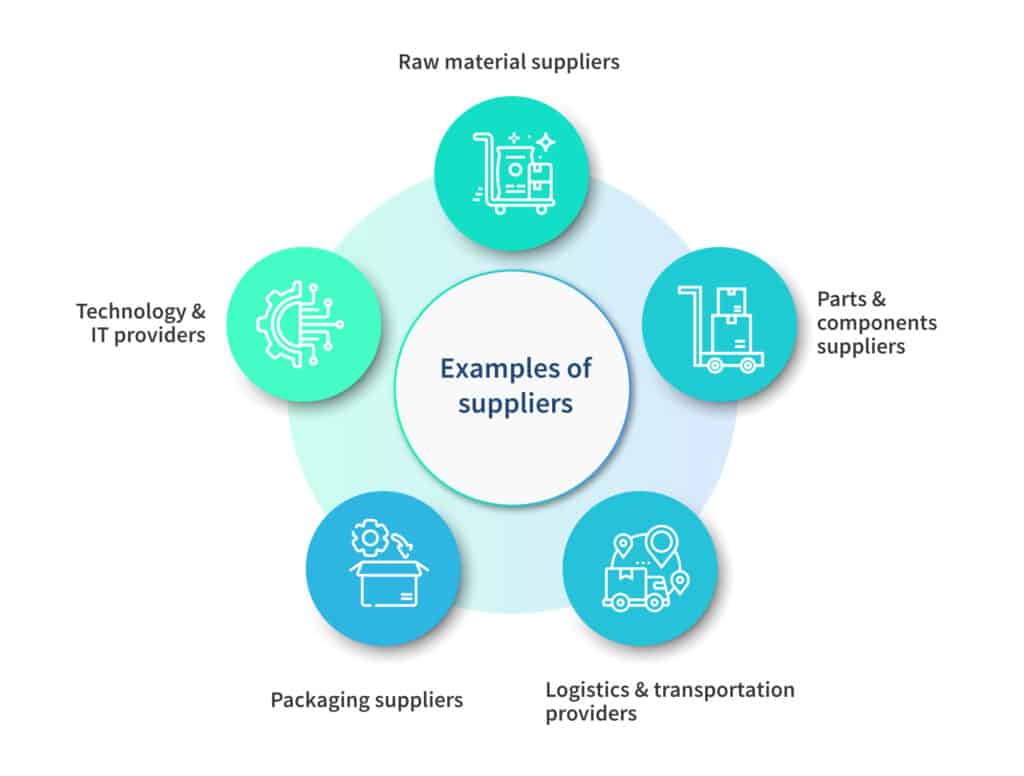
Examples of Suppliers
There are numerous suppliers and vendors that contribute to an organization’s supply chain. The specific suppliers and vendors can vary depending on the industry and the organization’s needs.
However, here are some common examples:
1. Raw material suppliers
These suppliers provide the necessary raw materials or components that are used in the manufacturing or production process. For instance, in the automotive industry, suppliers may provide steel, rubber, glass, or electronic components.
2. Parts and components suppliers
These suppliers specialize in providing specific parts or components required to assemble finished products. They may supply items like circuit boards, engines, fasteners, or specialized components for various industries.
3. Logistics and transportation providers
These vendors offer transportation services to move goods from suppliers to the organization’s facilities or between different locations within the supply chain. This can include freight companies, shipping companies, airlines, or trucking companies.
4. Packaging suppliers
These vendors provide packaging materials and solutions to protect and present products during transportation and storage.
5. Technology and IT providers
These suppliers offer technology solutions to support supply chain management and operations. They may provide software systems for inventory management, order processing, or enterprise resource planning (ERP) solutions.
6. Equipment and machinery suppliers
These vendors provide the necessary equipment and machinery for manufacturing or production processes. They can include suppliers of machines, tools, automation equipment, or specialized equipment required for specific industries.
7. Maintenance and repair service providers
These vendors offer services to maintain and repair equipment or machinery used within the supply chain. They may provide on-site technicians, spare parts, or maintenance contracts to ensure smooth operations.
8. Utilities and energy suppliers
These vendors provide essential utilities such as electricity, water, or gas to power the organization’s operations. They ensure the availability of necessary resources for production and distribution.
What does SCRM entail?
Implementing SCRM practices helps organizations to effectively identify, assess, and mitigate risks within their supply chains, thereby enhancing resilience and ensuring smooth operations even in the face of potential disruptions.
Here are some common processes associated with SCRM:
1. Supply chain mapping
SCRM begins with mapping out the entire supply chain to gain a holistic understanding of its structure. This includes identifying all the tiers, suppliers, subcontractors, and other dependencies within the supply chain network.
By visualizing the complete chain, organizations can better comprehend how each element connects and influences the overall supply chain’s functionality.
2. Understanding dependencies and vulnerabilities
With the supply chain mapped out, the next step is to analyze the various tiers and dependencies. This involves assessing the critical components, suppliers, and activities that are essential for smooth operations.
By understanding these dependencies, organizations can identify potential vulnerabilities and points of failure within the supply chain. This knowledge is crucial for proactive risk management.
3. Risk assessment
SCRM involves a comprehensive risk assessment process that evaluates risks associated with suppliers. This assessment covers various aspects, including geopolitical factors, natural disasters, transportation disruptions, and supplier financial instability.
By conducting a thorough risk assessment, organizations can identify potential threats that may impact the supply chain and take proactive measures to mitigate them.
4. Contingency planning
To ensure business continuity, organizations must develop robust contingency plans. These plans are designed to address potential disruptions in the supply chain, considering the identified risks and vulnerabilities.
Contingency planning involves creating alternative strategies, backup suppliers, redundancy plans, or inventory management techniques that can be implemented in the event of a supply chain disruption.
It aims to minimize the impact of disruptions and maintain the flow of goods and services.
5. Collaboration
SCRM emphasizes the importance of collaboration with suppliers and partners within the supply chain. By working closely with suppliers, organizations can establish shared risk management strategies.
This collaboration involves open communication channels, frequent information sharing, and joint efforts to enhance supply chain resilience.
By fostering strong relationships with suppliers, organizations can collectively address risks and proactively adapt to changing circumstances.
Conclusion
Vendor Risk Management (VRM), Third-Party Risk Management (TPRM), and Supply Chain Risk Management (SCRM) are distinct approaches that organizations employ to manage different aspects of risks associated with external relationships.
While VRM focuses on assessing and mitigating risks associated with individual vendors, TPRM manages risks posed by a broader range of third-party relationships. SCRM, on the other hand, focuses specifically on managing risks within the extended supply chain.
Understanding these differences allows organizations to adopt targeted risk management strategies and ensure the security, continuity, and resilience of their operations in an interconnected business environment.
Using a tool like Scrut will help manage all associated risks with vendors, service providers, and suppliers. Schedule a demo today to learn more.
FAQs
What is vendor risk management?
Vendor risk management is the process of assessing and managing the risks associated with working with third-party vendors, suppliers, or service providers.
What is third-party risk management?
Third-party risk management encompasses the management of risks associated with all external parties, including vendors, suppliers, contractors, service providers, consultants, or any other external entities that have access to an organization’s systems, data, or resources.
What is supply chain risk management?
Supply chain risk management involves identifying, assessing, and managing the risks within a complex network of suppliers, vendors, manufacturers, distributors, and logistics providers that make up an organization’s supply chain.
10 Aug 2023
7minutes
Authored by
Aayush Ghosh Choudhary
Co-founder & CEO at Scrut
How to perform vendor risk assessment in five easy steps
Back in 2013, Target, one of America’s biggest retailers, suffered a harrowing data breach. Its hackers got away with 41 million credit and debit records and 70 million customer records.
The reason for the breach: Their third-party HVAC company fell for a phishing email.
To avoid a similar fate, vendor risk management should be a vital part of an organization’s security strategy.
Since most organizations today rely on external vendors to fulfill various operational needs, vendor risk assessment is non-negotiable when it comes to managing vendor risks.
In this blog, we will explain what vendor risk assessment is, highlight its importance, and provide eight key steps to perform an effective assessment.
What is vendor risk assessment?
Vendor risk assessment is the systematic process of identifying and evaluating the potential risks associated with engaging third-party vendors.
It involves identifying and analyzing vulnerabilities within vendor relationships and measuring their potential impact on the organization.
The assessment is carried out by evaluating the vendor’s security controls, values, goals, policies, procedures, and other relevant factors. Vendors are typically made to fill out a vendor risk assessment questionnaire that requires them to share information about their security controls.
Why is Vendor Risk Assessment Important?
Major security incidents such as the SolarWinds attack and Colonial Pipeline attack, which were major supply chain breaches, call attention to the need for vendor risk assessment.
Here are some reasons why it is important for an organization to perform a thorough vendor risk assessment.
Prevents data breaches
Vendors are potential entry points for cybercriminals since they often have access to sensitive data or critical systems.
Performing a thorough risk assessment enables organizations to identify vulnerabilities in the vendor’s security posture and assess their data protection measures. This helps in determining if the vendor is likely to pose risks to the organization’s security.
Reduces operational risks
Vendor risk assessment allows organizations to evaluate the capabilities, performance history, and business continuity plans of their vendors. This reduces the likelihood of operational interruptions caused by the inefficiency of service providers.
Promotes compliance
It is mandatory for organizations to comply with regulatory frameworks, industry standards, and data protection laws. Associating with vendors who do not adhere to these requirements can result in severe legal and financial consequences.
Performing vendor risk assessments helps in evaluating the compliance posture of vendors, enabling organizations to choose partners that align with their regulatory obligations.
Protects reputation
If your vendors engage in unethical practices, suffer from frequent breaches, or fail to meet quality standards, your organization will be guilty by association. Unethical or negligent vendors can damage your company’s reputation.
Vendor risk assessment helps evaluate the reputation, stability, and past performance of your vendors, which ensures the protection of your organization’s reputation.
How to perform vendor risk assessment?
It is important for organizations to conduct vendor risk assessment before engaging with any third-party vendor. This assessment serves as a crucial step to evaluate potential risks associated with the vendor. Only after a thorough assessment and approval can the vendor be considered safe to work with.
Here are five key steps involved in a thorough vendor risk assessment.
1. Identify the typical risks associated with vendors
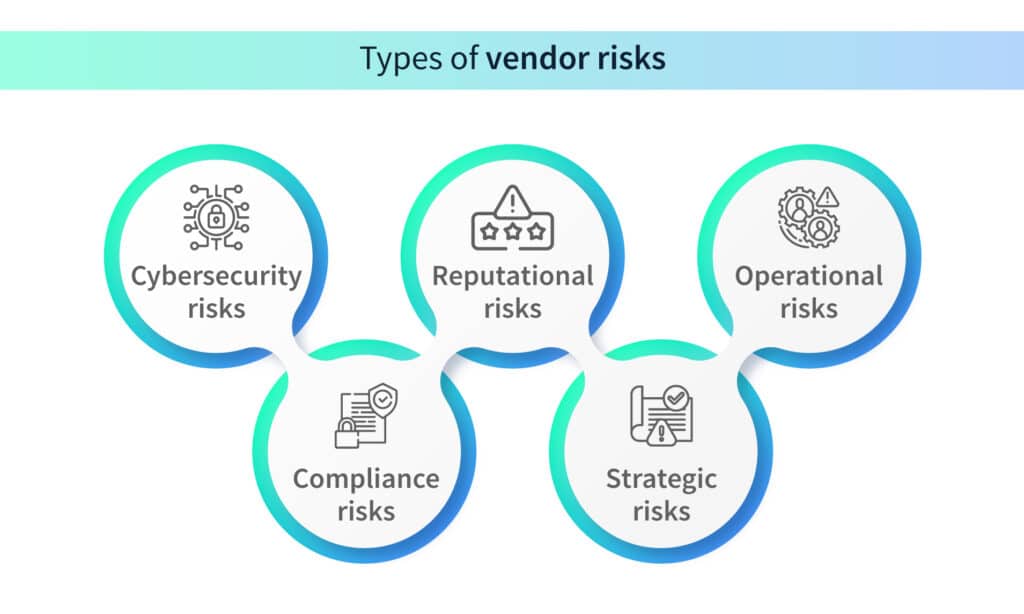
Before diving into the evaluation process, it is important to identify the different risks that could arise when entering into a business agreement with a vendor. It’s crucial to cover all your bases and have a clear understanding of the potential risks associated with different kinds of vendors. Here is a list of the most common vendor risks.
Cybersecurity risks
If any one of your vendors does not enforce adequate cybersecurity measures, your organization becomes vulnerable to cyber-attacks. Vendors who pose cybersecurity risks may have vulnerabilities in their systems, possess inadequate access controls, and enforce weak security practices and data protection measures.
Compliance risks
If your organization engages a vendor that does not comply with laws, regulations, or industry standards, it becomes vulnerable to compliance risks. This could result in your organization being slapped with legal consequences, reputational damage, or financial penalties.
Reputational risks
Vendors with a bad reputation either due to poor security or unethical practices will ruin your organization’s reputation if you engage them. It is important to thoroughly assess the history of vendors before doing business with them.
Additionally, if the vendor suffers a cybersecurity attack, their reputation will be damaged and in turn the reputation of the organization will be dented.
Strategic risks
If a vendor’s strategies clash with the objectives of your organization, it could stand in the way of your business goals. For instance, if they launch a product that competes with your product, it negatively impacts your sales.
Operational risks/business continuity risks
Inefficient vendors could hamper the operations of your business. If they fail to deliver their product or service on time, your organization’s productivity will suffer.
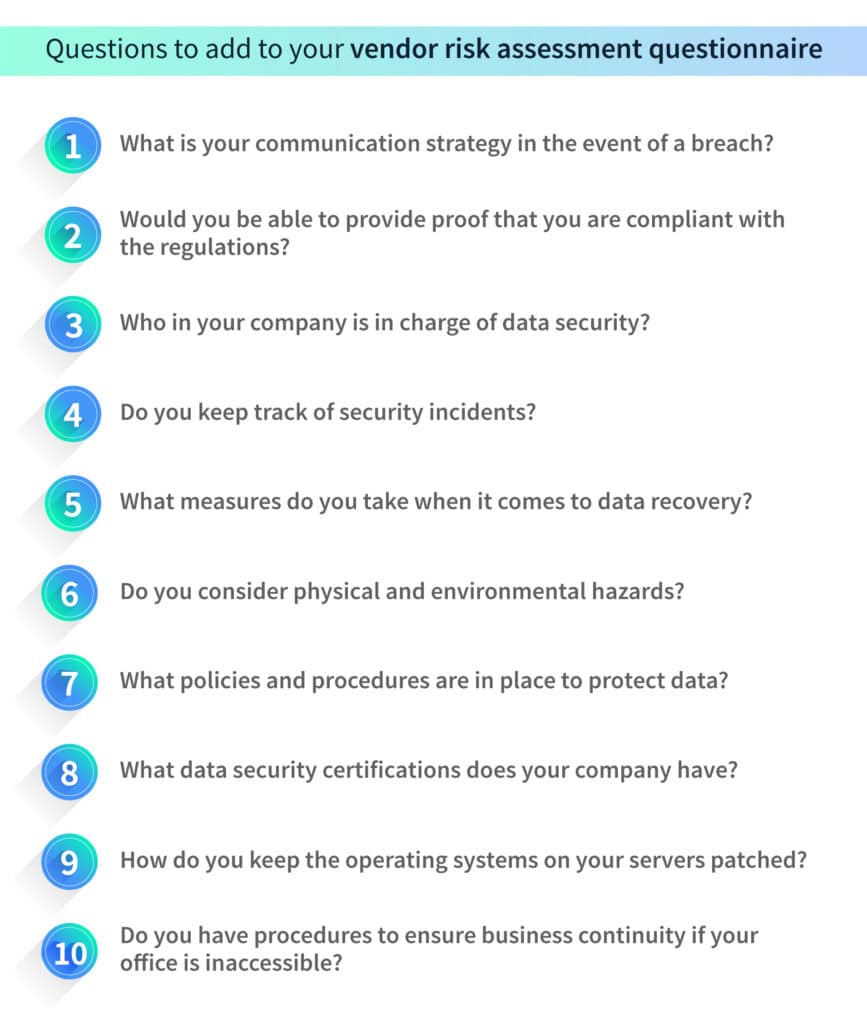
2. Create a vendor risk assessment questionnaire
Getting your vendors to fill out a questionnaire that requires them to detail their security measures helps assess the risk they pose to your organization. The questions should focus on areas such as data security, compliance, financial stability, reputation, and IT infrastructure.
Here are some examples of questions that could be included in a vendor risk assessment questionnaire.
3. Analyze vendor risk profiles
Once all your vendors have filled out the questionnaire, you will have an idea of the kind of risks they pose. Conduct a detailed analysis of each vendor’s risk profile by reviewing their security practices, financial reports, audit results, and compliance certifications.
Assess potential risks such as data breaches, service disruptions, compliance failures, financial instability, and legal or regulatory issues.
4. Categorize vendors based on their risk profiles
After you’ve analyzed the risk profiles of your vendors, assign scores based on the levels of risk they pose. Higher risk scores should be assigned to vendors who have access to sensitive data, critical infrastructure, or those involved in key operational processes.
Vendors should be categorized based on their criticality and potential impact on your organization.
It is a good idea to avoid engaging with vendors whose questionnaires revealed poor security measures.
5. Develop risk mitigation strategies
The final step is to develop risk mitigation strategies for the vendor categories that you created. This may involve implementing security controls, conducting security assessments, establishing performance metrics, defining contractual obligations related to security and compliance, and conducting regular audits.
Recommended practices for effective vendor risk assessment
There are a few best practices that can help make your vendor risk assessment strategy even better. We’ve listed them below.
Promote vendor communication and education
It is necessary to encourage open and continuous communication with vendors to ensure a collaborative approach to risk assessment.
You could share security expectations, incident response plans, and updates on regulatory compliance with your vendors to have them on the same page as your organization.
You could also educate your vendors by providing them with resources to enhance their understanding of security best practices and industry-specific compliance requirements.
Assess vendors regularly
Implementing processes for continuous monitoring and evaluation of vendor performance is an effective way of preventing vendor risks. Conducting periodic reviews, audits, and assessments to detect emerging risks ensures continuous compliance and addresses any deviation from agreed-upon security standards.
Involve vendors in incident response plans
By collaborating with vendors to develop incident response plans in the event of a breach, you can reduce the risk of supply chain attacks. You must define clear roles and responsibilities with your vendors to ensure an effective response to security incidents or breaches.
How can Scrut help in vendor risk assessment?
Scrut can assist you in evaluating, monitoring, and managing vendor risks. It helps in understanding your vendors’ security postures and determining if they meet your organization’s security standards and compliance requirements.
The tool manages vendor security from onboarding to offboarding. It assesses vendors, evaluates vendor-related risks, and mitigates them.
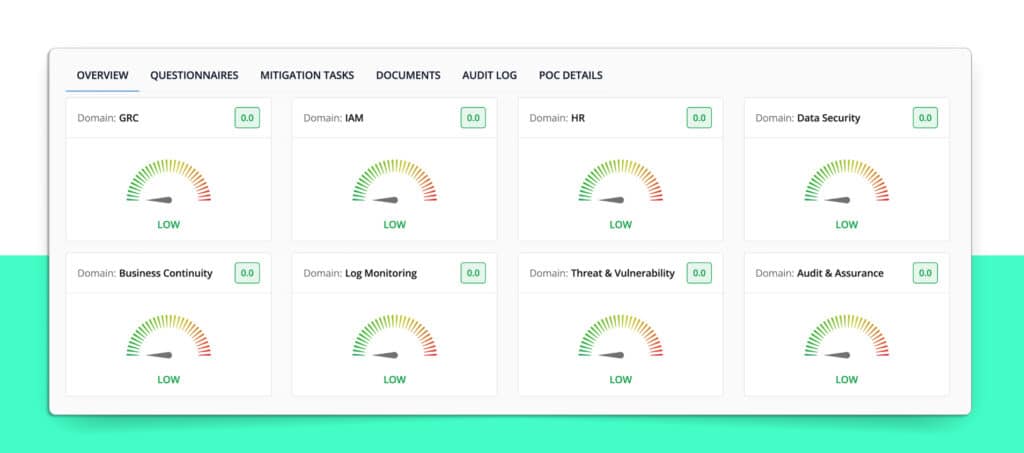
It assists you in streamlining your vendor compliance tests with security questions. You can design your questionnaire or use one of our pre-made templates, as shown in the screenshot below.
The platform allows you to identify, evaluate, and track vendor risks that your company faces in a single window. It speeds up the assessment of your vendors’ security postures by 70% and determines whether they meet your organization’s compliance standards.
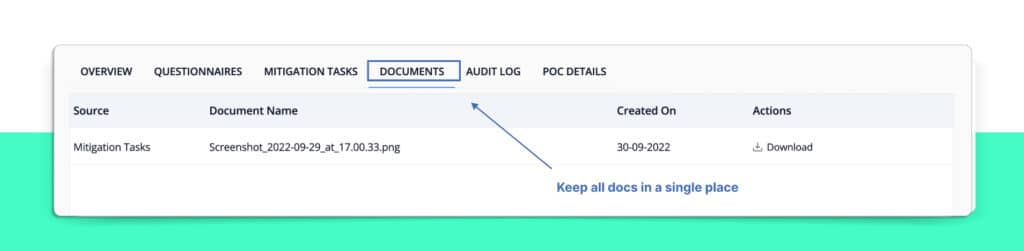
Scrut is the central repository for all vendor security information, including certificates, audits, and paperwork, as shown in the screenshot below. It also allows you to easily share vendor responses with customers and auditors.
You can easily compare vendors to find the lowest-risk business partner or create a risk security strategy based on vendor risk categories.
Conclusion
Vendor risk assessment plays a crucial role in safeguarding organizations from potential security threats and vulnerabilities associated with vendor services. By conducting comprehensive assessments, your organization can identify and mitigate risks related to data breaches, service disruptions, compliance failures, and reputational damage.
Using a tool like Scrut can help boost your organization’s security assessment strategies by efficiently and effectively identifying, evaluating, and monitoring vendor risks. Schedule a demo today to learn more.
FAQs
1. What is vendor risk assessment?
Vendor risk assessment is the systematic process of identifying and evaluating the potential risks associated with engaging third-party vendors.
2. What is a vendor risk assessment questionnaire?
A vendor risk assessment questionnaire is a form that requires vendors to detail their security measures in order to assess the potential risks they could pose to an organization.
3. How to perform vendor risk assessment?
1. Identify types of risks 2. Create a vendor risk assessment questionnaire 3. Analyze vendor risk profiles 4. Categorize vendors based on risk profiles 5. Develop risk mitigation strategies
4 Aug 2023
4minutes
Authored by
Aayush Ghosh Choudhary
Co-founder & CEO at Scrut
Are You Still Making These Common Compliance Mistakes?
Compliance plays a pivotal role in safeguarding both the data and the interests of a company.
While many organizations recognize its importance, several still fall victim to common compliance mistakes that can result in hefty penalties, damaged reputation, and legal repercussions.
In this blog, we will explore the most prevalent errors committed by companies and offer two practical solutions to avoid these pitfalls.
What compliance mistakes do companies make?
Compliance is a multifaceted process that requires ongoing efforts rather than a one-time endeavour. This complexity often leads to some companies making mistakes along the way. Here are some common compliance errors that organizations make.
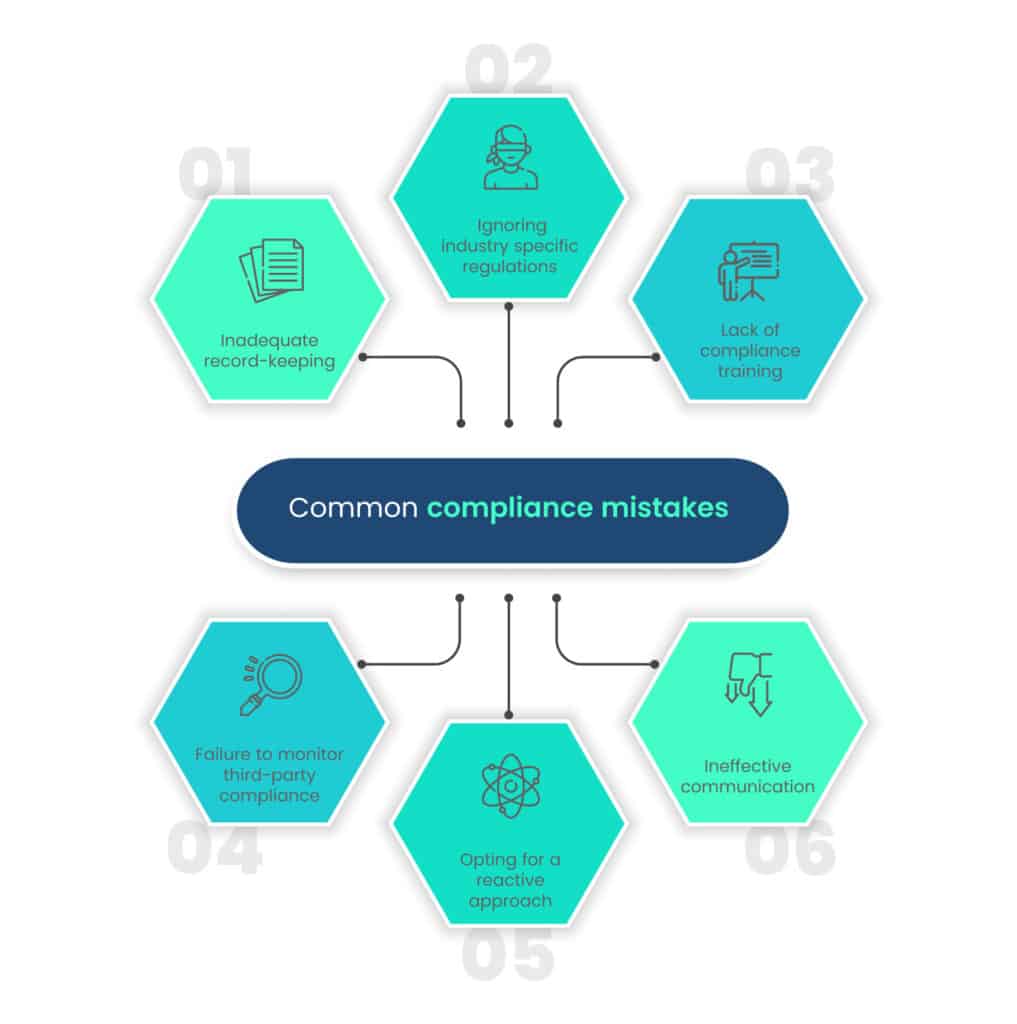
1. Inadequate record-keeping
Many companies struggle with maintaining proper records of their compliance-related activities. This lack of organized documentation makes it difficult for them to demonstrate adherence to regulations during audits. Moreover, poor record-keeping increases the likelihood of missing critical compliance deadlines, leading to potential penalties and legal consequences.
2. Ignoring industry-specific regulations
Each industry has its own unique set of regulations that companies must comply with. Failure to stay informed and adhere to these industry-specific rules can result in non-compliance issues. Ignoring industry-specific regulations not only exposes the company to legal risks but also damages its reputation and trustworthiness in the market.
3. Lack of compliance training
Companies often underestimate the importance of educating their employees about compliance requirements. Without proper training, employees may unknowingly engage in actions that violate regulations. Regular and comprehensive compliance training is crucial to ensuring that employees understand the rules and regulations that apply to their roles.
4. Failure to monitor third-party compliance
Businesses often outsource certain functions to third-party vendors and partners. However, they must ensure that these external entities also comply with relevant regulations. Neglecting to monitor third-party compliance can expose the company to significant risks and liabilities, as the actions of external entities can directly impact the company’s compliance status.
5. Opting for a reactive approach
Adopting a reactive approach to compliance is a common mistake. Waiting for compliance violations to occur before taking action can lead to severe consequences. Companies should take a proactive stance by identifying potential risks and implementing measures to prevent non-compliance before it becomes a problem.
6. Ineffective Communication
Communication breakdowns between compliance officers and other departments can lead to misunderstandings and non-compliance. Proper communication channels must be established and maintained to ensure that all relevant stakeholders are well-informed about compliance requirements and changes in regulations.
How to Get Compliance Right
Complying with one, let alone multiple frameworks, might seem daunting. However, compliance experts recommend two approaches that will not only help your company avoid common compliance errors but excel in meeting regulatory requirements. Here’s what they recommend:
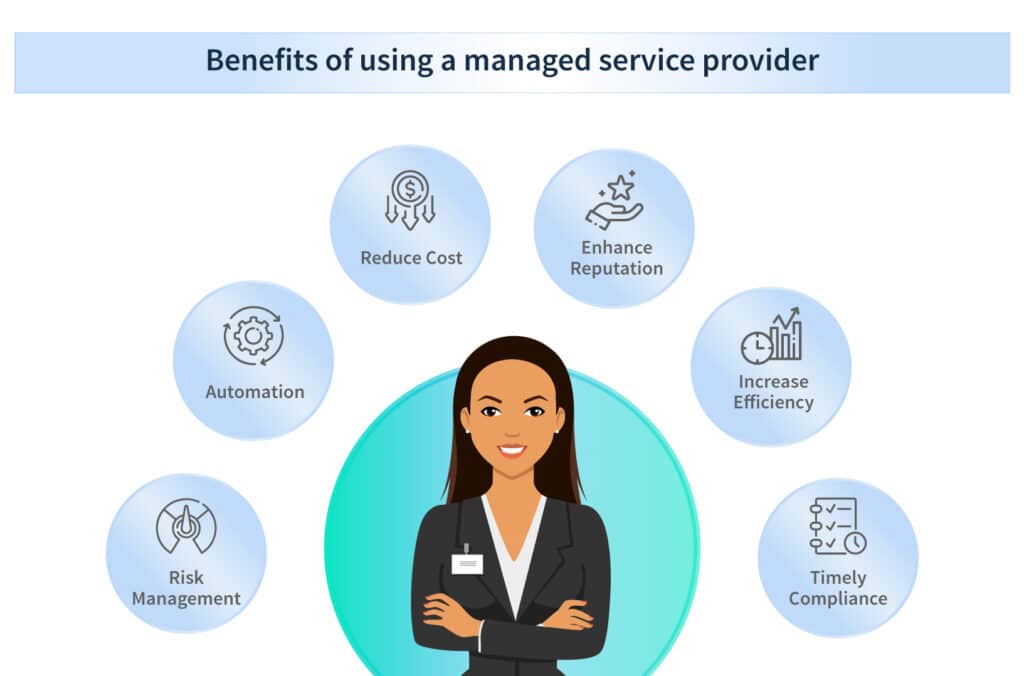
Outsourcing Compliance Activities to a Managed Service Provider (MSP)
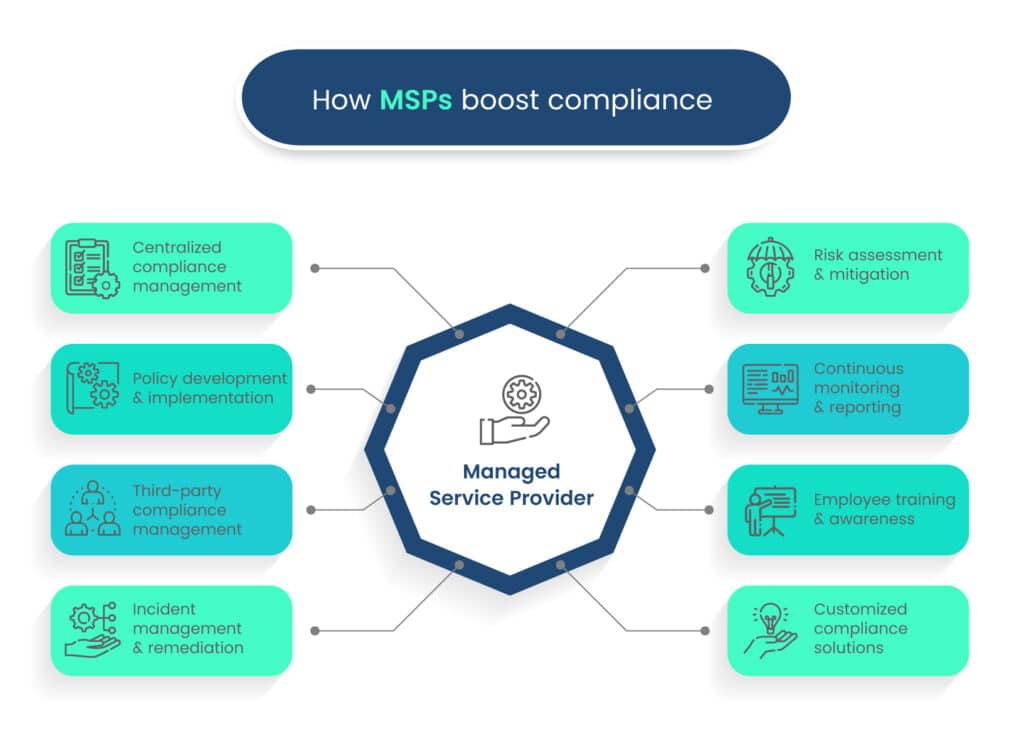
Outsourcing compliance activities to a trusted MSP can bring valuable expertise and efficiency to your compliance efforts. MSPs specialize in assisting with documentation, compliance audits, risk assessments, and risk monitoring.
Good MSPs employ a proactive approach to compliance, identifying potential risks and areas of improvement before they escalate into compliance issues. This preemptive strategy not only ensures a higher level of compliance but also fosters a culture of continuous improvement within the organization.
Moreover, outsourcing compliance activities to an MSP can lead to better resource allocation. Instead of dedicating internal resources to non-core compliance tasks, companies can allocate those resources to strategic initiatives and revenue-generating activities, ultimately driving business growth and innovation.
Furthermore, MSPs’ scalable solutions cater to the specific needs of each company, regardless of their size or industry. Whether a small startup or a large enterprise, partnering with a trusted MSP allows companies to access tailored compliance services that adapt to their evolving needs and compliance requirements.
Automating Compliance with GRC Automation
By implementing GRC automation tools, businesses can streamline and centralize their compliance processes, minimizing the risk of errors and oversight.
These tools provide a structured framework to manage multiple compliance frameworks efficiently and eliminate duplication of efforts. They ensure that all relevant requirements are addressed and met consistently.
They also generate automated reports, providing real-time visibility into compliance status, potential risks, and areas that need attention.
How TenisiTech – a trusted global MSP – can help prevent compliance mistakes
TenisiTech, a trusted Managed Service Provider (MSP), offers tailored Compliance-as-a-Service solutions to help organizations avoid compliance mistakes. TenisiTech’s team of compliance experts can assist your company in developing a comprehensive approach to compliance management, ensuring smooth navigation through the complex regulatory landscape.
In partnership with Scrut, TenisiTech extends its value to companies by granting access to a pool of compliance specialists who deeply comprehend the unique requirements, goals, and risk tolerance of each business. By collaborating closely with clients, TenisiTech and Scrut create compliance strategies that seamlessly align with the organization’s operations and objectives.
TenisiTech offers a wide array of assistance to compliance efforts, encompassing risk analysis, policy development and implementation, documentation management, third-party risk management, security training, and incident management.
By choosing to outsource compliance processes to TenisiTech, your organization can avoid compliance mistakes and enhance overall operational efficiency and business performance.
27 Jul 2023
3minutes
Authored by
Aayush Ghosh Choudhary
Co-founder & CEO at Scrut
Risk Grustlers EP 10 | The Perks of Automating Audits: Advice From a Compliance Expert
In the second episode of our podcast, Risk Grustlers, we are stepping into the future of audits with Shashank Karincheti, the mastermind behind Razorpay’s cutting-edge IT GRC.
Shashank unravels the secrets to streamlining compliance, optimizing efficiency, and maximizing accuracy and discusses perspectives on audit automation for organizations of all maturities.
He offers an inside look at the decision-making process between in-house development and partnering with third-party vendors for automation and highlights the power of culture and strategy as he explains how alignment of business goals, industry regulations, and company values is the key to automation triumph.
Get ready to delve into the strategic considerations behind prioritizing audit processes, establishing metrics and KPIs, and measuring the true effectiveness of automation programs.
Without further ado, let’s take a look at what our host Pratyush Kukreja and guest Shashank Karincheti uncovered in their illuminating conversation.
PK: Let’s talk about audit automation, which is something you’ve been championing at Razorpay. Given the evolving landscape of cybersecurity and fintech in India, audit automation can mean different things depending on the organization’s maturity. Where do you see audit automation fitting into your context?
SK: That’s a great question, Pratyush. In many cases, audits are seen as a checklist exercise, where you complete certain tasks and consider the job done. However, nowadays, audits are more about compliance by design. For example, certifications like SOC 2 require specific criteria to be met, indicating the presence of controls that provide a level of comfort. So, in our context, audit automation means creating a platform where compliance and framework requirements are built-in, ensuring a bigger picture of security and control.
PK:So, audit automation is about standardizing processes and incorporating compliance and framework requirements. It helps provide real-time insights and visibility into the state of compliance, making it easier to assess and manage.
SK: Exactly! Audit automation allows us to focus on the actual work rather than spending excessive time on manual tasks. It enables us to measure compliance levels, identify areas for improvement, and streamline the overall audit process. It also helps optimize our resources and reduce the time required for audits.
PK: That’s fascinating. So, as you continue to mature in your automation journey, how do you establish metrics and KPIs to measure the effectiveness of your automation program?
SK: Good question. One of the key metrics is the percentage of compliance achieved based on the established frameworks. We want to ensure that we are meeting the requirements set by various regulations and certifications. Additionally, we track the reduction in man-hours required for tasks that can be automated. By leveraging automation tools, we aim to minimize the effort needed for audits and enhance productivity within the compliance team.
PK: That makes sense. It’s crucial to track the time and effort saved through automation and demonstrate the return on investment. So, in your experience, when it comes to automation, organizations often face the build vs. buy decision. How do you approach this and what value does partnering with vendors bring?
SK: Indeed, it’s a common challenge. While we have the skills to build automation tools in-house, we believe in focusing our core capabilities on our products and services. Partnering with vendors allows us to leverage their expertise in automation and benefit from their specialized solutions. It also helps us ensure scalability, performance, and the ability to handle complex frameworks. Through robust vendor management practices, we maintain control over sensitive data while benefiting from the vendor’s domain knowledge and tool capabilities.
PK:I see. So, it’s about utilizing external expertise and specialized tools to optimize efficiency and scalability while maintaining control over data. Finally, for organizations starting their journey towards audit automation, what would be your recommended playbook to build a strong foundation?
SK: To begin, it’s essential to understand the nature of your business, whether it’s B2C or B2B, and the industry you operate in. This understanding will shape your compliance and framework requirements. Next, focus on building a culture of compliance and make it a part of your organization’s DNA. Understand the relevant frameworks, such as ISO 27001, and prioritize your actions accordingly. Lastly, once you have this foundation in place, you can evaluate automation tools and decide which processes to automate and which ones require manual handling.
PK: Great advice! Building a culture of compliance and aligning it with the organization’s goals is key. Thank you, Shashank, for sharing your insights and experiences with us today. It was a pleasure talking to you.
SK: The pleasure was mine, Pratyush. Thank you for having me.
27 Jul 2023
7minutes
Authored by
Aayush Ghosh Choudhary
Co-founder & CEO at Scrut
SecuriTea Time Ep 1 | Securing the Future: Strategies to Master Cloud Security
In the first-ever episode of our SecuriTea Timepodcast, we have two special guests joining us from the renowned cybersecurity consulting firm, Kalles Group, based in Seattle.
Our first guest is none other than Derek Kalles, the visionary founder of Kalles Group. With an extensive background in business and technology consulting, Derek has built a company that delivers premier consulting services to safeguard the future of businesses and communities.
Our second guest is Glen Willis, a seasoned cybersecurity and privacy leader with over two decades of experience in the technology industry. Glen has successfully tackled various challenges, ranging from data center operations to strategic governance functions.
In today’s exciting episode, our guests share their valuable insights and expertise on mastering cloud security strategies with our host Nick Muy. From navigating the ever-evolving cybersecurity landscape to tackling the unique challenges of data storage and access in the cloud, they’ve got you covered.
So, without further ado, let’s dive right into this captivating episode of SecuriTea Time!
NM: So, Glen, to start off, what are some of the unique cybersecurity challenges that organisations now face as they embrace the cloud?
GW: Over the years, we’ve realized that we can’t rely solely on the cloud platform’s security. We have to bring our own security approach and make a serious investment in protecting our programs, projects, and operations. Let’s debunk the myth that the cloud is automatically secure. Different cloud services have different considerations. For example, with infrastructure as a service, the responsibility lies largely on you for what you deploy. When it comes to software as a service, it’s crucial to treat it as a third-party risk and apply traditional risk assessment approaches. The challenge lies in adapting your existing team’s expertise to protect the cloud aspects effectively, leveraging the secure tooling provided by platforms like AWS or Azure. The cloud doesn’t change the need for a serious security investment on your part, even as a cloud consumer. It’s essential to address this upfront to avoid playing catch-up.
NM: What are the strategies that people should be thinking about in terms of mitigating and detecting security breaches and unauthorized access to cloud?
GW: Understanding the tooling available with the cloud service you’re using is key. Different cloud providers excel in different areas of security tooling, so it’s crucial to have architects on board who can guide you through the offerings and their capabilities.
Now, staying up to date with non-native tooling is equally important. Often, these tools outshine the native ones, unless you have deep expertise specifically in AWS or other platforms. Non-native tools focus on security as their core competency and can provide functionalities beyond what the native tools offer.
It’s all about knowing your priorities, understanding your real requirements, and aligning your tooling choices accordingly. It’s not just about the tools themselves. You need the expertise and proficiency to fully leverage the value of the chosen tooling.
NM: Derek, I think it’d be interesting to get your thoughts on what zero trust means for organizations moving to cloud or in cloud now.
DK:It all starts with understanding what you have and assessing your needs. When it comes to zero trust, it’s important to look at how it impacts your people, product, and customers before diving into segmentation strategies, privileged access, and monitoring.
Zero trust isn’t a magic solution that makes everything easier. It’s about improving your security posture dynamically and allowing your security professionals to focus on the right things within the constraints of capacity and resources. Building big walls and relying on dragons may work in Game of Thrones, but in the real world, we need a different approach.
Zero trust is a journey, a mindset, and an operating model that wraps around your technical and staffing choices. It’s about leveraging native toolsets, activating them with rigor, and utilizing technologies to streamline laborious processes. This way, your security team can focus on data analysis, incident response, and preventing bad things from happening.
NM: Glen, I’d love to hear your thoughts on incident response and disaster recovery in the cloud.
GW: Planning is crucial, but you can’t plan for everything, so good prioritization is key. And if you have an untested solution, it’s important to have backups, especially in the cloud. However, it depends on your specific technology setup.
The resilience and adaptability of your deployed cloud systems matter. So, the principles stay unchanged. Identify the top potential incidents based on your business and tech profile, create a playbook, and practice through exercises. Learn from those exercises and incorporate the lessons. Also, understand the capabilities and limitations of the cloud platform. Make sure your technology is equipped to handle failover and recovery events effectively.
It’s important to understand the capabilities and features of the cloud platform you’re using and test them collectively. Many organizations struggle to prioritize disaster recovery (D.R.) or business continuity (BCP) exercises because other work takes precedence. It’s tough to make time for it and have those conversations, but it’s critical to incorporate it into your yearly plan.
You need to hold yourself and your team accountable for following through on what you said you would do. If you haven’t started or you’re close to the deadline, you have to figure out how to handle it.
NM: Derek, what are some important things to keep track of? I would venture to guess that companies are doing a lot of these BCDR exercises maybe for specific regulatory requirements.
DK: Having a simple framework is crucial when making prioritization choices, whether it’s about security, business continuity, or resilience. In my opinion, the simple lanes to consider are revenue, people, customers, and regulatory aspects. That regulatory piece keeps expanding and growing in depth. What I want to emphasize is that regulatory influence is increasing, like with GDPR and various states creating their own standards.
Compliance and privacy are significant factors. Customers are increasingly demanding privacy and protection. Ultimately, regulatory agencies aim to safeguard individuals or groups. As leaders, we should acknowledge that there’s innovation happening upstream in these processes, and there are pragmatic steps we can take. You might wonder if there’s room for discretion when dealing with regulatory organizations, and the answer is yes. It’s a complex matter, and Glen, perhaps you can touch on a few good first steps. We often advise organizations to bring pragmatism into their approach, considering their capabilities and alignment over time. Before diving into unified compliance, risk frameworks, and advanced processes or technologies, it’s important to ground yourself in understanding what you have and how you can align with regulatory requirements.
GW: There are many gotchas to watch out for. For example, some people assume that if a regulation requires a secondary site to be a certain distance from the primary site, being in the cloud automatically fulfills that requirement. But that’s not always the case, right?
You need to dig deeper and find out if your contract or the mechanisms in place actually provide that. Don’t make assumptions about the location, thinking it’s automatically different from running everything in your own data center. That’s a key point for me. Focus on your top risks, while still keeping your team aware of a broader set of risks. When it comes to vetting all these regulatory aspects, you want your team to challenge assumptions and ensure they truly understand what they’re getting and what they’re not getting from the service contract with your cloud provider.
NM:What are some relevant insights or experiences you’ve gathered from your clients, both past and present, that highlight the importance of pragmatism in cloud security?
GW:So, if someone asked me for two practical, actionable things, here they are. First, when it comes to testing and exercising, don’t just focus on incident scenarios where attackers try to breach your system. Also, test your ability to respond to a zero-day exploit. It’s not typically considered an incident, but it’s crucial to have a strong response capability. In the cloud, this becomes trickier because our cloud assets are more ephemeral and attractive targets. Can you quickly identify vulnerabilities and respond effectively? Practice and test this aspect because it’s critical.
The second pragmatic point is about project lifecycles and security. In the cloud, the goal is to enable project teams to work faster and deploy resources as needed. But at what point should security functions come into play? Is it during QA or later? You don’t want to burden teams with a long list of security requirements on day one, but if you wait too long, you’ll face rework and delays that aren’t practical. Find the right balance and engage project teams to ensure security considerations are integrated smoothly.
These two aspects—testing the ability to respond to zero-day exploits and aligning security with project timelines—are often overlooked but highly important. So, if I were new to cloud security, these are the areas I would prioritize and keep an eye on.
DK: One thing I want to add to the discussion is the importance of tending to the process and the ongoing maturation within your organization. It’s not just about achieving specific regulatory compliance or privacy outcomes. It’s about actively managing the process and investing in automation.
There’s a recurring theme I’ve noticed, where organizations are becoming more intentional in managing their processes and journeys, encompassing people, processes, and technology. It’s about ensuring successful engagement across the organization and avoiding being left out or blindsided.
We’ve all experienced situations where it’s like, “Hey, we’re deploying tomorrow. Can your team handle it tonight?” or “Oh no, something just happened. Fix it!” Hopefully, we can all smile or chuckle at those moments because we’ve been there.
But when security leaders take the time to tend to the process and educate others, even if it means slowing down a bit and implementing necessary gates, they ultimately achieve better results.
NM: Derek, how do you ensure that people understand the direct impact of security on customers?
DK: As a security service provider, customers often want to know what’s new, exciting, or the latest shiny object, whether it’s about productivity or vulnerabilities, right? But stepping away from the Jack Bauer or James Bond moments, what we actually see are the failures where the basics weren’t being done. It’s unfortunate and challenging. It could be a Zero Day incident, some other type of security breach, or issues with continuity and resilience.
That’s why it’s crucial to anchor leadership and remind them that focusing on the basics forms the foundation for improving your security posture. Understanding the operational flows of your security engine and dialing in the right level of maturity are key. This allows you to then delve into the more exciting and shiny areas that truly advance your security posture.
However, I have to emphasize that many failures stem from neglecting the basics. It’s essential to gather everyone in a room and get them aligned, not necessarily for a Casino Royale scenario, but to establish a solid response playbook and address the fundamental elements of operational compliance. We must ensure that people understand how security directly impacts our customers.
That’s it for this episode’s highlights! Stay tuned for the highlights of our next episode where we’ll once again dive deep into the world of cybersecurity and compliance.
27 Jul 2023
5minutes
Authored by
Aayush Ghosh Choudhary
Co-founder & CEO at Scrut
Risk Grustlers EP 9 | The Art of Cyber Defense: Wisdom from a Seasoned Security Leader
In life, we often come face-to-face with critical choices that shape our future. Akshay Ahuja, a driven individual armed with a B. Tech degree, stood at such a crossroads. The decision to either tread the common path of the development industry or embark on an MS certification in cybersecurity would ultimately define his professional trajectory.
Choosing the road less traveled, Akshay embraced the realm of cybersecurity, delving into the intricacies of safeguarding digital assets and ensuring compliance. Little did he know that this bold choice would lead him to become a distinguished professional in the field, amassing over a decade of experience in the cybersecurity and compliance domain.
We are excited to kick off our new podcast series with Akshay Ahuja, Principal of Information Security at M2P Fintech!
From highlighting the need for automation in ensuring compliance to revealing what it takes to become a cybersecurity professional today, here’s a look at some of the things that Akshay and Pratyush discussed in their hour-long conversation.
PK: Why don’t you start off by telling us about your career journey so far?
AA: Sure. In my early career, I transitioned from electronics and communication engineering to become a SOC analyst driven by my passion for cybersecurity. Although I initially planned to pursue a master’s degree, circumstances led me down a different path. Engaging in the business side of cybersecurity, I gained valuable experience in SOC operations before transitioning into consulting at Panacea. As an associate consultant, I grew to handle significant engagements, particularly in certification matters.
Within the PCI accreditation domain, I served as a Qualified Security Assessor (QSA), akin to an auditor, providing rigorous assessments and recommendations to clients. Over the course of my career, I audited 100+ organizations spanning diverse sectors, including multinational corporations, Indian clients, banks, and merchants. These experiences exposed me to various geographies and enriched my understanding of different security environments.
PK: PCI access being your core expertise in consultancy, a large part of your exposure would have been to Fintech regulations and organizations. Is that correct?
AA: Yes, that is true, but I also worked with various industries beyond fintech, including hospitality, e-commerce, and m-commerce. While each industry has its own regulations, cybersecurity and compliance are common concerns. Regulators like SEBI and IRDA governed specific sectors, while the overall concepts of cybersecurity and compliance remained similar across industries.
PK: As far as regulators are concerned every company is a payments company, be it commerce, hospitality or a hardcore finance financial services company. What is your opinion on this?
AA: I agree. Take, for example, Flipkart.com, which is primarily an e-commerce platform, interacting with end consumers. However, when it comes to accepting payments, they enter the realm of fintech regulations. Safeguarding the payment process becomes crucial in ensuring compliance with the relevant regulations and maintaining security throughout the lifecycle. This demonstrates how even non-payment-focused companies can become subject to fintech regulations due to their involvement in payment transactions.
PK: What are your thoughts on the growing number of regulations that fintech organizations have to adhere to?
AA: Over the past seven years, I have witnessed a significant increase in regulations, especially post-COVID. The digital era, coupled with India’s focus on digital transformation, has led to a surge in inquiries about the Indian market and concepts like UPI (Unified Payments Interface). As a result, there has been a corresponding increase in cyber threats, prompting the need for stricter regulations.
Many regulators in the Middle East closely follow the guidelines set by the Reserve Bank of India (RBI), with some regulations being almost identical. The RBI’s research and development efforts have influenced other regulators to adopt similar approaches rather than going through the same hurdles independently.
PK: How do you think Indian fintech organizations can stay up to date with these regulations?
AA: Regulatory frameworks are released with specific compliance deadlines, and companies are expected to adhere to them. While I appreciate the regulators’ efforts to enhance cybersecurity, certain circulars, particularly those affecting the fintech industry, have disrupted the market. The circulars change business strategies and can be both positive and negative for companies.
To manage these regulatory changes, staying up to date with RBI circulars is crucial. Joining communities or dedicating team members to review RBI circulars has become a common practice among companies. Regulated entities (REs) directly answerable to the RBI have a more extensive role in staying informed and managing vendors accordingly.
These days, keeping up with regulatory updates has become an essential part of the role, ensuring compliance and effective vendor management.
PK: How can an organization leverage technology to be compliant?
AA: One viable option that comes to mind is implementing a common control framework. Conducting audits on a daily basis is impractical, but through my research, I have found that around 65 to 75% of regulations relating to Infosec, major compliances, and industry practices share common principles. This indicates a convergence of requirements across different regulations and governance frameworks. The key objective now is for companies to establish their own common control framework.
I witnessed a company that deviated from standard audits and created its own company control framework. They performed internal audits based on this framework, ensuring compliance with regulations and standards. They aligned their controls, conducted audits, validated evidences, and generated reports. This approach provided a streamlined process.
We can observe similar principles followed by major cloud providers like Amazon Workspace, Google Cloud, and Microsoft Azure. They adhere to numerous compliances, not only national standards but also local regulations such as GDPR in Europe, PDPL in Singapore, NGDPR in Nigeria, CCPA and HIPAA in the US, and local versions of ISMS in South Korea. It becomes crucial to establish a common control framework that can be adapted to meet these diverse regulatory requirements.
PK: How does automation, particularly in the compliance space, address the limitations faced by auditors and enhance their effectiveness in adapting to rapid technological changes?
AA: Automation is crucial in the current landscape as it allows for reduction of manual efforts. As an auditor, both technical and non-technical aspects rely on their knowledge, but there are limitations to how deep they can delve into an environment.
In my experience, I have witnessed exponential changes within five years, transitioning from physical data centers to cloud and serverless architectures. Auditors must adapt, constantly learn new technologies, and stay updated with industry trends. Third-party audits alone are insufficient in this rapidly changing landscape.
Automation, including the use of AI technologies like OpenAI and ChatGPT, is becoming essential in the compliance market. It is the future and a necessary direction for organizations to move forward in compliance efforts.
PK: What advice would you give young people who are interested in becoming cybersecurity professionals?
AA: To excel in the cybersecurity industry, it is crucial to start early and plan your path. Whether you are pursuing engineering, law, or any other field, gaining knowledge and skills in cybersecurity early on is essential. Take courses and engage in learning opportunities to understand the various profiles within the cybersecurity domain. Look for internships that allow you to gain practical experience and outperform expectations. Determination and focus are key attributes that will set you apart in this rapidly evolving industry.
Starting early and defining your specific field of interest within cybersecurity is vital. Simply mentioning “Infosec” is not enough; you need to understand the nuances of the specific field you want to pursue. Consider internships as they provide exposure to different domains within Infosec, helping you determine your career direction. Internship experiences will guide your learning path and enable you to make informed decisions. Remember that opportunities are abundant in the cybersecurity field, particularly in addressing supply chain gaps, and being prepared will help you seize them.
21 Jul 2023
15minutes
Authored by
Aayush Ghosh Choudhary
Co-founder & CEO at Scrut
FedRAMP decoded: A comprehensive reference guide for CISOs
The Federal Risk and Authorization Management Program (FedRAMP) is an initiative by the United States federal government that promotes the adoption of secure cloud services across the federal government by providing a standardized approach to security and risk assessment.
FedRAMP is crucial in the cybersecurity landscape because it provides standardized security assessments for cloud service providers (CSPs), mitigates risks, promotes cost efficiency, fosters collaboration, builds trust, and enables scalable and flexible cloud adoption within the federal government.
Understanding FedRAMP is essential for chief information security officers (CISOs) as it ensures compliance with federal regulations and enhances the security of federal cloud services. By comprehending the FedRAMP framework, CISOs can effectively navigate the authorization process, implement necessary security controls, and maintain a robust security posture, thereby safeguarding sensitive data and systems from potential cyber threats.
What is FedRAMP?
FedRAMP, short for the Federal Risk and Authorization Management Program, is a United States federal government initiative that aims to promote the adoption of secure cloud services across federal agencies.
It provides a standardized framework for assessing, authorizing, and continuously monitoring CSPs to ensure they meet stringent security requirements. FedRAMP facilitates the evaluation of CSPs’ security posture, streamlines the authorization process, and enhances the overall cybersecurity of federal cloud services.
What are the goals of FedRAMP?
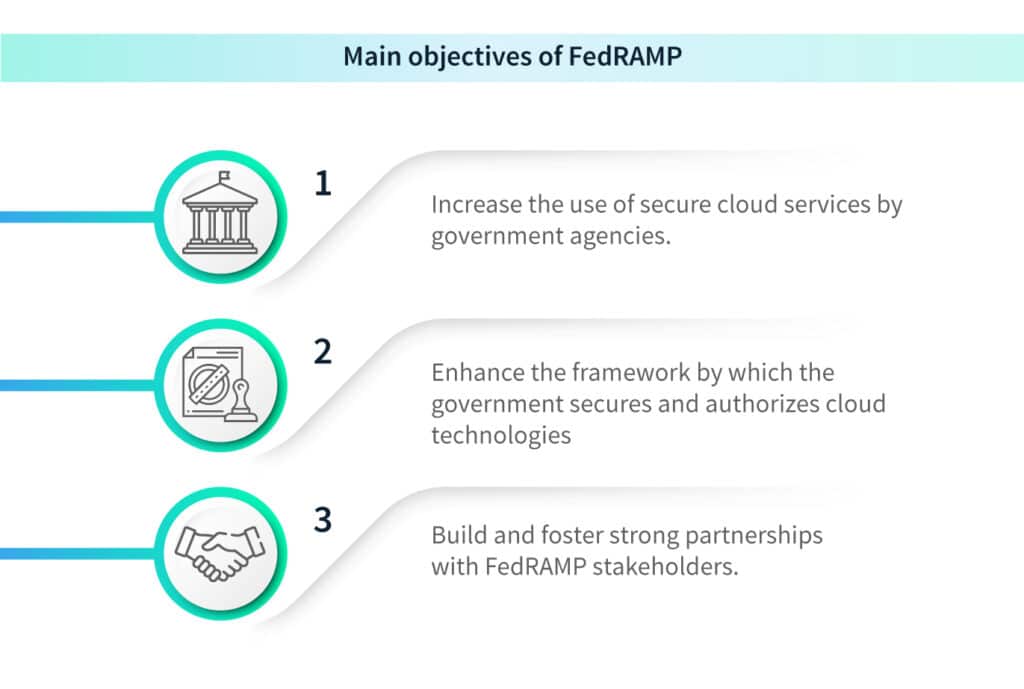
The main objectives of FedRAMP are to increase the use of secure cloud services by government agencies, enhance the framework by which the government secures and authorizes cloud technologies, and build and foster strong partnerships with FedRAMP stakeholders.
It ensures robust security measures, streamlines assessments, reduces costs, fosters collaboration, and instills confidence in the adoption of cloud services by federal agencies.
What is the scope of FedRAMP?
The scope of FedRAMP is centered around the evaluation and authorization of Cloud Service Providers who offer services to federal agencies. The program focuses on assessing the security posture of CSPs and their cloud services to ensure they meet rigorous security standards.
This includes evaluating the confidentiality, integrity, and availability of the data stored and processed in the cloud, as well as assessing the overall risk management practices of the CSP.
FedRAMP covers a wide range of cloud service models, including Infrastructure as a Service (IaaS), Platform as a Service (PaaS), and Software as a Service (SaaS). The program’s scope also extends to continuous monitoring of authorized CSPs to ensure ongoing compliance and the maintenance of security controls.
What are the benefits of FedRAMP for CISOs?
There are several ways in which FedRAMP can benefit CISOs. Let’s look at some of them.
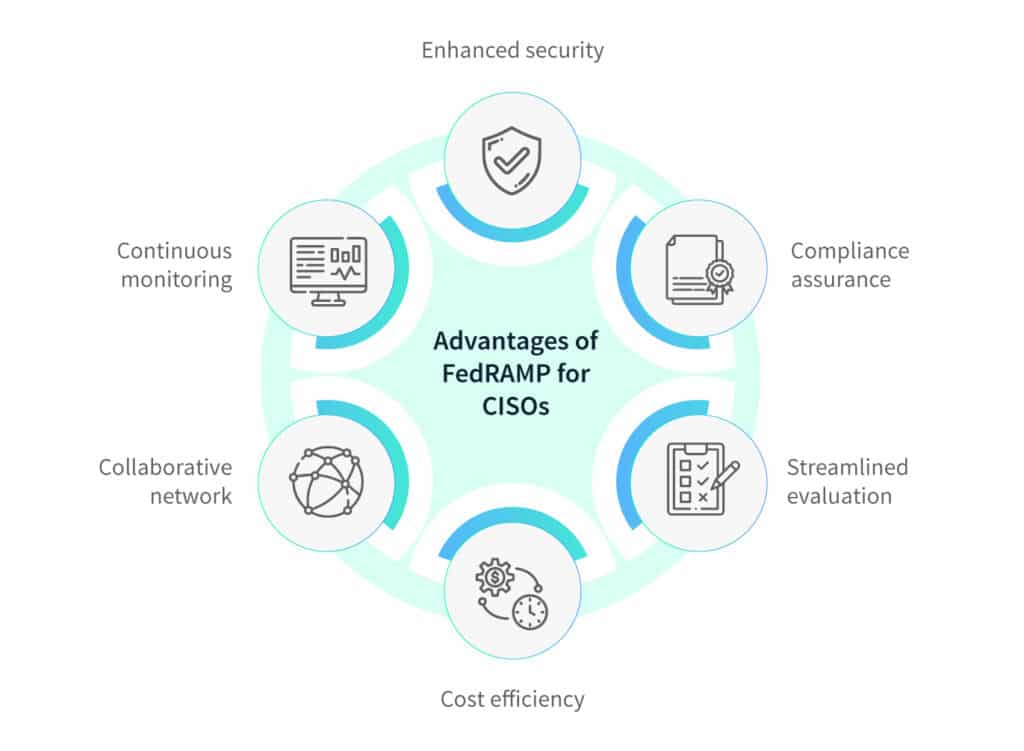
Enhanced security
FedRAMP promotes a standardized and rigorous approach to security assessments for CSPs. By leveraging FedRAMP-compliant CSPs, CISOs can ensure a higher level of security for federal cloud services, protecting sensitive data and systems.
Compliance assurance
FedRAMP compliance is crucial for CISOs in meeting federal regulations and requirements. By understanding and adhering to FedRAMP standards, CISOs can ensure their organizations’ cloud services align with the necessary compliance frameworks, reducing the risk of non-compliance penalties.
Streamlined evaluation
FedRAMP provides a centralized evaluation and authorization process for CSPs. CISOs can leverage this streamlined process to efficiently assess the security posture of potential CSP partners, saving time and effort in evaluating multiple providers individually.
Cost efficiency
FedRAMP eliminates the need for duplicate security assessments by providing a standardized framework. CISOs can leverage the FedRAMP authorization of CSPs, reducing the costs associated with conducting redundant evaluations and accelerating the procurement process.
Collaborative network
FedRAMP fosters collaboration and information sharing among federal agencies, CSPs, and third-party assessment organizations. CISOs can benefit from this network by gaining insights, best practices, and lessons learned from peers, enhancing their organization’s overall security posture.
Continuous monitoring
FedRAMP requires authorized CSPs to undergo continuous monitoring to maintain compliance. CISOs can leverage this aspect to ensure ongoing security and risk management of their organization’s cloud services, staying vigilant against emerging threats and vulnerabilities.
Overall, it offers CISOs enhanced security, compliance assurance, streamlined evaluations, cost efficiency, access to a collaborative network, and the benefits of continuous monitoring. By embracing and understanding FedRAMP, CISOs can effectively navigate the federal cloud landscape and strengthen their organization’s security posture.
The FedRAMP authorization process
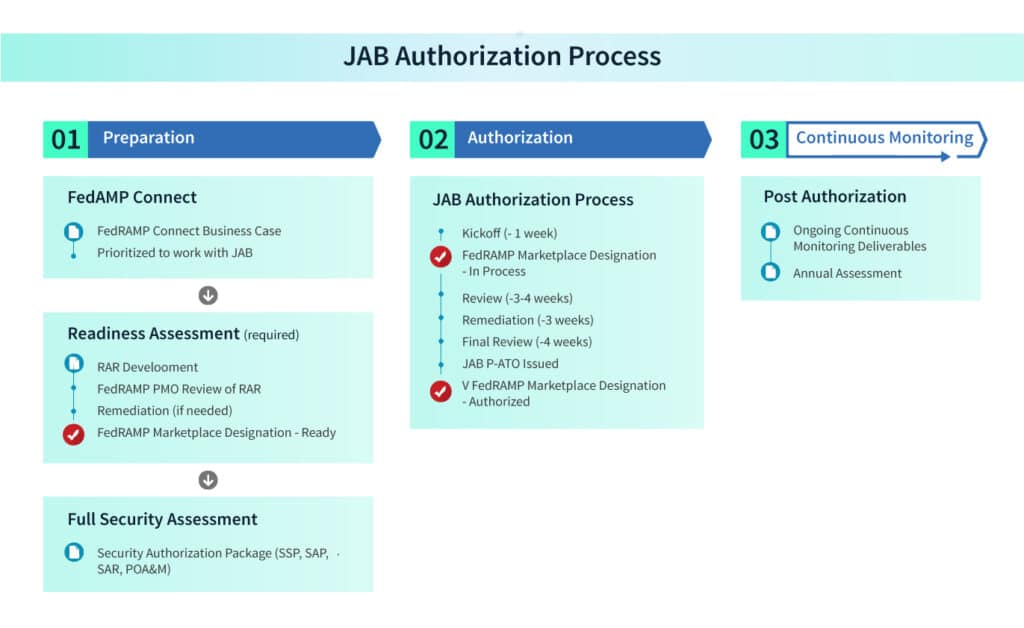
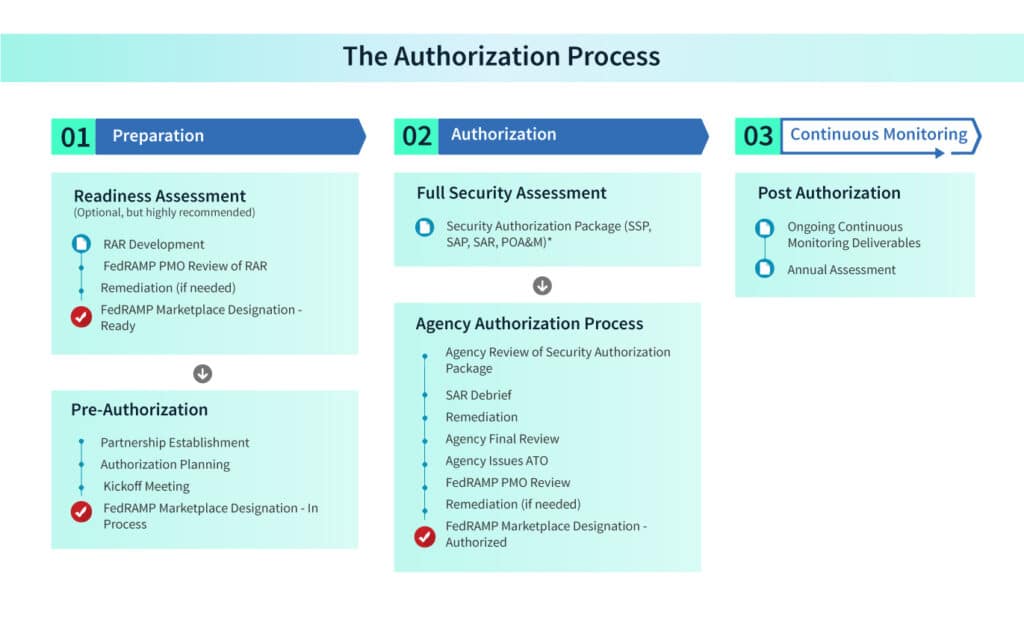
There are basically two types of FedRAMP authorization processes – JAB authorization and agency authorization. Let us look at both of them and their respective processes in detail
JAB authorization process
The JAB, or Joint authorization board, is the primary governance and decision-making authority for FedRAMP. The JAB is composed of the Chief Information Officers (CIOs) of the Department of Homeland Security (DHS), the General Services Administration (GSA), and the Department of Defense (DoD).
The JAB defines and establishes the FedRAMP, the basic security control and accreditation criteria for the Third Party Assessment Organizations (3PAOs). It also works in conjunction with FedRAMP program management office (PMO) to ensure that the baseline security controls are incorporated into consistent and repeatable processes for security assessments and authorizations of cloud service offerings (CSOs).
Here is a step-by-step breakdown of the JAB FedRAMP authorization process.
Phase 1: Preparation
There are three parts to the preparation stage of the JAB authorization process.
FedRAMP Connect
The JAB focuses on creating a diverse marketplace of providers but can only authorize a limited number of CSOs annually due to resource and funding constraints. To ensure a clear return on investment, CSOs undergo evaluation and prioritization through FedRAMP Connect. The key criterion for JAB prioritization is demonstrating government-wide demand for the CSO.
CSPs must provide proof of demand from six customers. After achieving a JAB Provisional Authorization To Operate (P-ATO), CSPs need a minimum of six unique federal agency customers to meet Continuous Monitoring requirements. The JAB prioritizes up to 12 CSOs per year, who have 60 days to become FedRAMP Ready, marking the first phase of the JAB Authorization process.
FedRAMP Ready
To pursue a JAB P-ATO or agency ATO, CSPs must obtain a FedRAMP Ready designation. While it doesn’t guarantee authorization, being FedRAMP Ready increases the chances of prioritization. This designation remains valid for one calendar year after approval.
To achieve FedRAMP Ready status, CSPs work with a FedRAMP-recognized 3PAO to conduct a Readiness Assessment. The resulting Readiness Assessment Report (RAR) showcases the CSP’s security capabilities. The RAR is reviewed by the FedRAMP PMO, and if approved, the CSO is listed as FedRAMP Ready on the Marketplace.
This exposure benefits CSPs as they are researched by potential agency customers. CSPs can also use the RAR for self-assessment and to identify any gaps in meeting FedRAMP requirements. Detailed steps can be found in the FedRAMP Marketplace Designations for Cloud Service Providers document.
Full security assessment
Once a CSO is prioritized and deemed FedRAMP Ready, the CSP finalizes the System Security Plan (SSP) and engages a FedRAMP-recognized 3PAO. The 3PAO conducts a comprehensive security assessment and provides a Security Assessment Report (SAR). The CSP participates in the assessment activities and develops a Plan of Action and Milestones (POA&M) to manage security risks.
These documents, prepared using FedRAMP templates, are submitted together as a full security package. The JAB reviews the entire package along with the first Continuous Monitoring submission. The package must be submitted to the PMO at least 2 weeks before the JAB Kickoff Meeting, following a completeness check by the FedRAMP PMO.
Phase 2: Authorization
The JAB Authorization Process follows an agile methodology with multiple stage gates and a “fail fast” principle. The first gate is the JAB Kickoff, where the CSP, 3PAO, and FedRAMP review the system architecture, security capabilities, and risks. Based on the outcome, the JAB decides whether to proceed or not. The JAB then conducts an in-depth review, addressing questions and comments with the CSP and 3PAO. After remediation, the JAB issues a formal authorization decision, including a P-ATO if favorable.
CSPs can be removed from the process for major architectural or unresolved deficiencies. During the process, the CSP and 3PAO must answer detailed questions and submit monthly Continuous Monitoring (ConMon) deliverables. The JAB P-ATO signifies acceptance by three JAB agencies, while individual agencies issue their own authorization for using the product.
Phase 3: Continuous monitoring
After receiving a JAB P-ATO, the CSP must ensure that its security posture remains in accordance with FedRAMP’s requirements established during the initial assessment and authorization process. This is accomplished through the practice of Continuous Monitoring, which involves the ongoing monitoring and assessment of the CSP’s system. As per NIST SP 800-137, the goal of continuous monitoring is to provide (1) operational visibility, (2) managed change control, and (3) attendance to incident response duties over the life or use of a system.
For systems with JAB P-ATOs, the JAB serves as a centralized PMO for Continuous Monitoring activities. It provides agencies with standardized processes and artifacts for assessing and managing JAB P-ATO systems. Here’s a simplified breakdown of the JAB’s responsibilities:
Reviews and approves Continuous Monitoring and security artifacts regularly.
Monitors, suspends, and revokes a system’s P-ATO as needed.
Authorizes or denies requests for Significant Change and deviations.
Reviews incident information to ensure proper handling and closure.
Ensures the FedRAMP PMO delivers artifacts to leveraging agencies promptly.
For leveraging agencies, the JAB’s Continuous Monitoring artifacts inform the final approval authority, which lies with each agency’s designated Authorizing Official (AO).
In addition to continuous monitoring, a CSP must engage a 3PAO recognized by FedRAMP to conduct an annual security assessment. This assessment includes updating penetration testing results, a comprehensive assessment of critical controls, and a full evaluation of all system controls over three years.
Agency authorization process
Like the JAB authorization process, the agency authorization process is also done in phases. Let’s look at different phases of the agency authorization process.
Phase 1: Preparation
Phase 1 is further divided into various processes:
1. FedRAMP Ready
A FedRAMP Ready designation is recommended for the Agency Authorization process, although it is optional. To achieve this designation, a CSP must collaborate with a FedRAMP-recognized 3PAO to conduct a Readiness Assessment of its service offering. The assessment, called the RAR, demonstrates the CSP’s ability to meet federal security requirements.
CSPs that successfully achieve the FedRAMP Ready designation are listed on FedRAMP’s Marketplace. The FedRAMP Marketplace is used by agencies to research cloud services that align with their specific organizational needs. If a CSP aims to attract government clients, being FedRAMP Ready provides valuable information about the security of their service offering through the FedRAMP Marketplace.
Moreover, for CSPs contemplating whether to pursue FedRAMP Authorization, the RAR can serve as a self-assessment tool. It helps identify any security gaps in the service offering and provides insight into areas that need improvement. This information enables CSPs to understand the level of effort required to align their system(s) with FedRAMP requirements before pursuing an Authorization to Operate (ATO) with an agency.
2. Pre-authorization – Partnership establishment
During the partnership establishment phase of Pre-Authorization, a CSP formalizes its partnership with an agency by meeting the requirements specified in FedRAMP Marketplace Designations for CSP. This can occur when a vendor is already under contract with an agency or when an agency is going through the acquisition process.
At this stage, the CSP should have a fully operational system and an executive team that is committed to the FedRAMP process. The CSP needs to engage with the FedRAMP PMO by completing a CSP Information Form as part of the intake process. The PMO will generate a FedRAMP ID for the CSP upon form completion.
Before identifying an agency partner, the CSP must determine the security categorization of the data that will be stored in the system. To do this, the CSP should use the FedRAMP FIPS 199 Categorization Template (Attachment 10) in the SSP and refer to the guidance provided in NIST Special Publication 800-60 Volume 2 Revision 1. This analysis will help the CSP appropriately categorize its system based on the types of information processed, stored, and transmitted. It will also determine the impact level that best fits the system.
Once a partnership is established, the CSP needs to confirm the impact level with the agency. The agency will conduct its own assessment based on FIPS 199 to validate the impact level chosen by the CSP.
3. Authorization planning
Once the partnership is established, a CSP should:
Confirm resources dedicated to the authorization process
Work with the agency to select a 3PAO for the assessment in Phase 2
Complete FedRAMP training for CSPs
Determine the agency’s approach for reviewing the authorization package as a just-in-time linear approach or all deliverables provided simultaneously approach
Complete a Work Breakdown Structure (WBS) with the assistance of your agency partner and send it to PMO for review
Work with your agency partner to complete an In-Process Request form indicating the readiness to begin the kickoff meeting
Begin working on the Kickoff Briefing Deck
4. Kickoff meeting
The final step in this phase is to prepare for and conduct a Kickoff Meeting. The purpose of this meeting is to officially start the Agency Authorization process by introducing key team members, reviewing the Cloud Service Offering (CSO), and ensuring everyone is on the same page regarding the process and milestone timelines. Although the FedRAMP PMO coordinates and facilitates Kickoff Meetings, the primary focus is to support the partnership between the CSP and the agency.
By the end of the Kickoff Meeting, all stakeholders will have a shared understanding of the following:
The overall authorization process, including milestones, deliverables, roles and responsibilities, and schedule
The purpose and function of the CSO, authorization boundary, data flows, known security gaps and plans for remediation, agency-specific requirements, customer-responsible controls, and areas that may require agency risk acceptance
The agency’s process for reviewing the authorization package and making a risk-based authorization decision
The PMO’s process for reviewing the authorization package from a government-wide reuse perspective
Best practices and tips for a successful authorization process
After the Kickoff Meeting, CSPs can gain access to FedRAMP’s secure repository (unless the system’s impact level is High). Additionally, CSPs that are not already listed as “In Process” on the FedRAMP Marketplace may be eligible for listing if the agency is comfortable with the briefing and timelines. However, please note that not all systems will be eligible for listing based solely on the Kickoff Meeting. It is important to engage with the PMO regarding the “In Process” status after completing this step.
Phase 2: Authorization
During this phase, the 3PAO conducts system testing while the CSP engages with them to develop a Security Assessment Plan (SAP). If the CSP has followed the Just-In-Time linear approach with an agency, it’s recommended to obtain agency approval for the SAP before testing begins. It’s crucial to freeze the system and avoid any changes during testing. Once testing is complete, the 3PAO prepares a SAR with findings and a recommendation for FedRAMP Authorization.
Based on the SAR findings, the CSP develops a POA&M in collaboration with the 3PAO. The POA&M outlines the plan for addressing the identified issues from testing. Afterward, a SAR Debrief presentation is conducted, which should be shared with the PMO for review before scheduling the meeting. The SAR Debrief aims to inform the agency’s risk review of the CSO.
During the SAR Debrief, the 3PAO presents the security assessment results, the CSP presents the plan and timeline for addressing residual risk, and the FedRAMP PMO provides guidance on remaining milestones and success tips. While the PMO facilitates the SAR Debrief, its purpose is to support the CSP and agency partnership.
By the end of the SAR Debrief, all stakeholders will have a shared understanding of:
The 3PAO’s assessment approach, methodology, and schedule
The scope of testing, including the validation of the authorization boundary and data flows
The assessment results and residual risk
The CSP’s plan and timeline for remediating residual risk
Deviation requests requiring agency approval (such as risk adjustments and false positives)
Operationally required risks necessitating agency risk acceptance (e.g., essential services or components excluded from the tested boundary)
The agency’s process for reviewing the authorization package and making a risk-based authorization decision
The PMO’s process for reviewing the authorization package from a government-wide reuse perspective
Best practices and tips for a successful authorization process
Phase 3: Continuous monitoring
Once a CSP obtains FedRAMP Authorization, they are required to provide monthly ConMon deliverables to the agencies using their service. These deliverables include an updated POA&M, vulnerability scan results/reports, deviation requests, Significant Change requests, incident reports, and the Annual Assessment package. Agencies review these monthly ConMon deliverables.
CSPs with cloud offerings categorized as LI-SaaS, Low, or Moderate use the FedRAMP secure repository to post their monthly ConMon materials. However, CSPs with cloud offerings categorized as High use their own secure repository.
The FedRAMP PMO encourages CSPs with multiple customer agencies to streamline the ConMon process and minimize duplicative efforts through a collaborative approach. The PMO has developed a recommended collaborative ConMon approach outlined in the Guide for Multi-Agency Continuous Monitoring. This approach allows agencies to share responsibility for ConMon oversight and provides a central forum for addressing deviation requests, Significant Change requests, and the Annual Assessment instead of coordinating with each agency individually. CSPs who are FedRAMP Authorized and wish to set up a Multi-Agency ConMon Group can request assistance by contacting info@fedramp.gov.
Additionally, a CSP must employ a FedRAMP-recognized 3PAO to conduct an annual security assessment to maintain an acceptable risk posture throughout the system’s lifecycle. The Annual Assessment, along with updated security authorization package documentation, must be uploaded to the FedRAMP secure repository. CSPs should notify FedRAMP via info@fedramp.gov when this process is complete.
Which businesses need FedRAMP certification?
FedRAMP certification is primarily required for CSPs that wish to offer their cloud services to U.S. federal government agencies. These cloud-based technology providers, which may include companies or organizations, must obtain FedRAMP certification if they want to bid on and provide cloud services for government contracts.
It’s important to note that not all businesses need FedRAMP certification. The requirement is specifically targeted at CSPs that want to offer cloud services to federal agencies. If a business does not intend to provide cloud services to the U.S. government or its agencies, FedRAMP certification is not mandatory.
However, some businesses may choose to pursue FedRAMP certification voluntarily, even if they do not directly work with the government. This certification can serve as a valuable credential and provide assurance to other customers about the security and reliability of their cloud services.
In summary, FedRAMP certification is required for cloud service providers seeking to offer their cloud services to U.S. federal government agencies. Other businesses that do not work with the government may pursue FedRAMP certification voluntarily for its potential benefits in the broader market.
What are the different FedRAMP levels?
The Federal Risk and Authorization Management Program (FedRAMP) classifies CSPs and CSOs into three impact levels: low, moderate, and high. These levels correspond to the sensitivity of the data the cloud provider can handle, store, and transmit.
At the low-impact level, a CSP is authorized to host data intended for public use, and unauthorized access to this data would not pose significant risks to the client’s mission, safety, finances, or reputation.
The moderate-impact level permits a CSP to host non-public data, like personally identifiable information (PII), where a breach could have serious consequences for an agency’s operations.
For the high-impact level, a cloud provider is deemed secure enough to handle sensitive federal information, such as law enforcement, emergency services, and healthcare data. Breaches of such data could be catastrophic, leading to operational shutdowns, financial losses, or even posing risks to intellectual property and human life.
These security levels are established in the National Institute of Standards and Technology’s (NIST) Federal Information Processing Standard 199 (FIPS 199), which defines data security as the protection of information confidentiality, availability, and integrity.
How to determine and implement these risk levels?
To determine the risk level, a CSP or CSO must undergo a security assessment conducted by a certified third-party assessor. This assessment evaluates the cloud service or product’s security controls against those specified in relevant NIST publications, such as NIST 800-53.
CSPs use these risk ratings to ensure that their information systems meet the minimum security requirements necessary to process, store, and transmit data for their federal government customers. Federal agencies select cloud providers, products, and services based on the required level of security. For example, an agency handling non-sensitive government information might use a cloud service with a “low impact” risk level.
Each risk level mandates a minimum number of security controls to ensure that the cloud service or product adequately safeguards the contained information. Under FedRAMP, high-level cloud providers, products, or services must comply with 421 controls, while moderate-level CSPs need to implement 325 controls, and low-level providers only require 125 controls.
Controls refer to the technologies and techniques that CSPs employ to secure federal information stored in the cloud.
In June 2016, FedRAMP released the high-level security baseline, allowing federal agencies to outsource highly sensitive data to any high-level cloud services provider that is FedRAMP compliant. Prior to this, agencies could only outsource low-level and moderate-level information and workloads to CSPs.
FedRAMP’s Joint Authorization Board, consisting of chief information officers from the U.S. Department of Defense (DoD), the U.S. Department of Homeland Security (DHS), and the General Services Administration (GSA), establishes FedRAMP accreditation standards and reviews FedRAMP authorizations.
How much does it cost to get FedRAMP certified?
Complying with FedRAMP, the government program that certifies the security of cloud-based technology providers bidding on government contracts can be quite costly. The certification expenses for CSPs used by federal agencies can vary significantly, ranging from several hundred thousand dollars to over $1 million.
The total cost is influenced by several key factors, which include:
Scope: The number and complexity of services you intend to authorize for federal government use will impact the certification cost. More services or complex offerings may require additional security measures and assessments, leading to higher expenses.
Approach: The choice between an agency Authorization to Operate (agency ATO) and the broader Joint Authorization Board Provisional Authorization to Operate (JAB P-ATO) can affect costs. The JAB P-ATO, overseen by multiple agencies, requires a pre-authorization readiness assessment, adding both time and expenses to the process. However, the FedRAMP Accelerated program aims to reduce costs and streamline the JAB P-ATO process, aiming for completion in six months or less.
Risk Level: FedRAMP categorizes the data being processed into three impact levels based on its security requirements: low, moderate, and high. Higher impact levels demand more stringent controls and more comprehensive security assessments by third-party assessment organizations (3PAOs). These assessments typically cost around $150,000 to $200,000, including the baseline readiness assessment (recommended for JAB P-ATO but not required for ATO).
Current information security maturity: The security level of your existing cloud solutions and the up-to-dateness of your cybersecurity program play a role in certification costs. If your cloud solutions are already compliant with other frameworks like FISMA or NIST, it may facilitate the process. However, the JAB review of your readiness assessment might require you to address any vulnerabilities and adjust your current cloud security controls, which can constitute around 50 percent of the certification expenses.
Resources: Having qualified staff to guide your organization through the authorization process can impact the overall cost. If you require external consultants, their fees can range from $20,000 to $40,000 for short-term assistance and possibly more if you need continuous support throughout the FedRAMP compliance process.
Conclusion
In conclusion, the Federal Risk and Authorization Management Program (FedRAMP) is a critical initiative in the cybersecurity landscape, promoting secure cloud services adoption within the US federal government. By providing standardized security assessments, mitigating risks, fostering collaboration, and ensuring compliance, FedRAMP enables CISOs to navigate the authorization process, implement necessary security controls, and safeguard sensitive data and systems.
Embracing FedRAMP empowers CISOs to enhance security, achieve cost efficiency, and maintain a robust security posture, ultimately strengthening the overall cybersecurity of federal cloud services.
If you want to know more about how Scrut can help you with your FedRAMP compliance, book a demo by clicking here.
Frequently asked questions
1. What types of businesses need to be FedRAMP compliant?
FedRAMP certification is required for cloud service providers (CSPs) that want to offer cloud services to U.S. federal government agencies. Other businesses may pursue it voluntarily for market advantages.
2. Is FedRAMP certification perpetual, or does it require regular renewal?
FedRAMP certification is not perpetual and must be renewed periodically to ensure ongoing compliance with evolving security standards.
Can FedRAMP certification be recognized internationally?
While FedRAMP is specific to the U.S. government, its security standards and practices align with many international security frameworks, making it a valuable reference for global best practices. However, it is not a direct substitute for international certifications.
20 Jul 2023
4minutes
Authored by
Aayush Ghosh Choudhary
Co-founder & CEO at Scrut
Top Compliance Challenges Faced by Fast-Growing Companies
To remain competitive and avoid potential legal pitfalls, it is essential for fast-growing companies to prioritize compliance activities and processes.
However, prioritizing compliance comes with its own set of challenges, a few being – an increasingly complex regulatory landscape, managing multiple jurisdictions, and balancing business growth.
In this blog, we will discuss the top compliance challenges faced by such companies and provide effective solutions to overcome them.
What are the compliance challenges fast-growing companies face?
1. Keeping up with the evolving regulatory landscape
One of the most significant compliance challenges for fast-growing companies is staying up-to-date with the ever-changing regulatory landscape. As regulations evolve, companies must adapt their practices to ensure compliance. This requires ongoing monitoring and interpretation of regulatory updates, which can be a resource-intensive task for growing organizations.
2. Scaling compliance operations with business growth
Fast-growing companies often need help to scale their compliance operations in line with their expanding business. As the organization grows, new business lines are added, increasing compliance responsibilities, such as complying with new set of regulatory requirements.
This necessitates the requirement of efficient processes to manage and track compliance activities across the entire company. Simply using manual methods can result in potential compliance gaps, creating even bigger challenges for the business.
3. Managing multiple jurisdictions and complex requirements
Expanding into new geographic regions introduces additional compliance challenges. Each jurisdiction has its own unique set of regulations and reporting requirements, making compliance management a complex and time-consuming task. For example, an organization with business in the EU must comply with GDPR, while an organization in California needs compliance with CCPA/CPRA.
4. Lack of bandwidth to manage compliance
A growing company has a lot of areas to focus on, primarily scaling operations and meeting market demands. Amidst these challenges, allocating resources to manage compliance becomes a huge challenge for fast-growing companies.
In most instances, lack of resource bandwidth, not enough knowledge about compliance management, and shaky internal infrastructure can become primary bottlenecks. Due to this, compliance tasks take a backseat, potentially exposing the company to regulatory risks and penalties.
Even companies with established security teams shift their focus on managing compliance while they should be focusing on setting up proper security measures – which eventually leads to digging an even deeper hole.
5. Managing multiple frameworks with duplicative requirements
Another challenge that fast-growing companies find themselves subjected to is multiple compliance frameworks, each with overlapping or duplicative requirements. This redundancy can create confusion and inefficiencies, as the company must allocate additional resources to address similar compliance demands across different frameworks.
How to solve these compliance challenges?
The solution to all these challenges is largely dependent on the methods an organization implements or deploys. Two of the most common methods recommended by experts in order to tackle compliance challenges are as follows.
1. Automating compliance with GRC Automation
GRC Automation tools play a crucial role in managing multiple compliance frameworks efficiently. By centralizing compliance processes and data, these tools eliminate duplication of efforts and streamline compliance activities.
With automated workflows and reporting capabilities, fast-growing companies can address duplicative requirements more effectively, reduce the risk of errors, improve efficiency, and scale their compliance operations effectively, saving time and resources.
2. Outsourcing compliance activities to a trusted Managed Service Provider (MSP)
Engaging with a trusted Managed Service Provider specialized in compliance services can help fast-growing companies overcome most compliance challenges. Trusted MSPs possess the expertise and resources to monitor regulatory changes continuously, interpret their impact, and implement necessary updates to compliance programs.
When thinking of outsourcing compliance activities to a third-party provider, a trusted MSP takes precedence because of their deep understanding of their customer’s IT environment and visibility into gaps & vulnerabilities. Their familiriazation with the cloud infrastructure helps them prioritize risk and perform regular reviews.
By partnering with a trusted MSP, companies can ensure their compliance needs are met while freeing up internal teams to concentrate on strategic initiatives and core business functions.
Moreover, outsourcing compliance operations to a global MSP with expertise in multiple jurisdictions can alleviate the burden of managing compliance across various geographic regions. Such MSPs possess a deep understanding of regional regulations, enabling them to tailor compliance programs and ensure adherence to specific jurisdictional requirements.
TenisiTech – a trusted global MSP provides Compliance-as-a-Service for fast growing organizations
Organizations can find tailored solutions to address their unique challenges by outsourcing compliance operations to a trusted Managed Service Provider (MSP) like TenisiTech. They provide Compliance-as-a-Service to help fast-growing companies develop a tcomprehensive approach to compliance management, helping them navigate the complex regulatory landscape with ease.
Thanks to Scrut’s partnership with TenisiTech, companies can now gain access to a team of compliance experts who possess deep knowledge and experience in various industries and jurisdictions. Recognizing that every business has its own set of requirements, goals, and risk appetite, TenisiTech and Scrut work closely with their clients to understand their specific needs. This collaborative approach allows for the development of compliance strategies that align seamlessly with the organization’s operations and objectives.
In conclusion, fast-growing companies face unique compliance challenges as they expand their operations and to simplify and solve these challenges, they should embrace the power of outsourcing compliance to MSPs like TenisiTech, and embark on a journey towards streamlined, tailored, and successful compliance management.
20 Jul 2023
4minutes
Authored by
Aayush Ghosh Choudhary
Co-founder & CEO at Scrut
Staying on the Offence: Strengthening Cloud Security with Continuous VAPT
Cloud computing has become an integral part of modern businesses, enabling agility, scalability, and cost-efficiency. However, the rise of cloud adoption has also brought about new security challenges.
To tackle these challenges, organizations are fast turning towards offensive security methods. Offensive security involves actively testing and probing an organization’s systems and networks to uncover vulnerabilities before malicious actors can exploit them.
One such crucial security measure which falls under the realm of offensive security is continuous Vulnerability Assessment and Penetration Testing (VAPT).
In this blog, we will explore what VAPT entails, why it is essential to continuously perform VAPT, and how it strengthens cloud security.
What is VAPT?
Vulnerability Assessment and Penetration Testing (VAPT) is a systematic approach to evaluating the security of an organization’s IT infrastructure, including its cloud-based systems and applications.
There are two primary components of VAPT; vulnerability assessment and penetration testing. Let’s take a look at each one in detail.
Vulnerability Assessment
This process involves identifying and quantifying vulnerabilities in a system or network. It aims to detect weaknesses that could potentially be exploited by attackers, such as misconfigurations, outdated software, weak access controls, or unpatched vulnerabilities. Vulnerability assessment tools and techniques, such as automated scans and manual inspections, help identify these weaknesses.
Penetration Testing
Also known as ethical hacking, penetration testing simulates real-world attacks on a system to identify vulnerabilities and assess the effectiveness of security controls. Penetration testers employ various techniques to exploit weaknesses, gain unauthorized access, and provide insights into the system’s resilience against potential threats.
Why is Continuous VAPT necessary to strengthen cloud security?
1. Evolving Threat Landscape
Cyber threats are constantly evolving, with new attack vectors and sophisticated techniques emerging regularly. Relying on a one-time security assessment is no longer sufficient to safeguard cloud environments. Continuous VAPT ensures ongoing visibility into security vulnerabilities and provides proactive measures to mitigate risks in a rapidly changing threat landscape.
2. Timely Detection and Response:
Cloud environments are dynamic, with frequent changes in configurations, software updates, and new application deployments. These changes can introduce new vulnerabilities or inadvertently weaken existing security measures. Regular VAPT enables organizations to detect vulnerabilities in real-time, allowing for prompt remediation before attackers can exploit them.
3. Compliance Requirements
Many industries and regulatory frameworks mandate regular security assessments and penetration testing to ensure compliance. Continuous VAPT helps organizations meet these requirements and provides evidence of their commitment to maintaining a robust security posture. Failure to comply with such regulations may result in severe financial penalties and reputational damage.
4. Third-Party Risks
Cloud-native organizations often rely on various third-party components, such as APIs, frameworks, and libraries. These dependencies can introduce vulnerabilities that are beyond an organization’s direct control. Continuous VAPT helps identify potential risks arising from third-party integrations and allows organizations to work collaboratively with vendors to address them.
How to effectively use Vulnerability Assessment and Pentesting to strengthen cloud security?
Step 1: Define Objectives and Scope: Before initiating VAPT, organizations should clearly define their objectives, including the systems and applications to be tested. A well-defined scope ensures that all critical components are thoroughly evaluated, minimizing any blind spots.
Step 2: Establish a Testing Framework: Developing a comprehensive testing framework helps ensure consistency and repeatability in VAPT activities. This framework should include guidelines for vulnerability scanning and penetration testing
Step 3: Automated Vulnerability Scanning: Automated vulnerability scanning tools play a vital role in continuously monitoring cloud environments. These tools can identify known vulnerabilities, misconfigurations, and weaknesses in software versions, providing organizations with an initial assessment of their security posture.
Step 4: Manual Penetration Testing: While automated tools provide valuable insights, manual penetration testing is crucial to simulate real-world attacks and identify complex vulnerabilities that may go undetected by automated scans. Skilled penetration testers employ their expertise to explore different attack vectors and test the effectiveness of security controls.
Step 5: Prioritize and Remediate Vulnerabilities: After performing VAPT, organizations must prioritize vulnerabilities based on their severity and potential impact. This allows for the efficient allocation of resources for remediation efforts. Promptly addressing vulnerabilities and tracking the remediation progress is vital to maintaining a strong security posture.
Step 6: Regular Retesting: As cloud environments evolve, it is essential to conduct regular retesting to validate the effectiveness of remediation efforts and identify new vulnerabilities that may arise due to system changes. This iterative process helps organizations stay ahead of potential threats and maintain continuous improvements in their security posture.
Final thoughts
In an era where cyber threats are constantly evolving, continuous Vulnerability Assessment and Penetration Testing (VAPT) is no longer an option but a necessity to strengthen cloud security.
By following a structured approach and leveraging both automated vulnerability scanning and manual penetration testing, organizations can confidently navigate the cloud landscape and safeguard their critical assets.
Scrut is enabling organizations to perform continuous VAPT scans without adding any additional burden to their plate. As experts in application security and compliance automation services, we’re placing organizations at the forefront of defining cloud security.
To know more about our services and how it can help you strengthen your security posture, talk to us today.